
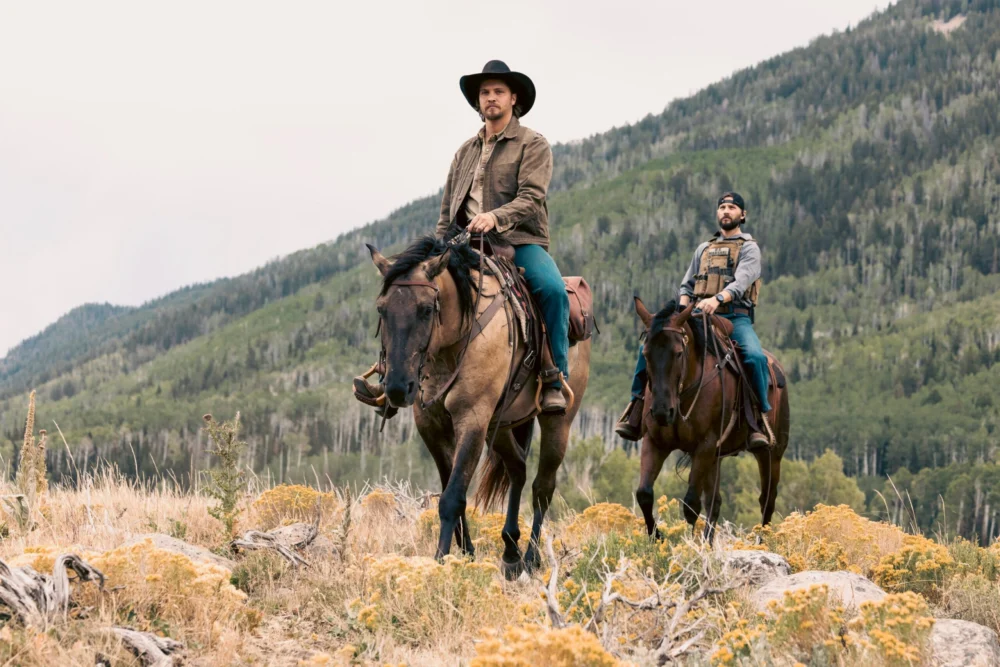
“The death of Monica Dutton serves as a definitive catalyst for Kayce’s return to law enforcement, transforming a personal tragedy into a volatile narrative engine that shifts the franchise from a family pastoral to a high-stakes procedural.”
The premiere of the highly anticipated sequel series Marshals has fundamentally altered the landscape of the Yellowstone universe by removing its moral center, Monica Dutton. This creative pivot not only provides the necessary friction to pull Kayce Dutton back into a life of violence and service but also signals a tonal shift for the franchise as it expands onto broadcast television. By grounding the character’s exit in the environmental realities of the Broken Rock Reservation, the series maintains its commitment to social commentary while clearing the path for a new chapter in the Dutton family legacy.
The Yellowstone franchise has never been shy about its penchant for high-stakes drama, but the opening moments of its newest sequel series, Marshals, have delivered one of the most significant shocks to the fandom since the original series began in 2018. Set approximately one year after the conclusion of the flagship series, Marshals catches up with Kayce Dutton, played by Luke Grimes, only to reveal a landscape that is as emotionally barren as it is physically rugged. The most jarring change is the absence of Monica Dutton (Kelsey Asbille), Kayce’s wife and the long-standing moral compass of the series.
The revelation of Monica’s death is not just a plot point; it is the foundational trauma upon which the entire new series is built. We learn that during the time gap between the end of Yellowstone and the start of Marshals, Monica succumbed to cancer—a diagnosis attributed to toxins and pollution dumped by industrial corporations near the Broken Rock Reservation. This development serves a dual purpose: it provides a tragic end to one of the franchise’s most central figures and anchors the show’s drama in the real-world environmental issues that have plagued indigenous communities for decades.

A Calculated Departure
For many observant fans, Monica’s absence was expected. In the months leading up to the premiere of Marshals, marketing materials and trailers featured Kayce and his son, Tate (Brecken Merrill), prominently, but Kelsey Asbille was nowhere to be found. This raised immediate questions about how the show would handle the family unit, which had ended the original series seeking a peaceful, secluded life.
The creative decision to kill the character rather than recast or write her out through a separation was a deliberate choice by showrunner Spencer Hudnut and executive producer Taylor Sheridan. In television production, character exits are often dictated by the "three-legged stool" of narrative necessity, actor availability, and thematic resonance. In this instance, Asbille’s unavailability for the new series forced the writers to make a difficult choice.
Spencer Hudnut explained that once it was clear Asbille would not be returning, the goal was to move on from the character in the "least exploitative way" possible. Rather than a sudden accident or a mysterious disappearance, the choice of an illness linked to the reservation’s environmental struggles allowed the show to honor the character’s heritage and the themes she represented throughout Yellowstone.
The Motivation of a Grieving Hero
From a narrative standpoint, Kayce Dutton required a monumental shift to justify his return to the world of badges and bullets. At the end of Yellowstone, Kayce had famously "thrown his badge in a field," signaling an end to his tenure as a livestock agent and a rejection of the violence that had defined his family for generations. He was a man who wanted nothing more than to protect his wife and son from the Dutton family curse.
Luke Grimes, in reflecting on the character’s evolution, noted that a "dream life" does not make for compelling television. "Something’s gonna have to happen that gets in the way of him having that," Grimes stated. "Otherwise, why is he gonna take a badge?"

The loss of Monica strips Kayce of his anchor. He is now a single father grappling with profound guilt and the daunting task of raising a grieving teenager. This emotional volatility is what drives him back into the field, joining forces with his old friend Cal, played by Logan Marshall-Green. For Kayce, the Marshal’s badge is no longer just a job; it is a way to channel a "kinetic and volatile" pain into something structured. It is the classic western trope of the widowed lawman, but updated with the gritty, modern sensibilities of the Sheridan-verse.
Environmental Justice and the Broken Rock Reservation
The choice to link Monica’s death to pollution on the Broken Rock Reservation is a poignant callback to the themes of land rights and corporate greed that have permeated the franchise. Throughout Yellowstone, the tension between the Dutton ranch, the developers, and the Tribal Council was a constant source of conflict. By making Monica a victim of corporate negligence, Marshals ensures that the political and social stakes of the reservation remain at the forefront of the story.
The premiere episode depicts protests against the corporations responsible for the toxins, showing that Monica’s death has become a rallying cry for the community. This adds a layer of depth to Kayce’s new role as a Marshal. He is not just chasing fugitives; he is operating in a landscape where the very air and water have been weaponized against the people he loves. This background provides a rich tapestry for the 13-episode first season to explore, moving beyond simple "manhunt" stories into the complexities of environmental law and indigenous rights.
A New Network, A New Format
One of the most interesting aspects of Marshals is its home on CBS. While the original Yellowstone aired on the Paramount Network and the upcoming Dutton Ranch (expected in 2026) will reside on Paramount+, Marshals represents the franchise’s foray into the world of major broadcast networks. This move likely necessitates a shift in formatting.
While Taylor Sheridan’s series are known for their "quasi-experimental" pacing—often lingering on long scenes of ranch work or philosophical monologues—a CBS audience typically expects a more procedural, "story of the week" structure. Marshals appears to be finding a middle ground. It maintains the serialized emotional arc of Kayce’s grief while likely introducing self-contained cases that his team of Marshals must solve.

This procedural element allows the show to explore different facets of the American West that the original series couldn’t reach. As Kayce and Cal travel across jurisdictions, viewers will see a broader view of the law enforcement challenges in rural America, from drug trafficking to land disputes, all while the shadow of the Dutton family legacy looms in the background.
The Future of the Expanded Universe
Marshals is the first of several planned sequels and spinoffs to hit the air following the conclusion of the flagship series. Its success—or failure—will likely dictate how Paramount and CBS approach future projects. By taking the bold step of killing off an original series regular like Monica, the creators have signaled that no character is safe and that the "happily ever after" endings of the original series were merely temporary reprieves.
As the season progresses, fans will be watching closely to see how Tate Dutton handles the loss of his mother. As a character who represents the bridge between the Dutton ranching legacy and the indigenous heritage of the reservation, Tate’s development is crucial. With his mother gone, his relationship with Kayce will be the emotional heartbeat of the show.
In the broader context of the Yellowstone timeline, Marshals serves as a bridge. It keeps the fire of the Dutton saga burning while the audience waits for Dutton Ranch to explore the next generation’s struggle for the land. For now, however, the focus remains on Kayce Dutton—a man who has lost everything he fought to protect, and who must now find a way to live in the wreckage of that loss.
The death of Monica Dutton is a bitter pill for fans to swallow, but in the harsh world of Taylor Sheridan’s Montana, it is perhaps the only ending that could have truly set the stage for what comes next. As Kayce picks up the badge once more, he does so not as the man we knew, but as a survivor of a tragedy that has redefined his purpose and the very world he inhabits.
