
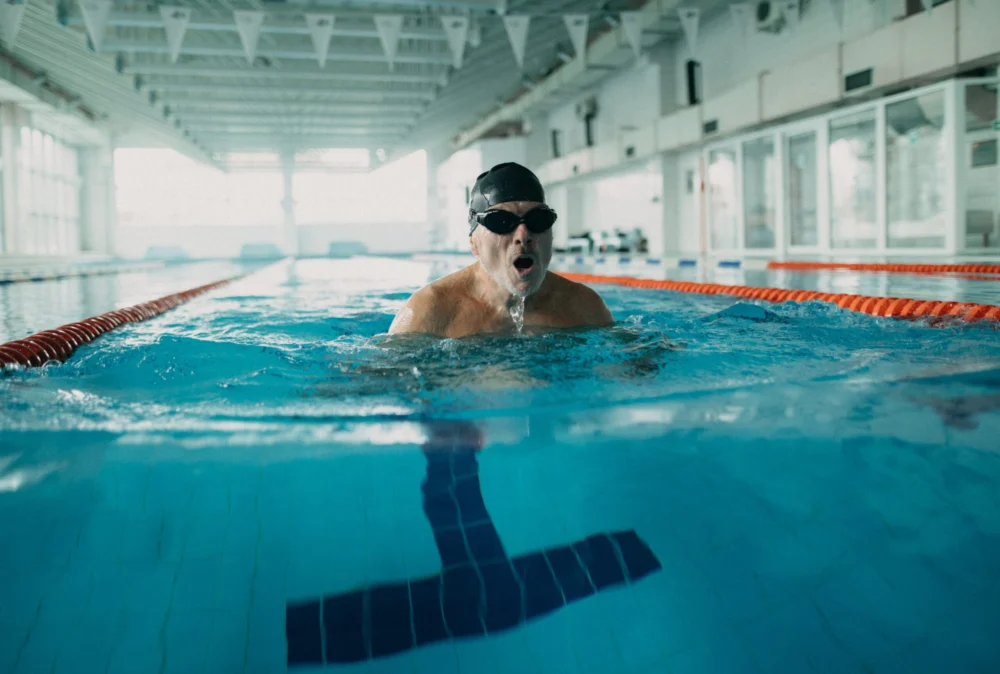
"To stimulate muscle growth in the water, athletes must transition from steady-state endurance laps to explosive, high-resistance intervals that prioritize mechanical tension and intentional drag."
While swimming is traditionally lauded as a premier cardiovascular exercise, the inherent density of water—which is roughly 800 times denser than air—provides a unique medium for resistance training. By strategically manipulating this resistance through high-intensity movements and specialized drills, swimmers can bridge the gap between aerobic conditioning and functional hypertrophy. This approach requires a fundamental shift in mindset: rather than seeking the most streamlined and efficient path through the water, the muscle-building swimmer must embrace resistance, utilizing the pool as a liquid weight room to challenge the upper body, lower body, and core stabilizer muscles.
The Science of Aquatic Resistance
Building significant muscle mass requires two primary drivers: mechanical tension and metabolic stress. In a traditional gym setting, this is achieved by lifting progressively heavier weights. In the pool, the "weight" is provided by the water itself. Because water is a viscous fluid, the resistance it provides is "accommodating," meaning the harder you push against it, the more it pushes back.
However, standard lap swimming often falls short of the intensity needed for hypertrophy because most swimmers prioritize efficiency and "slipping" through the water. Terry Heggy, a Level 3 USMS coach and NASM-certified personal trainer, notes that building muscle in the pool requires an entirely different approach. "You must do short, high-intensity work," Heggy explains. "It’s about choosing the right motion, the right resistance, and the right number of repetitions." By focusing on explosive bursts and movements that increase the body’s surface area, swimmers can recruit Type II fast-twitch muscle fibers, which are the primary drivers of muscle growth.

Targeting the Lower Body: The Tombstone Drill
The lower body often takes a backseat in traditional swimming, serving primarily as a stabilizer. To turn a swim set into a leg day, athletes can utilize the "Tombstone Drill." In this exercise, the swimmer holds a kickboard vertically, with half of the board submerged and the other half sticking out of the water like a tombstone.
Beth Jones, a swim coach and personal trainer with PlayTri, explains that this vertical orientation creates massive frontal resistance. "The board creates extra resistance so you have to engage your hip flexors, quads, and hamstrings more than you would in a standard kick set," Jones says. To maximize muscle recruitment, swimmers must avoid "kicking from the knees," a common error that reduces tension. Instead, the power should generate from the hips with a relatively straight leg and a "soft" knee. This creates a constant load on the posterior and anterior chains of the legs, mimicking the constant tension found in leg extensions or heavy sled pushes.
Upper Body Power: Kickboard Press and Pull
For those looking to develop the chest, shoulders, and back, the Kickboard Press and Pull offers a high-intensity alternative to the bench press or seated row. This drill involves standing or treading in chest-deep water and explosively pushing and pulling a kickboard horizontally through the water.
The key to this movement is speed. Because water resistance increases with the square of the velocity, moving the board twice as fast creates four times the resistance. Heggy emphasizes that this should be treated as a power exercise rather than an endurance one. "You don’t need to do it for a minute each time—you should be able to get yourself cranking within 10 to 15 seconds," he says. By dunking the board deeper underwater, the swimmer increases the hydrostatic pressure and surface area, further taxing the pectorals during the "push" phase and the rhomboids and lats during the "pull" phase.
Core Stability and the "Gutbuster"
Core strength in the water is often about resisting rotation and maintaining a rigid "vessel" for the limbs to pull against. The "Gutbuster" is a specialized drill designed to challenge the entire midsection, from the rib cage to the hips. This exercise involves a specific body position—often vertical or slightly reclined—where the swimmer must use rapid flutter kicks and core bracing to stay afloat and move forward.

The instability of the water acts similarly to a Bosu ball or a suspension trainer on land. Because the water is constantly shifting, the internal and external obliques, along with the transverse abdominis, must fire continuously to maintain balance. Heggy notes that this drill helps stabilizer muscles "understand they need to participate," creating a level of functional core strength that translates directly to better posture and more powerful swimming strokes.
Functional Hypertrophy: Treading and Pull-Ups
Not all muscle-building happens while moving down the lane. Some of the most effective strength gains come from stationary, high-output movements. "Dry Shoulder Treading" is a variation of the traditional eggbeater or flutter kick tread where the athlete attempts to lift their shoulders, and eventually their sternum, completely out of the water.
This requires immense power from the legs and the forearms (through "sculling"). Heggy points out that for strong athletes, the goal is to get as high out of the water as possible, which puts a massive load on the rear deltoids and the small muscles of the forearms.
Additionally, the pool environment offers unique ways to perform bodyweight staples. If a pool is equipped with starting blocks, they can be used for "Starting Block Pull-Ups" or "Bicep Curls." By grasping the edge of the block and using the water’s buoyancy to assist the initial phase of the movement, beginners can build the necessary strength for full pull-ups. Advanced athletes can vary their hand grip, width, and elbow angle to target different muscle groups, using the water to provide a "de-loaded" environment that allows for higher volume and focused eccentric control.
Enhancing Resistance with Specialized Gear
To truly mimic the load of a weight room, swimmers often turn to external resistance tools. Two of the most effective are swim paddles and parachutes.
Swim Paddles: These devices strap onto the hands to increase the surface area of the "catch." This creates more torque on the lats and shoulders. However, Jones warns that beginners should use caution. If a swimmer’s technique is flawed—such as "dropping the elbow"—the added resistance of the paddles can place injurious stress on the rotator cuff. When used correctly, paddles act like weighted gloves, forcing the upper body to pull more water with every stroke.
The Parachute Pull: Just as a sprinter might use a parachute for resisted runs, a swimmer can clip a small aquatic parachute to their waist. This creates constant drag behind the athlete. Heggy explains that the parachute provides enough resistance that the swimmer will reach muscular failure much faster than usual. "That’s what stimulates muscle growth," he says. This constant tension is excellent for developing the "pull" muscles of the back and the "drive" muscles of the legs.
Integrating Strength into the Swim
To see real muscle gains, these drills should not be performed as an afterthought. Instead, they should be programmed like a hypertrophy-focused gym session. This means performing 3 to 5 sets of short, high-intensity intervals (15–30 seconds) with adequate rest (30–60 seconds) to allow for near-maximal effort on every repetition.
While traditional lap swimming will always be a cornerstone of cardiovascular health, the strategic use of water density, explosive movements, and resistance gear can transform the pool into a comprehensive tool for muscle development. By focusing on intensity over distance, and resistance over efficiency, athletes can build a physique that is as strong as it is buoyant.
