
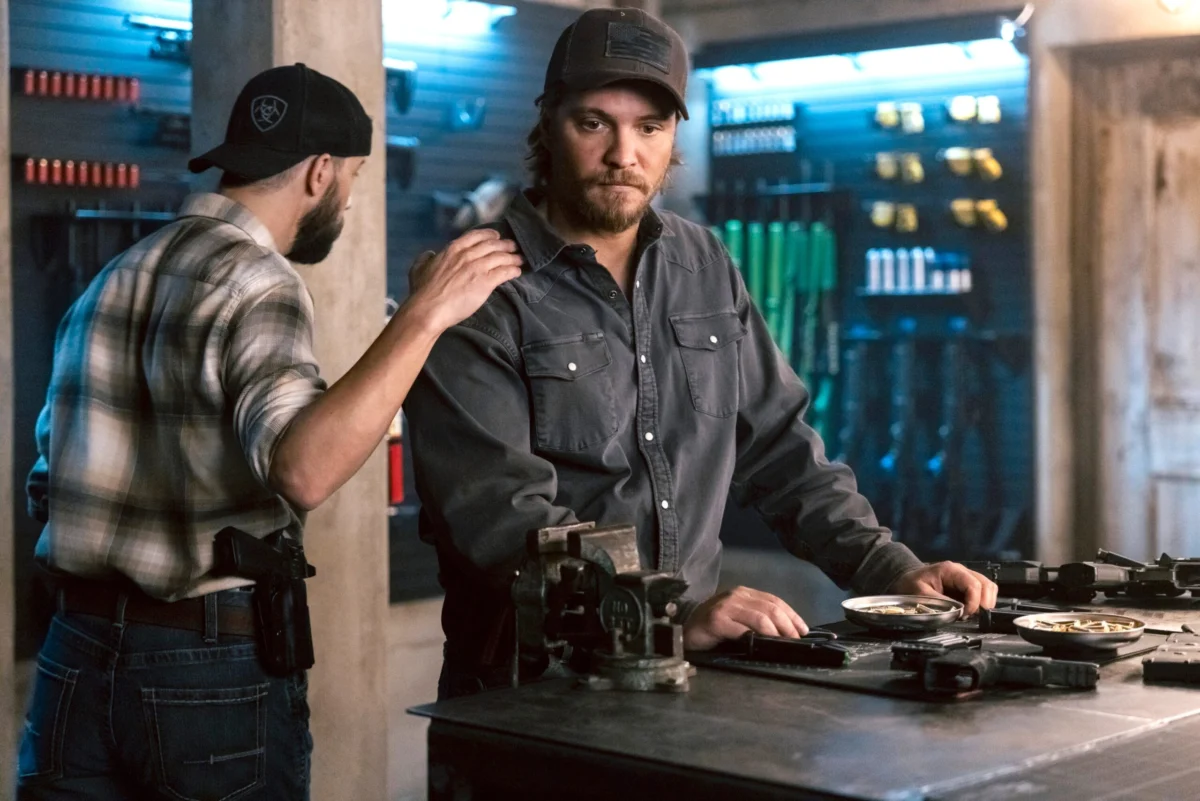
"In the volatile landscape of the modern American West, the law is often a thankless burden that demands a heavy psychological toll, driving those who enforce it toward private vices as they navigate a community that views them with more suspicion than respect."
In "Road to Nowhere," the third installment of the CBS crime procedural Marshals, the narrative shifts from the high-octane introductions of its premiere toward a more cynical and grounded exploration of its protagonists. Set within the expansive and increasingly complex Yellowstone universe, the episode delves into the simmering tensions between federal authority, indigenous sovereignty, and local desperation, while simultaneously exposing the fragile internal lives of the Marshals themselves.

The Paradox of Big Sky Country
To understand the world of Marshals, one must first reconcile the fictional carnage on screen with the statistical reality of its setting. According to 2025 data from the CDC, Montana maintains one of the lowest homicide rates in the United States, hovering at approximately 4.5 per 100,000 residents. In stark contrast, states like Mississippi face rates as high as 21.4. Yet, in the vision of Montana crafted by executive producer Taylor Sheridan and his creative team, the state is a "near-warzone," a place where Deputy Marshal Pete “Cal” Calvin (played with a weary intensity by Logan Marshall-Green) notes that the escalating violence provides "Afghanistan vibes."
This narrative choice serves a specific purpose: it heightens the stakes of a "thankless" job. One of the primary questions "Road to Nowhere" asks is why the local population so deeply despises the Marshals, many of whom are members of the very communities they police. The episode highlights a vacuum of authority; while the FBI, DEA, and local Sheriff’s offices are conspicuously absent, the Marshals are left to deal with an astonishing body count and a public that views them as an occupying force rather than a protective one.
The Private Vices of the Law
The episode’s title, "Road to Nowhere," serves as a metaphor for the burnout and moral erosion facing the team. The narrative is bookended by the coping mechanisms—or vices—of its lead characters. We are introduced to the episode through Belle Skinner (Arielle Kebbel), a hardened law enforcer whose "grizzled" exterior masks a deepening instability. Skinner is found at a casino, chasing losses and asking for a $2,000 credit line.

Her gambling is not merely a hobby; it is a manifestation of the high-stakes life she leads on duty. As the episode later reveals, Skinner is operating under a pseudonym, having changed her name from Isabel Turek to escape a past that remains shrouded in mystery. For Skinner, risking her life savings at the poker table is a logical extension of risking her literal life on the job. She drinks her whiskey neat and bets her future, perhaps because the present is too heavy to carry.
Calvin, the team’s de facto leader, is not immune to this erosion. In a private moment by his locker, the audience sees him downing a handful of what appear to be unprescribed opioids—"raw-dogging" them without water. This moment of vulnerability contrasts sharply with the "pep talks" he gives his team at the local bar. Cal’s reliance on chemical numbing suggests that the "generational rage" he encounters on the streets has begun to seep into his own psyche.
Standoff at Broken Rock
The central conflict of the episode involves a modern Western standoff that pits industrial interests against the Broken Rock Reservation. The tension begins when a mining project, which threatens to expose the indigenous community to hazardous chemicals, is met with violent resistance. An unknown assailant uses explosives to blow a massive hole in the highway, forcing mining trucks to reroute directly through Broken Rock property.

This creates a volatile three-way confrontation: the truck drivers, who are simply trying to earn a living; the residents of Broken Rock, led by Thomas Rainwater (Gil Birmingham) and his right-hand man Mo (Mo Brings Plenty), who argue that the rerouting is an act of trespassing; and local livestock workers, whose livelihoods depend on using the same roads to bring their stock to market.
When the Marshals are deployed to "break up the mob," they find themselves in the unenviable position of being the face of a federal government that satisfies no one. As Kayce Dutton (Luke Grimes) warns, "Locals see the feds siding with Broken Rock, we’re gonna be pouring gasoline on a fire." His prediction proves accurate. The confrontation quickly devolves from verbal sparring to physical violence. In a telling moment of character history, a protester recognizes Skinner as "Isabel Turek" and spits in her face—an act of intimate disrespect that Skinner chooses to endure rather than escalate, showing the restraint of a woman who knows she is being watched by neighbors who remember her before the badge.
Recon by Fire: The Clegg Brothers
The tension breaks not with a conversation, but with gunfire. Shots ring out from the surrounding woods, targeting the Marshals but wounding innocent bystanders in the process. The ensuing manhunt through the Whitebark Pine forests of Montana showcases the show’s "Western-procedural" hybridity. The Marshals employ a tactic known as "recon by fire"—essentially firing into suspected cover to provoke a reaction—a move that underscores the militarized nature of their current mandate.

The culprits are identified as the Clegg brothers, Carson and Wes. One of the brothers is the same individual who threw the first punch during the standoff, a detail that haunts Cal, as it suggests his earlier decision not to handcuff the man led directly to the subsequent bloodshed. The chase ends in a grim fashion: Kayce narrowly survives an explosion, while Cal is forced to pick off one of the shooters, sending him falling to his death over a cliffside.
While the Cleggs are apprehended or neutralized, the "win" feels hollow. As Marshal Andrea Cruz (Ash Santos) observes, "Generational rage and guns are a bad problem." The episode suggests that while the Marshals can stop a specific shooter, they are powerless against the cultural resentment that produces them.
A Grim Token for the Future
The episode concludes by returning to the bar, a space that serves as both a sanctuary and a battlefield for the characters. Cal attempts to rally his team, telling them they must "stay in the fight, together," but his voice lacks conviction. The thankless nature of the job is briefly interrupted when a local man buys the team a round of drinks, thanking them for saving his daughter during the shootout. It is a rare moment of grace in an otherwise cynical hour, yet it is overshadowed by the looming threats that remain.

Kayce Dutton, ever the outsider, chooses to skip the bar festivities. His caution is validated in the episode’s final moments. Returning to his ranch, Kayce is awoken by a distant noise. Investigating with his weapon drawn, he finds a "grim token" left on his welcome mat: a long, menacing rifle bullet.
This silent warning serves as a reminder that in the world of Marshals, the "Road to Nowhere" is paved with old grudges and new ammunition. The episode successfully transitions the series from a standard "case-of-the-week" format into a serialized drama about the heavy price of authority. As the characters grapple with their private vices and public failures, the show positions itself as a meditation on the cost of maintaining order in a place that might not want it.
