
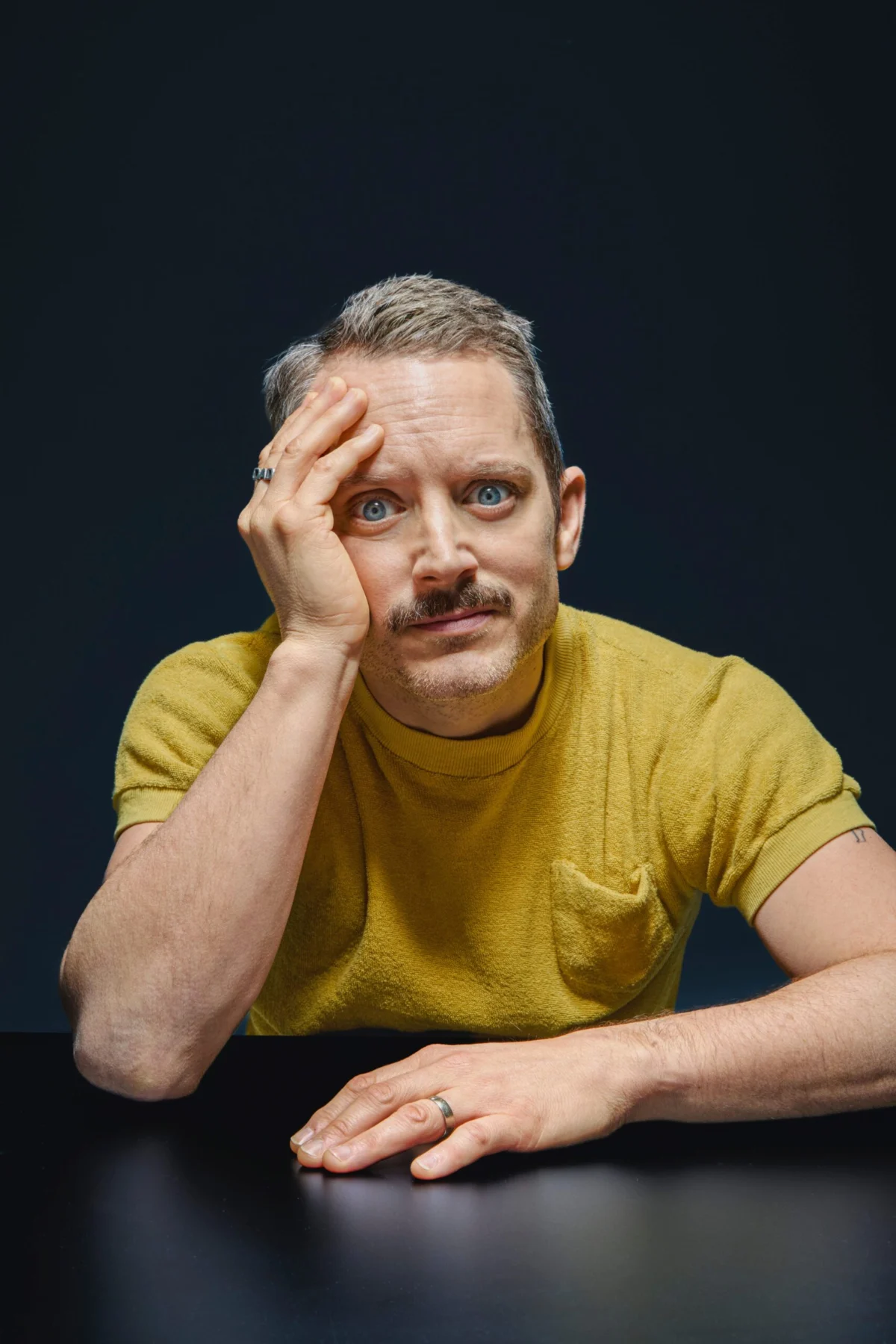
"Elijah Wood has leveraged the massive cultural capital of The Lord of the Rings not to pursue conventional stardom, but to curate a career defined by experimental genre films and ‘weird’ characters that challenge both the actor and the audience."

This shift from blockbuster protagonist to indie genre icon represents a deliberate strategy of artistic preservation. Rather than becoming trapped by the shadow of Frodo Baggins, Wood has embraced the fringes of cinema, using his production company, SpectreVision, and a series of subversive roles to explore the darker, more eccentric corners of the human experience, proving that the most enduring careers are often built on the courage to stay "left of center."
The Adjudicator of Chaos
Elijah Wood sits comfortably in the middle of a cinematic bloodbath, and he couldn’t be happier. In the upcoming horror sequel Ready or Not 2: Here I Come, Wood portrays a character known simply as "the Lawyer." While his costars are subjected to the visceral indignities of the genre—being drenched in what Wood gleefully notes was 325 gallons of fake blood—his character remains unsettlingly poised. The Lawyer is the adjudicator of a lethal game, a mysterious figure who oversees the Faustian bargains of the ultra-wealthy.

The film serves as a direct follow-up to the 2019 sleeper hit Ready or Not, which introduced audiences to Grace (Samara Weaving), a bride forced into a deadly game of hide-and-seek by her in-laws to satisfy a literal pact with the Devil. The sequel expands this lore, pitting Grace and her sister (Kathryn Newton) against multiple families of Satan-worshipping elites. For Wood, the role offered an opportunity to play with ambiguity. Despite the lack of an explicit backstory, Wood and the filmmakers discussed the possibility that the Lawyer is immortal—a silent witness to centuries of ritualistic carnage. His performance acts as a barometer for the film’s escalating absurdity; when Wood’s disarming blue eyes glint with amusement, the audience knows the situation has transitioned from the macabre to the truly wild.
A Foundation in the Macabre
Wood’s affinity for the unsettling is not a recent development. It is rooted in a childhood spent in the glow of a VCR, watching horror films he was technically too young to see. At age six or seven, Wood’s older brother would rent horror movies under the condition of secrecy. Where other children might have found nightmare fuel, Wood found an "electrifying excitement." To him, these films weren’t traumatic; they were a fun, energetic introduction to the power of cinema.

This early exposure fostered a nuanced relationship with "the darkness." Today, Wood speaks of the genre with the vocabulary of a connoisseur. He describes John Carpenter’s Halloween not as a terrifying slasher, but as "cozy" and nostalgic, citing the iconic soundtrack and imagery as a source of comfort. Conversely, he recognizes the subversive power of films like Michael Haneke’s Funny Games, noting that its matter-of-fact depiction of violence is far more disturbing than any supernatural entity. This duality—the ability to find joy in the "paffing" sound of an exploding body while respecting the psychological weight of realistic horror—has become the hallmark of his professional choices.
The Frodo Factor: A Legacy Without a Burden
To understand Wood’s current trajectory, one must look back to the turn of the millennium. At 18, Wood was cast as Frodo Baggins in Peter Jackson’s The Lord of the Rings trilogy. The franchise became a cultural phenomenon, grossing over $2.9 billion and winning 17 Academy Awards. For many actors, such a monumental role becomes a gilded cage, defining them so narrowly that they spend the rest of their lives attempting to distance themselves from it.

Wood, however, has navigated his legacy with remarkable grace. Twenty-five years later, he remains an active participant in the fandom. He maintains deep friendships with his fellow "Hobbits"—Sean Astin, Dominic Monaghan, and Billy Boyd—and even hosts themed events, such as a Lord of the Rings-inspired rave to celebrate the anniversary of The Fellowship of the Ring. "It is not a burden to me," Wood insists. He views the experience as a transformative life event rather than a professional albatross. By embracing the franchise rather than fleeing from it, he earned the freedom to experiment without the pressure of maintaining a specific "leading man" image.
The Pivot to the Weird
Following the conclusion of the trilogy in 2003, Wood took a path similar to that of Mark Hamill or Daniel Radcliffe. He used his "Frodo money" to fund a series of eclectic, often daring projects. He appeared in the high-concept Eternal Sunshine of the Spotless Mind and the indie darling Everything Is Illuminated. However, it was his role in Robert Rodriguez’s Sin City that signaled a major shift. Playing Kevin, a mute, cannibalistic serial killer, Wood proved he could weaponize his innocent appearance to create something truly terrifying.

This began a decade-long exploration of genre-defying roles. From the grimy, POV-shot slasher Maniac to Osgood Perkins’ upcoming adaptation of Stephen King’s The Monkey, Wood has consistently sought out characters that are "slightly left of center." This inclination led him to co-found SpectreVision in 2010. The production company has become a powerhouse in the indie horror space, producing cult hits like the psychedelic revenge thriller Mandy, starring Nicolas Cage. For Wood, genre filmmaking is the ultimate creative playground—a space where the rules of traditional narrative are often discarded in favor of experimental artistry.
Summer Camp and Horror Royalty
The production of Ready or Not 2 acted as a bridge between Wood’s past and present. The set featured a reunion with Shawn Hatosy, his costar from the 1998 cult classic The Faculty. Wood describes the filming of that Robert Rodriguez alien-thriller as "summer camp," a formative experience with a cast of rising stars like Josh Hartnett and Sarah Michelle Gellar. Decades later, reuniting with Hatosy and finally working with Gellar—with whom he had shared a manager for 20 years but never a set—felt like a "college" experience: more mature, more confident, and more willing to take risks.

Adding to the film’s prestige was the presence of David Cronenberg, the legendary "Father of Body Horror," who plays the Danforth family patriarch. Wood admits to being nervous in the presence of the man behind The Fly and Videodrome, yet he found the auteur to be disarmingly kind. This collision of horror royalty—from the 90s teen-scream era to the masters of the 70s and 80s—highlights the specific niche Wood now occupies: he is both a student and a steward of the genre.
The Philosophy of the Oddball
Beyond horror, Wood’s "willingness to go weird" has translated into a diverse television career. In Wilfred, he played a man who sees his neighbor’s dog as a person in a suit, a role that required him to balance absurdist comedy with genuine pathos. In Yellowjackets, he joined the cast as Walter, an eccentric citizen detective who matches the sociopathic energy of Christina Ricci’s Misty.

Perhaps the most telling example of Wood’s ego-free approach is his recent cameo in Rachel Sennott’s HBO series I Love LA. Playing an exaggerated, germaphobic, and socially inept version of himself, Wood fully leans into "cringe comedy." By delivering lines like "I’m not just a fuck machine!" with pained earnestness, he demonstrates a rare willingness to lampoon his own celebrity status for the sake of a joke.
Chasing the High of Discovery
As the 25th anniversary of The Lord of the Rings approaches, the franchise is entering a new era. With Andy Serkis set to direct The Hunt for Gollum in 2027, rumors of Wood’s return as Frodo have reached a fever pitch. While Wood remains coy about his involvement, his excitement for the project is genuine. He views the new films not through the lens of a former star looking for a paycheck, but as a fan eager to see what the "creative brain trust" will explore next.

This perspective—fan first, actor second—is what ultimately defines Elijah Wood. Whether he is adjudicating a ritual murder in a tailored suit or hosting a rave for Tolkien fans, he is still that six-year-old kid watching a forbidden VHS tape, chasing the high of something new, exciting, and wonderfully weird. He has successfully navigated the transition from the face of a billion-dollar franchise to the heart of the indie genre scene, proving that in Hollywood, the most interesting path is rarely the straightest one.