
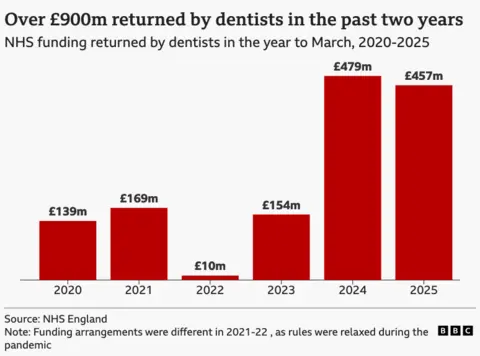
"Over £900 million earmarked for NHS dental services has been returned by practices in England over two years, underscoring a systemic failure in the contract model that pushes dentists towards private work and leaves millions of patients without vital care."
This staggering sum, representing one in every seven pounds paid to dentists for NHS work, highlights the dire state of public dental provision across England. As dental practices increasingly find NHS contracts financially unviable, a significant portion of the allocated budget remains unspent, only to be clawed back by the government. This financial leakage directly correlates with a widespread patient access crisis, where millions report being unable to secure essential dental treatment, exacerbating health inequalities and prompting urgent calls for fundamental reform of the antiquated dental contract.
The BBC has revealed that dentists in England have handed back over £900 million to the government across the last two financial years for NHS care they were contracted to provide but did not deliver. This unprecedented figure, comprising nearly £480 million in the preceding year and over £450 million in 2024-25, represents a substantial portion of the NHS dental budget. It also marks a significant escalation from previous years, indicating a deepening crisis within the sector. Each year, more than 40% of dental practices found themselves in a position where they had to return money, a clear signal of the systemic challenges practitioners face in meeting their NHS commitments.
This financial phenomenon helps to explain the widespread frustration among the public. Despite record sums being allocated to NHS dentistry, more than a fifth of people report being unable to access care when they need it. The underlying issue is rooted in the current NHS dental contract, a framework established nearly two decades ago in 2006. Under this system, dental practices agree to provide a specific volume of NHS work, measured in "Units of Dental Activity" (UDAs), for which they receive monthly payments. If a practice falls below 96% of its agreed contract value, the NHS recoups the unfulfilled portion in the subsequent year. Critics argue that this UDA-based system incentivises a focus on quantity over quality, often failing to adequately compensate for complex procedures or preventative care, and is a major disincentive for dentists to prioritise NHS work.
The British Dental Association (BDA) has consistently highlighted the inherent flaws of the 2006 contract, stating that it leaves dentists with little choice but to under-deliver on NHS commitments. Eddie Crouch, chair of the BDA, articulated the severity of the situation, explaining that the current remuneration structure means dentists are often struggling to even cover their operating costs when delivering NHS care. The union points to a stark financial disparity: the sums that can be earned in the private sector for common procedures such as new patient exams, fillings, and extractions are often double what the NHS pays. Crouch cited that for new patient exams under the NHS, a typical dentist could face a loss of approximately £7 per patient due to the costs outweighing the reimbursement. "It’s the simple fact we now have dentists losing money delivering NHS care," Crouch stated. "It might suit the Treasury, but no healthcare professional can be expected to work this way." This creates an environment where, despite a professional commitment to public service, the economic realities push practitioners towards more financially viable private work.
The impact on patients is profound and often distressing. Nikita Jenkins, a 27-year-old from Cornwall, epitomises the struggle faced by millions. She has not seen an NHS dentist in 14 years and, faced with local waiting lists reportedly stretching to seven years, was compelled to pay privately for her two young daughters’ dental treatment. "I tried every dentist in and around my area, but it was near impossible," Jenkins told the BBC. "We were waiting and, in the end, I felt like we had no choice but to take the jump and pay to go private, to ensure that our children had the right health care." For families like the Jenkins, who already contend with numerous financial pressures, dental care has become an unaffordable luxury rather than an accessible necessity. "Dentistry feels like a luxury, not a necessity, because it’s just so inaccessible, which shouldn’t be the case – especially for children," she added, highlighting the erosion of a fundamental public health service.
The widespread shift towards private dentistry, driven by the perceived unviability of NHS contracts, has not gone unnoticed by regulators. The Competition and Markets Authority (CMA) is expected to announce an investigation into the private dentistry market and the fees being charged. This inquiry comes amidst growing concerns that the lack of NHS provision is funneling patients into an increasingly expensive private sector, where pricing transparency and fairness are under scrutiny. The CMA’s intervention underscores the gravity of the market distortion, where a failing public system inadvertently fuels a private one that many cannot afford.
Patient watchdog Healthwatch England has echoed the concerns raised by patients and professional bodies. Rebecca Curtayne from Healthwatch England observed that these figures directly reflect the experiences reported by people across the country: "many cannot get an NHS dental appointment and others find their dentist has stopped providing NHS care altogether and now only offers private treatment." She emphasised that the burden falls disproportionately on the most vulnerable, particularly those facing financial hardship, who are left with severely limited options. Curtayne’s assessment that the dental contract is "simply not fit for purpose" resonates with a broad consensus among patient advocates and dental professionals alike.
The government acknowledges the challenges, asserting that improvements are being made. It states that any money returned by dentists is reinvested into services. Recent measures include increasing the amount dentists receive for NHS work and offering £20,000 "golden hellos" to entice dentists to practice in areas with the poorest access. The government claims these initiatives are already leading to an increase in the number of treatments being carried out. Furthermore, a commitment has been made to fundamentally reform the dentistry contract by the end of the current parliament, with the aim of boosting access further. Health and Social Care Minister Stephen Kinnock stated, "We are making progress," but conceded, "We know there is more to do to get to the root of the problem."
An NHS England spokeswoman clarified that the clawback data is effectively "a year behind reality," meaning the figures reflect past performance rather than the immediate impact of current reforms. She reiterated that returned money is indeed reinvested into dentistry, and that NHS England is "working closely with government to introduce further reforms in the coming months." However, the effectiveness of simply reinvesting returned funds without addressing the structural deficiencies of the contract remains a point of contention. Critics argue that merely recycling funds from unfulfilled contracts does not tackle the core reasons why practices are unable or unwilling to deliver the contracted NHS care in the first place.
The current dental crisis is a complex interplay of an outdated contract, rising operational costs for practices, an increasing demand for care, and the financial incentives of the private sector. The substantial sum of unspent NHS dental funding underscores the urgent need for a truly transformative overhaul of the system, rather than incremental adjustments. Without a contract that fairly compensates dentists for their work and prioritises patient needs, the struggle for accessible, affordable dental care for millions of people in England is set to continue.

Additional reporting by Elena Bailey and data analysis by Aidan McNamee.