
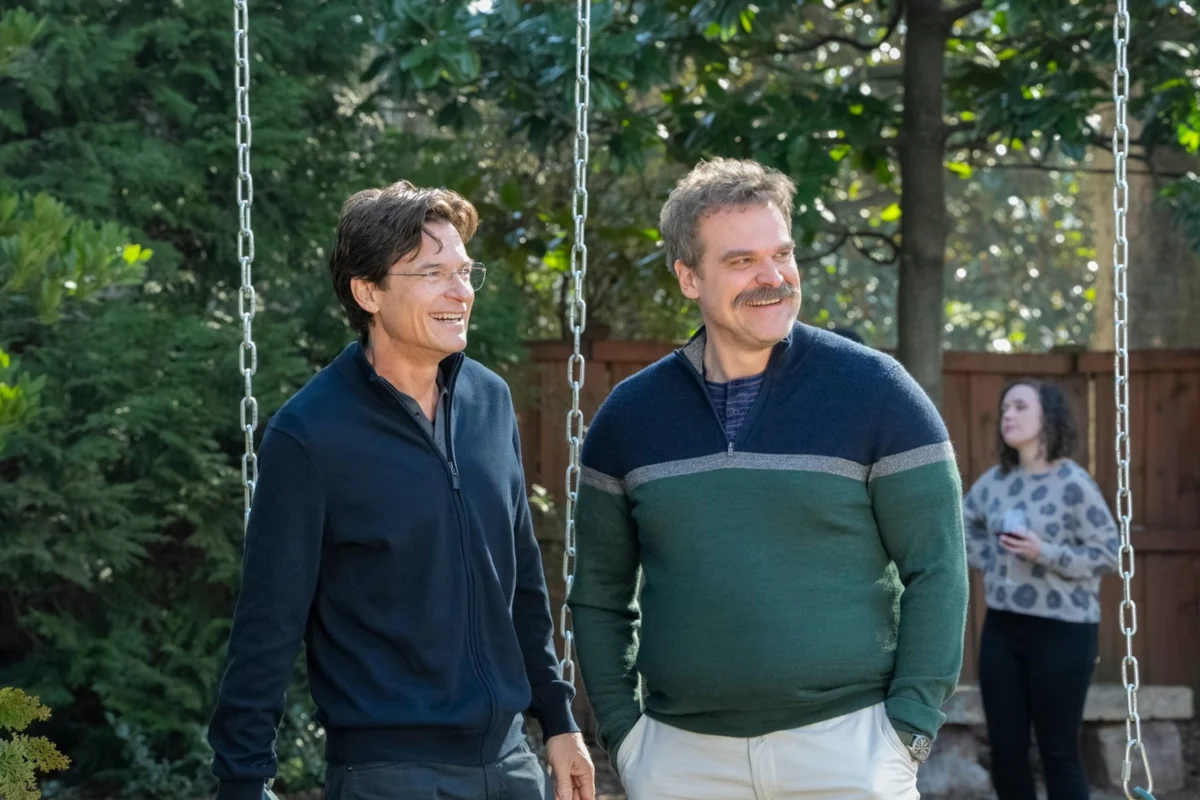
"DTF St. Louis masterfully deconstructs the mid-life crisis through a lens of dark comedy and neo-noir mystery, proving that HBO remains the definitive architect of the ‘water cooler’ television era."
As television audiences increasingly migrate toward fragmented streaming platforms, HBO continues to assert its dominance by producing "appointment viewing" content that captures the collective cultural imagination. The network’s latest offering, DTF St. Louis, is a sophisticated hybrid of genres that leverages the immense talent of Jason Bateman, David Harbour, and Linda Cardellini to explore the complexities of friendship, infidelity, and existential dread in the American Midwest. By blending the high-stakes tension of a neo-noir investigation with the biting wit of a dark comedy, the series establishes itself as a spiritual successor to the network’s most prestigious dramas while carving out a unique identity centered on the "zig-zag" narrative structure of modern life.
The HBO Pedigree and the Evolution of Prestige TV
To understand the impact of DTF St. Louis, one must first acknowledge the lineage from which it descends. HBO has long held the secret formula for generating cultural discourse, from the era-defining mob dynamics of The Sopranos to the social satire of The White Lotus. This "prestige" label is not merely a marketing term; it represents a commitment to high production values, complex character arcs, and a willingness to subvert audience expectations. DTF St. Louis enters this arena with a confidence that suggests it knows exactly how to get group chats buzzing.
The series arrives at a time when audiences are craving more than just simple escapism. There is a growing appetite for stories that reflect the "mid-life malaise"—the feeling of being stuck in a routine despite having achieved traditional markers of success. By setting the story in St. Louis, a city that perfectly encapsulates the blend of metropolitan ambition and suburban stagnation, the show provides a grounded backdrop for its increasingly surreal and mysterious events.
The Central Trio: Bateman, Harbour, and Cardellini
The gravitational pull of DTF St. Louis lies in its powerhouse lead cast. Jason Bateman, who has perfected the "straight man with a hidden darkness" archetype in series like Ozark, portrays Clark, a local television weatherman. Clark is a "quasi-celebrity," a man whose face is known to everyone in the city but whose inner life is a vacuum of unfulfilled desires. Bateman’s performance is a nuanced study of a man trying to maintain a curated public persona while his private world begins to fracture.

Opposite Bateman is David Harbour as Floyd, an American Sign Language (ASL) interpreter. Harbour, known for the rugged vulnerability he brought to Stranger Things, plays Floyd with a jovial, larger-than-life energy that masks a deeper complexity. The inciting incident of the series—Floyd saving Clark’s life during an on-air forecast—establishes an immediate, intense bond between the two men. This is not the typical "bromance" seen in network sitcoms; it is an exploration of male friendship forged in trauma and mutual dissatisfaction.
Linda Cardellini rounds out the trio as Carol, Floyd’s wife. Cardellini has a storied history of playing characters who navigate the precarious line between domesticity and chaos, as seen in Dead to Me. In DTF St. Louis, Carol is the catalyst for the show’s central romantic tension. However, the series avoids the clichés of the standard "love triangle." Instead, Carol’s involvement introduces a layer of psychological complexity that forces both Clark and Floyd to confront their own moral failings.
A Narrative of Zigs and Zags
The showrunners of DTF St. Louis have crafted a narrative that is intentionally unpredictable. The original description of the show suggests that every time a viewer thinks they have a handle on the plot, the story "zigs when it should zag." This erratic storytelling is not just for shock value; it mirrors the chaotic nature of the characters’ lives.
The first three episodes—"Cornhole," "Snag It," and "The Go Getter"—set the stage by establishing the mundane details of St. Louis life before slowly introducing the elements of mystery. By the time the fourth episode, "Missouri Mutual Life & Health Insurance Company," arrives, the stakes have shifted from personal drama to something far more dangerous. The inclusion of law enforcement characters played by veteran actor Richard Jenkins and Wednesday breakout star Joy Sunday adds a "neo-noir" investigative layer that keeps the audience guessing. Jenkins and Sunday provide the "outsider" perspective, looking into the lives of Clark, Floyd, and Carol with a skepticism that mirrors the audience’s own questions.
Exploring the Themes of Mid-Life Malaise
At its core, DTF St. Louis is an autopsy of the American Dream in middle age. Clark’s career as a weatherman is a metaphor for his life: he predicts the future based on patterns, yet he is completely blindsided by the actual events of his existence. Floyd’s role as an ASL interpreter is equally symbolic, representing the difficulty of true communication even when the tools for it are literally at one’s fingertips.
The show asks difficult questions about what happens when the "middle" of life doesn’t feel like a peak, but a plateau. The mystery element serves as a vehicle for these characters to feel something—anything—other than the dull ache of their daily routines. This "darkly comedic mystery" allows the show to explore heavy themes of mortality and regret without becoming overly somber, maintaining a sharp, satirical edge that lampoons the very culture it depicts.

The Investigative Neo-Noir Angle
While the character drama is the heart of the show, the mystery is its pulse. The involvement of Richard Jenkins and Joy Sunday signals that DTF St. Louis is not just interested in domestic disputes. There is a "neo-noir" sensibility at play—a style characterized by cynical heroes, intricate plots, and a sense of moral ambiguity.
The mystery doesn’t just drive the plot; it serves as a mirror for the characters’ internal struggles. As the investigation unfolds, the secrets that Clark, Floyd, and Carol have been keeping from themselves—and each other—begin to surface. The show utilizes the "whodunnit" or "what happened" format to keep viewers theorizing week after week, ensuring that the conversation remains active long after the credits roll.
Production Schedule and How to Watch
DTF St. Louis is designed for the weekly release model, a strategy that HBO has used to great effect to build tension and community engagement. The seven-episode season ensures a tight, focused narrative without the "filler" often found in longer seasons.
The series airs on HBO and is available for streaming on HBO Max every Sunday at 9:00 P.M. ET. For those looking to keep track of the remaining mystery, here is the complete release schedule:
- Episode 1, "Cornhole": Premiered March 1. This episode established the fateful meeting between Clark and Floyd.
- Episode 2, "Snag It": Premiered March 8. The friendship deepened, and the first hints of Carol’s involvement emerged.
- Episode 3, "The Go Getter": Premiered March 15. The domestic drama began to bleed into the characters’ professional lives.
- Episode 4, "Missouri Mutual Life & Health Insurance Company": Airing March 22. This episode is expected to pivot heavily into the investigative and insurance-related mysteries.
- Episode 5: Airing March 29.
- Episode 6: Airing April 5.
- Episode 7 (Season Finale): Airing April 12.
Conclusion: Why ‘DTF St. Louis’ Matters
In a crowded television landscape, DTF St. Louis stands out by refusing to be just one thing. It is a comedy that isn’t afraid to be dark, a drama that isn’t afraid to be funny, and a mystery that is as much about the human condition as it is about clues and evidence. With a stellar cast and the backing of HBO’s prestige infrastructure, it is a definitive example of how modern television can still create a shared cultural experience. Whether you are drawn in by the star power of Jason Bateman and David Harbour or the intrigue of a St. Louis-based neo-noir, DTF St. Louis is a series that demands, and rewards, your full attention.