
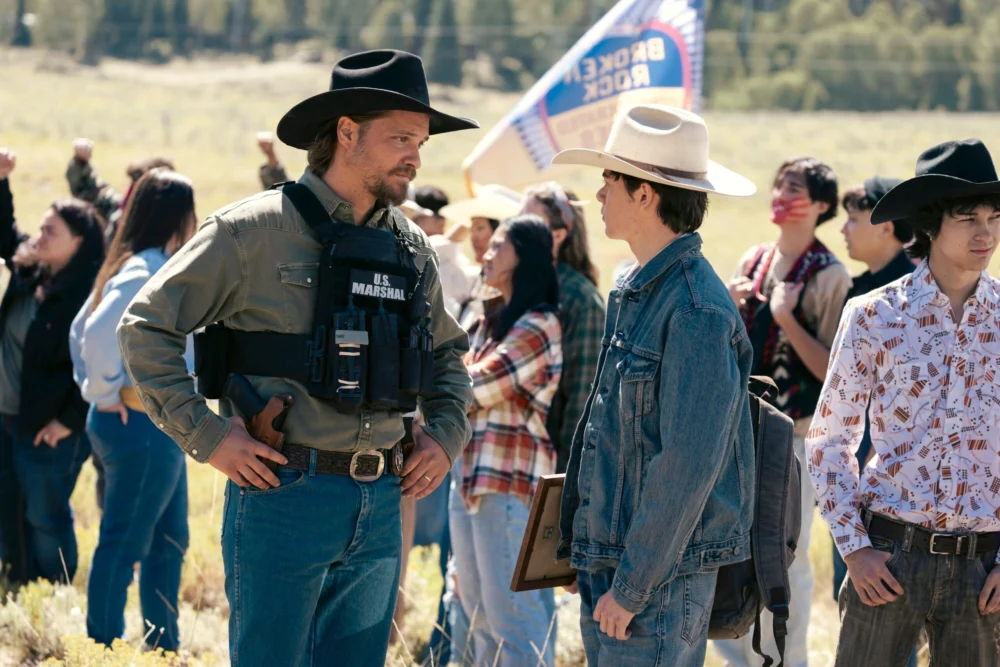
"In the wake of personal tragedy and ancestral upheaval, Kayce Dutton finds a new moral compass within the U.S. Marshals Service, trading the isolation of the ranch for the proactive duty of a protector."
The premiere episode of Marshals, titled “Piya Wiconi,” marks a pivotal expansion of the Yellowstone universe, shifting the narrative focus from internal family dynastic struggles toward a high-stakes federal law enforcement procedural. By centering the story on Kayce Dutton’s attempt to reconcile his violent past with a desire for a peaceful future, the series explores the complexities of grief, tribal sovereignty, and the heavy burden of the Dutton legacy in a rapidly changing Montana.

The Evolution of the Dutton Legacy
For five seasons of Yellowstone, Kayce Dutton (played by Luke Grimes) was defined by his proximity to his father, John Dutton, and the sprawling empire of the Yellowstone Ranch. However, the debut of Marshals finds Kayce in a state of self-imposed exile. Having sold the family’s ancestral land to the Broken Rock Indian Reservation, Kayce has attempted to downsize his life. Yet, as the episode illustrates, a "downgraded" Dutton ranch remains a symbol of opulence; his new home is a sprawling structure of Bur Oak that still feels more like a fortress than a simple homestead.
This transition is framed by profound personal loss. The offscreen death of his wife, Monica, a native of the Broken Rock Reservation, haunts the premiere. Kayce, ever the stoic, attempts to mask his devastation, but his internal fractures are evident. His son, Tate, has found his own path through activism, joining a protest against the federal government’s toxic waste disposal on reservation land. This generational divide sets the stage for a story that is as much about the political realities of modern Montana as it is about the action-oriented duties of a U.S. Marshal.
High-Stakes Production and the Sheridan Portfolio
With a reported budget of $52 million, the production values of Marshals are immediately apparent. The series utilizes its financial resources to capture the sweeping, cinematic vistas of the American West, punctuated by high-intensity sequences involving horseback riding and explosive action. While Taylor Sheridan serves as an executive producer, the show is helmed by creator and showrunner Spencer Hudnut.

The aesthetic quality of the show arguably surpasses other entries in the Sheridan portfolio, such as Landman. While the latter relies heavily on the screen presence of Billy Bob Thornton, Marshals aims for a grander, more atmospheric scale. However, the writing in this premiere reflects a departure from Sheridan’s signature "offbeat poetry." Hudnut’s script is punchy and direct, leaning into the conventions of the procedural genre while maintaining the grit expected by the franchise’s established audience.
The Recruitment of a "Door Kicker"
The narrative engine of the series is ignited by the arrival of Pete “Cal” Calvin, portrayed by Logan Marshall-Green. Cal and Kayce share a history as Navy SEALs, a bond that transcends the socio-political weight of the Dutton name. Cal, who has found his own "salvation" within the U.S. Marshals Service after a post-military spiral into substance abuse, views Kayce not as a rancher, but as a "door kicker."
The recruitment process is subtle but effective. Cal appeals to Kayce’s inherent need for purpose, noting that while Kayce claims to be at peace, his inability to even shoot a prowling wolf suggests a man at odds with his environment. The hook for Kayce is the specific nature of the Marshals’ current mission: pursuing fugitives who have been "preying on Rez women." This specific call to justice, tied to the community of his late wife, provides the moral impetus for Kayce to step back into the line of fire.

Conflict at Broken Rock
The episode’s central conflict converges at a protest on the Broken Rock Reservation. The event is attended by the U.S. Secretary of the Interior and chaired by Thomas Rainwater (Gil Birmingham). Rainwater remains one of the most compelling figures in the franchise, representing the sophisticated intersection of tribal leadership and political maneuvering.
The tension escalates when Kayce, acting as an informal observer, identifies a suspicious individual carrying a backpack. His tactical instincts are proven correct when a homemade bomb detonates, causing mass casualties and leaving Chairman Rainwater in critical condition. This act of domestic terrorism shifts the episode from a character study into a fast-paced investigation, highlighting the Marshals’ technological capabilities. The use of advanced facial recognition software to identify the suspect, Jim Kane, demonstrates the show’s intent to blend traditional Western grit with modern forensic drama.
The Trail Keepers and the Moral Arc
The investigation reveals that Jim Kane was not a willing terrorist but a man coerced into action. His family was held captive by the "Trail Keepers," a white-supremacist-coded militia operating in the rugged Montana wilderness. This revelation allows the show to explore the dark underbelly of extremist groups in the rural West, providing a clear antagonist for the Marshals to dismantle.

Kayce’s involvement in the subsequent raid is a homecoming of sorts. He is officially deputized, signaling his formal entry into the service. The ensuing shootout is choreographed with a focus on realism and tactical precision. In a moment of reflection following the rescue of Kane’s daughter, Kayce notes that it felt "nice to kill for someone rather than something." This line encapsulates his character’s struggle; for years, he killed to protect land and a name, but as a Marshal, he finds a new identity as a "protector" of individuals.
Cultural Nuance and Procedural Logic
The premiere is not without its minor inconsistencies. A dialogue exchange involving Mo (Mo Brings Plenty), where he claims the sun rarely shines on the reservation during a scene bathed in piercing Montana sunlight, highlights a slight disconnect between metaphor and visual reality. Similarly, the "three rules of Montana"—never pet a buffalo, never try to outdrink a Canadian, and never mess with a cowboy’s music—provide a moment of levity that leans into regional stereotypes, though they serve to ground the "motley crew" of Marshals in a specific sense of place.
Despite these small hurdles, the ensemble cast of Marshals is introduced as a highly skilled, diverse, and capable unit. The series avoids the pitfall of condescending to its supporting characters, instead presenting them as elite professionals who respect Kayce’s unique skill set without being overshadowed by his legacy.

Conclusion: A New Direction for the Franchise
The final moments of the premiere bring Kayce’s journey full circle. By finally shooting the wolf that had been haunting his property, he symbolically puts an end to his period of hesitation. His visit to Monica’s grave and his renewed commitment to his son, Tate, suggest that while he cannot replace what was lost, he can honor it through service.
Marshals successfully carves out a niche within the Yellowstone ecosystem by pivoting toward a "case-of-the-week" structure that remains tethered to a larger overarching narrative. It balances the high-octane action of a federal thriller with the somber, reflective tone of a modern Western. As Kayce Dutton trades his rancher’s hat for a federal badge, the series promises to explore whether a man born into a world of lawlessness can truly find peace by enforcing the law. The premiere establishes a solid foundation for a series that is as much about the soul of Montana as it is about the pursuit of justice.