

"The burpee is more than a test of sheer willpower; it is a complex, multi-joint movement that demands technical precision to transform raw physical exhaustion into a sophisticated tool for explosive athletic power."

While often used as a shorthand for gym-induced suffering, the burpee is a misunderstood cornerstone of modern conditioning that requires a delicate balance of strength, coordination, and aerobic capacity. By moving beyond the "hit the floor and hop" mentality, athletes can unlock the exercise’s true potential as a functional movement that builds triple extension power and cardiovascular resilience without the common risks of joint injury or metabolic burnout.
The Anatomy of the Perfect Burpee: Form Over Speed
In the high-intensity world of modern fitness, the burpee is frequently treated as a race against the clock. However, according to Men’s Health fitness director Ebenezer Samuel, C.S.C.S., and senior editor Brett Williams, NASM, the secret to a high-performing burpee lies in efficiency rather than raw speed. When an athlete focuses solely on moving fast, they often sacrifice body mechanics, leading to "energy leaks." These leaks—such as a sagging core or improper foot placement—waste caloric energy and cause premature fatigue, ultimately slowing the athlete down more than a controlled, technical pace would.

The first pillar of a safe burpee is the "Strong Ground" principle. Many exercisers become what Samuel calls a "jellyfish" the moment they drop to the floor. To prevent this, the transition from standing to the ground must be treated as a dynamic plank. By firing the abdominals and contracting the glutes, the athlete protects the spine from the jarring impact of the descent. This rigid midsection not only staves off lower back injuries but also creates a stable platform from which the athlete can explosively push back up.

The second pillar involves the "Wide Base." A common mistake is keeping the feet narrow during the squat-thrust and the subsequent jump. By maintaining a stance at least shoulder-width apart throughout the entire movement, the athlete remains in a constant state of "jump readiness." This eliminates the need for micro-adjustments between the floor phase and the air phase, allowing for a seamless transition that maximizes power output.

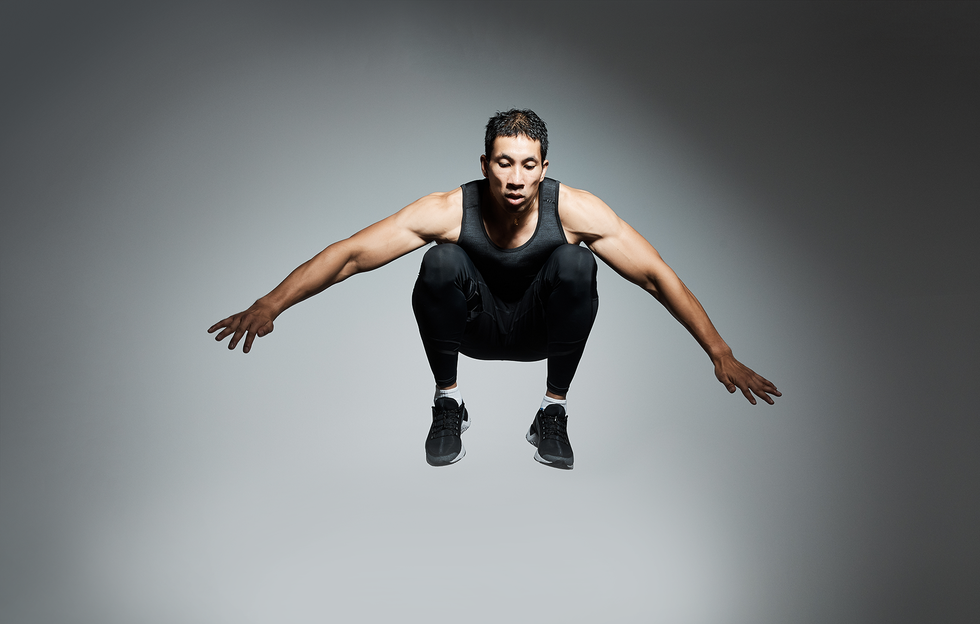
Finally, the jump itself must be "owned." Rather than performing a low-effort "bunny hop," athletes should strive for triple extension—the simultaneous straightening of the ankles, knees, and hips. This is the same mechanical sequence used by elite athletes in power cleans or vertical leaps. Treating every burpee as an opportunity to train this explosive extension turns a simple conditioning drill into a legitimate athletic development tool.

From Physiology Labs to the Front Lines: A History of the Burpee
The burpee’s reputation as a grueling punishment is a far cry from its academic origins. The movement was named after Royal H. Burpee, an American physiologist who developed the exercise in the late 1930s as a component of his Ph.D. thesis at Columbia University. Originally designed as a quick, four-part movement to assess the physical capacity of average citizens, it was never intended to be performed in the high-volume, "to-failure" sets seen in modern CrossFit WODs or HIIT classes.

In the original 1930s template, the burpee did not include the vertical jump or the full pushup that are standard today. It was a simple squat-thrust: squat down, kick the feet back to a plank, jump the feet back in, and stand up. The movement gained massive scale during World War II when the United States military adopted it as a benchmark test for incoming recruits. It was an efficient way to evaluate coordination, agility, and cardiovascular health in thousands of men simultaneously. Over the decades, fitness culture added the pushup and the jump, evolving the "Burpee Test" into the "Burpee Exercise"—a much more taxing and controversial version of its former self.

The Physiological Benefits and the "Metabolic Cost"
Trainers gravitate toward the burpee because of its immense "metabolic cost." Because it utilizes nearly every major muscle group—including the pectorals, deltoids, triceps, quads, hamstrings, and core—the oxygen demand is astronomical. This makes it one of the most effective bodyweight movements for raising the heart rate and improving VO2 max.

Beyond the cardiovascular benefits, the burpee is a masterclass in body control. The rapid change in planes—moving from a vertical standing position to a horizontal plank and back again—challenges the vestibular system and forces the brain to maintain spatial awareness under fatigue. This hones proprioception and coordination, skills that are directly transferable to sports like football, wrestling, and martial arts.

The Controversy: Why Some Trainers "Avoid It Like the Plague"
Despite its benefits, the burpee is polarizing. Many fitness professionals argue that the move is inherently dangerous when programmed for high volume. The primary concern is the breakdown of form under exhaustion. As an athlete tires, they are more likely to "flop" onto the floor, putting excessive shear force on the wrists and shoulders. If the core isn’t engaged, the hips sag, leading to hyperextension of the lumbar spine.

Furthermore, the "speed at all costs" mentality of many group fitness classes encourages participants to ignore these red flags. When a workout is time-capped, the incentive to maintain a rigid plank or a wide base vanishes, replaced by a desperate scramble to hit a rep count. For beginners who lack the prerequisite core strength or shoulder stability, this can lead to acute injuries or chronic repetitive stress issues.

Elevating the Standard: Six Strategic Variations
To prevent the monotony and injury risk of the standard burpee, athletes can utilize variations that emphasize different athletic qualities:

- The Tuck Jump Burpee: By pulling the knees toward the chest during the jump phase, this variation increases the demand on the hip flexors and requires significantly more explosive power from the lower body.
- The Hand Release Burpee: This is a "tendency-breaker." By forcing the athlete to briefly lift their hands off the floor at the bottom of the movement, it ensures a full range of motion for the pushup and engages the posterior chain (lats and rhomboids). This variation also protects the shoulders by slowing down the eccentric phase of the descent.
- The Burpee to Jump Lunge: This introduces a unilateral (single-leg) challenge. By landing in a lunge rather than a squat, the athlete trains balance and stabilizes the knee and hip joints.
- The Single-Leg Burpee: Perhaps the most difficult version, this requires immense core stability and leg strength to navigate the entire movement on one limb, highlighting and correcting muscle imbalances.
- The Burpee Switch: This variation tests coordination by requiring the athlete to rotate their body or switch foot positions mid-movement, mimicking the chaotic nature of competitive sports.
- The Lateral Jump Burpee: By jumping sideways over an object or line between reps, the athlete incorporates frontal-plane movement, which is often neglected in traditional "forward-back" gym routines.
Strategic Programming for Longevity
To reap the rewards of the burpee without the risks, experts suggest a "quality over quantity" approach. Rather than performing burpees for minutes on end, a smarter strategy is the 20/40 interval: 20 seconds of high-quality, technically perfect reps followed by 40 seconds of rest. This allows the heart rate to spike while giving the nervous system enough recovery time to maintain proper form in the next set.
For those looking for a structured challenge, fitness coach Kurt Ellis recommends a 5-minute focused block using the Hand Release variation. This ensures that every rep is intentional and that the athlete remains "plugged in" to their mechanics. By treating the burpee as a skill to be mastered rather than a chore to be endured, exercisers can transform this infamous move from a source of pain into a cornerstone of elite physical performance.