
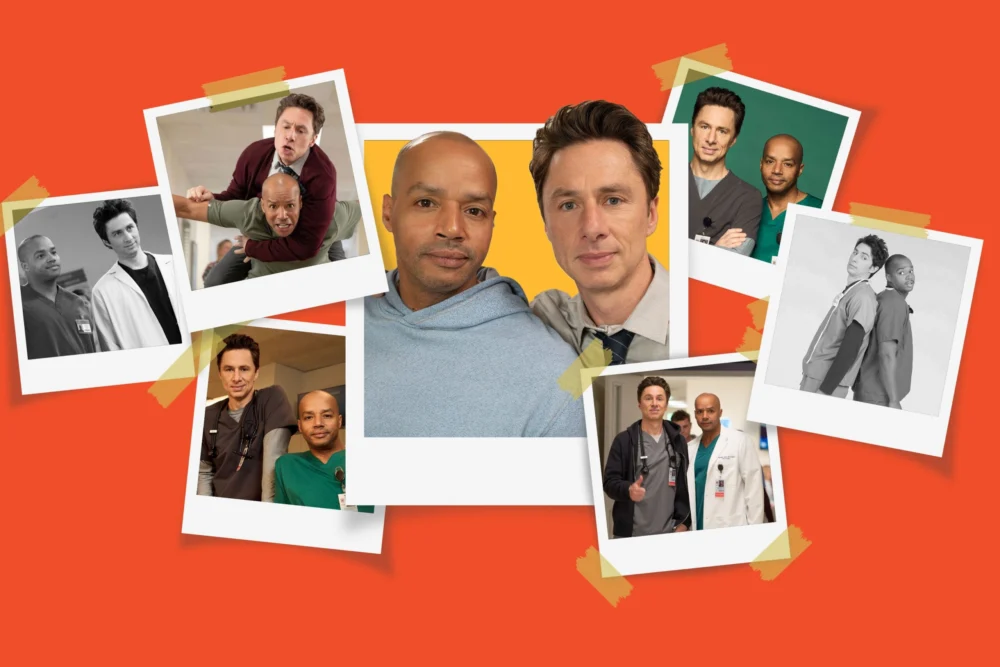
The enduring bond between Zach Braff and Donald Faison transcends the screen, proving that the foundation of their iconic "bromance" is a rare, ego-free partnership that has redefined male friendship and professional mentorship for a new generation.
Nearly two decades after the fictional Sacred Heart Hospital first opened its doors to a group of bumbling interns, the real-life connection between stars Zach Braff and Donald Faison remains the beating heart of the Scrubs franchise. As the series prepares for its long-awaited revival, the duo’s transition from goofy residents to distinguished department chiefs reflects a broader evolution in television—one where emotional vulnerability and platonic male love are treated with as much gravity as the medical emergencies they treat on screen.

The Resurrection of Sacred Heart
It has been sixteen years since Scrubs concluded its original run, yet for Zach Braff and Donald Faison, the characters of J.D. and Turk never truly faded into the background. While many television ensembles drift apart once the cameras stop rolling, Braff and Faison’s lives remained inextricably linked. Their history is a tapestry of personal milestones: Faison held his wedding in Braff’s backyard, and Braff serves as the godfather to Faison’s youngest children. This profound personal history served as the catalyst for the show’s return.
The momentum for a revival began in earnest during the 2020 global pandemic. Launching the Fake Doctors, Real Friends rewatch podcast, the duo revisited all 182 episodes, providing fans with a blend of nostalgia and behind-the-scenes insights. The podcast did more than just entertain; it proved the IP’s enduring viability. Combined with a series of successful, musically-driven T-Mobile advertisements, the path was cleared for creator Bill Lawrence and showrunner Aseem Batra to bring the doctors back to the wards.
In this new iteration, the dynamic has shifted. J.D. and Turk are no longer the wide-eyed novices navigating the terrors of residency. They are now the "distinguished mentors," serving as Chief of Medicine and Chief of Surgery, respectively. The revival seeks to balance the show’s signature surrealist humor with the grounded realities of middle-aged healthcare professionals, all while introducing a new generation of doctors who bring with them the sensitivities and digital-first habits of the modern era.

From Sitcom Tropes to Cultural Superheroes
The original run of Scrubs (2001–2010) was revolutionary for its portrayal of male friendship. At a time when most sitcoms relied on "tough guy" archetypes or emotional distance between male leads, J.D. and Turk embraced "Guy Love"—a term they famously coined in a musical episode. They hugged, they shared their deepest insecurities, and they practiced an unabashedly affectionate "bromance" that defied the rigid gender norms of the early 2000s.
During their podcast rewatch, Braff and Faison viewed their work through a post-2020 lens. Recording the first episode on the day the world shut down, they found themselves re-evaluating the heroism of the medical profession. Braff notes that while they previously saw themselves as playing doctors, they now view their characters as "superheroes." This perspective informs the revival’s tone; the stakes are higher, and the responsibility of teaching the next generation is presented as a heroic endeavor.
The show’s legacy is built on its "grounded surrealism." While J.D.’s elaborate fantasy sequences provided the laughs, the emotional weight of patient loss and the burnout of the medical field provided the pathos. The revival aims to maintain this balance, ensuring that even as Turk can "telepathically" sense J.D.’s arrival in the hospital, the medical cases remain rooted in the complexities of contemporary healthcare.

The Anatomy of an Ego-Free Partnership
One of the most significant hurdles in any long-running television production is the "toxic environment" often created by competing egos. Braff and Faison attribute their longevity to a complete lack of professional jealousy. In an industry where screen time and "having the last laugh" are often points of contention, the Scrubs cast operated on a "funniest line wins" philosophy.
Braff, who frequently directs, observes that many actors struggle when a co-star "shines" too brightly, fearing they will be cast into the shadows. Conversely, Faison and Braff have spent their careers rooting for each other. Whether it was Braff appearing in Faison’s sitcom The Exes or Faison taking a role in Braff’s directorial effort Wish I Was Here, the two have consistently championed each other’s creative pursuits.
This lack of friction dates back to the summer of 2001. Following the show’s initial success, the two shared a loft in New York’s SoHo district—a period Braff describes as "every young actor’s fantasy." Living on a shoestring budget despite having a hit show, they spent their nights playing ping-pong and their days navigating a 180-degree shift in their public profiles. Faison, who had already seen success in films like Clueless, acted as a guide for Braff, who was still adjusting to the sudden transition from waiting tables to leading a network comedy.

Vulnerability as a Professional Tool
The contrast in their personalities has always been a source of both comedic and dramatic strength. Braff, raised in a family of psychologists, is an advocate for emotional transparency and therapy. Faison, by his own admission, tends to avoid confrontation and internalize his feelings—a trait Braff playfully needles him about.
In the revival, this translates to a mentorship style that reflects their real-life differences. J.D. remains the emotional anchor, encouraging the new interns to tap into their feelings, while Turk provides the steady, albeit sometimes guarded, hand of a surgical leader. This interplay allows the show to explore different facets of the modern male experience, particularly how men in their 50s navigate the transition from being the "rising stars" to the "old guard."
The physical reality of aging is also a recurring theme. The "Eagle," a move where Turk spins J.D. around in the air, remains a fan-favorite staple. While Faison insists he can still perform the feat with ease—asserting his fitness as a 51-year-old—the duo acknowledges that their "nights out" have shifted from SoHo clubs to 6:00 p.m. dinners and 9:00 p.m. bedtimes. This shift in energy isn’t presented as a loss, but rather a new chapter. They watch the younger cast members head out to clubs with a sense of vicarious nostalgia, knowing exactly how much their lives are about to change as the show’s legacy continues.

Looking Ahead: The Men’s Health Challenge
The conversation around the revival eventually turned to physical transformation, sparked by Faison’s desire to grace the cover of Men’s Health. The duo issued a playful yet earnest challenge: given three months of training, Faison aims to achieve the physique of Michael B. Jordan, while Braff targets the lean, "shredded" look of Brad Pitt in Fight Club.
While the challenge was made in jest, it underscores the theme of the revival: renewal. Scrubs is not merely returning to repeat old jokes; it is returning to see how these characters—and the actors who inhabit them—fit into a world that has aged alongside them. By leaning into their middle-aged realities while maintaining the "spark" that first ignited at their 2001 table read, Braff and Faison are proving that some friendships, much like some television shows, only get better with time.
As J.D. and Turk return to the halls of Sacred Heart, they carry with them twenty-five years of history, a podcast-fueled resurgence, and a commitment to showing that the most important medicine a doctor can provide is often a sense of community and a lifelong friend.