

"As Kent grapples with an ‘unprecedented’ meningitis outbreak, health officials remain cautious about its containment, emphasizing a rapid, multi-pronged public health response to curb further transmission and protect the community from this aggressive disease."

The county of Kent is currently at the centre of an escalating public health crisis as authorities battle a severe outbreak of meningococcal disease, a form of meningitis that has led to two fatalities and affected at least 20 individuals. This rapid spread, primarily linked to social gatherings in Canterbury, has prompted an urgent alert from the UK Health Security Agency (UKHSA) and triggered a massive vaccination and antibiotic distribution effort, particularly targeting students in the affected areas. The situation is deemed "unprecedented" by health officials, highlighting the unusual pace and extent of the disease’s transmission.
The gravity of the situation became starkly clear with the tragic deaths of a 21-year-old university student and Juliette, a sixth-former at Queen Elizabeth’s Grammar School in Faversham. These fatalities underscore the aggressive nature of meningococcal disease, which can progress rapidly and lead to severe complications or death if not promptly treated. The outbreak’s suspected origin points to the Club Chemistry nightclub in Canterbury, where the owner, Louise Jones-Roberts, confirmed that two of her staff members had also contracted the disease but were reported to be in stable condition in hospital. The nightclub has since closed its doors, with Jones-Roberts stating they are "not prepared to open until we know this is under control and people are safe," reflecting the deep anxiety pervading the local community.

Dr. Anjan Ghosh, Kent County Council’s director of public health, articulated the ongoing challenge, telling BBC Radio 4’s Today programme that officials were "not in a position yet to say that definitively" whether the outbreak had been contained. He explained that while new cases are being reported daily, many of these relate to the initial exposure period. However, the critical concern lies with "secondary transmission"—cases where the disease spreads from an infected individual to others. Ruling out such onward spread is crucial before containment can be declared. This nuanced assessment highlights the complex epidemiology of infectious disease outbreaks, where a clear picture often emerges only after a period of close monitoring.
The UKHSA has initiated an urgent public health alert, a measure typically reserved for significant health threats such as MPox, urging healthcare professionals across the country to remain vigilant for symptoms of meningococcal infection. This proactive stance reflects the seriousness with which the authorities are treating the cluster of cases in Kent. Susan Hopkins, Chief Executive of the UKHSA, stated that the agency is actively investigating the factors contributing to the unusually rapid spread in Canterbury, suggesting that an initial "super spreader event" may have occurred, with subsequent transmission within university accommodation.
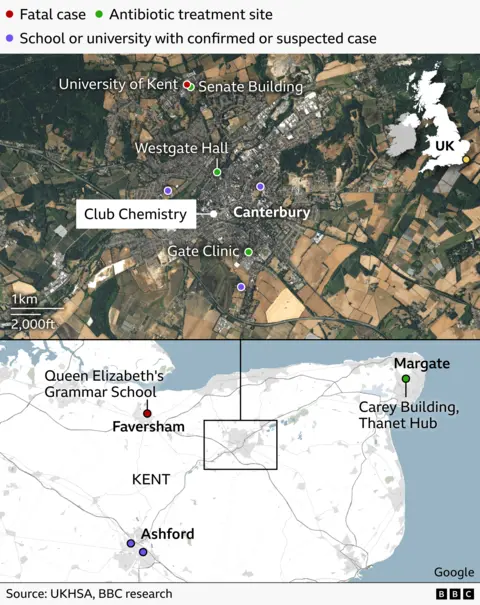
In response, a comprehensive public health campaign has been swiftly implemented. A mass vaccination programme commenced at the University of Kent, aiming to inoculate approximately 5,000 students. On the first day alone, 600 vaccines were administered, with arrangements being made for students to receive their vital second dose within the recommended timeframe. The scenes of students queuing for jabs in the sports hall, reminiscent of the Covid-19 pandemic, underscored the urgency and scale of the operation. Beyond vaccination, over 8,400 precautionary antibiotic doses have been distributed, primarily to those considered at highest risk.
The antibiotic protocol is broad: GPs nationwide have been advised to prescribe antibiotics to anyone who visited Club Chemistry between 5 and 7 March, as well as to students from the University of Kent. This aggressive pre-emptive treatment aims to prevent the disease from taking hold in individuals who may have been exposed. While the vaccine is currently prioritized for students residing on the Canterbury campus, the UKHSA has indicated that while government vaccine stocks are primarily for NHS patients, they would not rule out supplying pharmacies to meet broader demand. Indeed, pharmacies like Boots and Superdrug have already reported significant demand, implementing queuing systems and waiting lists for jabs.

The outbreak has not been confined to the University of Kent. Canterbury Christ Church University has also confirmed a case of meningococcal disease involving one of its students, Tyra Skinner, 20. Her parents shared that Tyra contracted meningitis after attending Club Chemistry. Initially presenting with flu-like symptoms and a red eye, her condition rapidly deteriorated, leading to her hospitalization at William Harvey Hospital in Ashford, where she is now stable. Her family has also taken precautionary antibiotics. Professor Rama Thirunamachandran, Vice-Chancellor and Principal of Canterbury Christ Church University, confirmed the link to the Club Chemistry cluster and assured that the campus remains open, with core activities continuing. The spread has also been noted in the wider community, with five schools in the county reporting confirmed or suspected cases, indicating the far-reaching nature of the transmission.
The situation has profoundly impacted student life and morale in Canterbury. Oliver Contreras, a 22-year-old postgraduate law student from Brighton, who was among the first to receive the vaccine, expressed regret about not having more information before attending social events. Architecture student Divine Nweze recounted his parents’ insistence on getting vaccinated, even preventing him from returning home due to concerns. Mohammed Olayinka, an economics student, described the campus as "a bit of a ghost town," noting that some students had "panicked and left," while others chose to stay for vaccination. Architecture student Sophie observed that many of her friends had fled the city, leaving their house largely empty. She, like others, was waiting for confirmation of close contact before taking antibiotics.

The national response, while centrally managed, acknowledges the localized nature of the outbreak. Health Secretary Wes Streeting clarified that while meningitis cases occur annually (around 350 nationally), the "pace and extent of the spread of the disease – that is unprecedented" in Canterbury. He underscored the proactive provision of antibiotics and rapid vaccination as extraordinary measures for an extraordinary situation. Prime Minister Sir Keir Starmer expressed his sympathy for the affected families, reiterating the government’s commitment to supporting health experts in contact tracing, antibiotic distribution, and targeted vaccination efforts.
Adding an international dimension, French authorities reported that a person admitted to hospital in France after returning from England was in a "stable" condition, underscoring the potential for broader dissemination in a highly mobile society. This highlights the global interconnectedness and the need for international vigilance in public health responses.

Meningococcal disease is a serious bacterial infection that can cause meningitis (inflammation of the membranes surrounding the brain and spinal cord) and septicaemia (blood poisoning). Symptoms can include a sudden high fever, headache, stiff neck, rash (which doesn’t fade under a glass), sensitivity to light, confusion, and drowsiness. Early diagnosis and treatment with antibiotics are critical for survival and to prevent long-term complications such as brain damage, hearing loss, or limb loss. Young adults and students living in close quarters, such as university halls of residence, are recognized as a higher-risk group due to increased social mixing, making the current outbreak particularly concerning for the student population in Kent.
As health authorities continue to monitor the situation closely, the focus remains on containing the spread, protecting vulnerable populations, and providing comprehensive care to those affected. The unprecedented nature of this outbreak serves as a stark reminder of the continuous challenges posed by infectious diseases and the vital role of robust public health infrastructure and rapid response mechanisms. The community is urged to remain vigilant for symptoms and follow all public health guidance to help mitigate further transmission.