
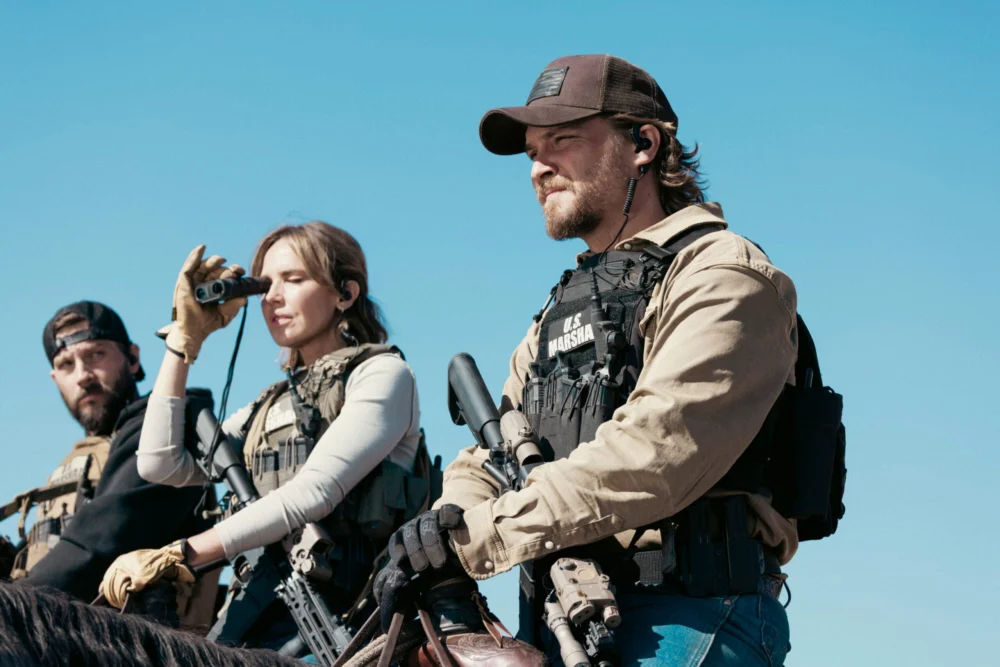
"As Kayce Dutton trades the branding iron for a federal badge, Marshals explores the thin line between frontier justice and modern law enforcement within the unforgiving landscape of the Montana wilderness."
The transition of the Yellowstone franchise into its latest iteration, Marshals, represents a pivotal shift in the "Sheridan-verse," moving beyond the immediate confines of the Dutton ranch to explore the broader implications of federal authority in the modern West. In the second episode of the inaugural season, titled “Zone of Death,” the series grapples with its identity as both a high-octane police procedural and a character-driven neo-Western. By placing Kayce Dutton—a man defined by his trauma and his loyalty to a fading way of life—into the structured, yet often explosive, world of the U.S. Marshals Service, the show tests whether the law can truly contain a man raised on the principles of frontier retribution.

A New Architect for a Familiar World
While Marshals remains firmly rooted in the world established by Taylor Sheridan, it bears the distinct fingerprints of showrunner Spencer Hudnut. Known for his work on SEAL Team, Hudnut brings a tactical, military-infused sensibility to the series that departs from Sheridan’s typical rhythmic, often eccentric dialogue. The result is a show that feels more grounded in the mechanics of modern law enforcement—procedural elements, tactical gear, and high-tech surveillance—while still maintaining the sweeping, cinematic vistas of Montana that fans have come to expect.
The premiere established Kayce Dutton (Luke Grimes) as a newly minted U.S. Marshal, a position secured through his past combat service and his connection to Pete “Cal” Calvin (Logan Marshall-Green). However, as Episode 2 unfolds, it becomes clear that the transition from ranch hand to federal agent is fraught with institutional friction. The "lone wolf" must now learn to run with a pack, a challenge that is as much about psychological adjustment as it is about professional protocol.
The Compound: A Modern Frontier Outpost
The episode introduces the Marshals’ base of operations, a facility that serves as a physical manifestation of the show’s procedural ambitions. Described as a "compound," the set design evokes a mixture of a high-end "man cave" and a tactical command center. Complete with foosball tables, punching bags, and leather couches, it reflects a fraternal, high-stakes environment where the lines between work and life are perpetually blurred.

Within this compound, we see the introduction of the technical infrastructure that supports the field agents. A "cyber room" filled with analysts evokes the aesthetic of 1990s tech-thrillers, emphasizing that modern manhunts are won as much with keyboards as they are with revolvers. Kayce, however, is explicitly told that his role is that of the "gunslinger." This distinction is vital; the agency recognizes Kayce’s utility not as an investigator, but as a kinetic force—a weapon to be pointed at the state’s most dangerous elements.
The Institutional Tension: Harry Gifford and the Dutton Baggage
The integration of Kayce Dutton into the U.S. Marshals is not met with universal acclaim. Harry Gifford (Brett Cullen), the veteran Marshal in charge, represents the institutional skepticism toward the Dutton family. Gifford, a traditionalist who wears his cowboy hat with a sense of seasoned authority, views Kayce as a liability draped in "unwanted baggage."
The tension stems from the very history that makes Yellowstone so compelling. The state’s two largest cold cases—the assassination of patriarch John Dutton III and the mysterious disappearance of Jamie Dutton—loom over Kayce like a shadow. While the audience knows the grim reality of Jamie’s fate (murdered by his sister Beth and disposed of in the "Zone of Death" by Rip Wheeler), the official record remains a blank slate. Gifford correctly identifies that having a Dutton on the force while the family is at the center of multiple federal and state inquiries is a recipe for conflict of interest, if not outright corruption.

The "Zone of Death": A Legal and Moral Vacuum
The episode’s title and central set piece revolve around the "Zone of Death," a concept inspired by a real-world legal loophole involving a 50-square-mile uninhabited stretch of Yellowstone National Park. In this area, due to a quirk in the U.S. Constitution and the boundaries of federal districts, it is theoretically impossible to impanel a jury for a trial, potentially allowing crimes to go unpunished.
In Marshals, this geographic anomaly serves as the backdrop for a high-stakes drug bust. The agency is called in to intercept a fentanyl transaction between two unlikely allies: the Latin 406 Royals and an Aryan Brotherhood faction. This alliance of convenience highlights the desperate and transactional nature of the modern drug trade in rural America.
The ensuing shootout is a showcase for Hudnut’s tactical direction. Moving away from the chaotic brawls of the ranch, the action here is characterized by precision sniping, advanced ballistics, and coordinated movement. Belle Skinner (Arielle Kebbel), the unit’s leader, and Andrea Cruz (Ash Santos) demonstrate the lethal efficiency required of modern agents. However, the sequence also highlights the show’s reliance on "suspension of disbelief," as the level of ordnance and explosive violence depicted far exceeds the typical daily operations of the actual U.S. Marshals Service.

Frontier Justice in a Federal Uniform
The climax of the episode reinforces the idea that while Kayce Dutton may wear a badge, his moral compass remains calibrated to the Montana wilderness. When a member of the Aryan Brotherhood attempts to flee in an SUV, Kayce pursues him on horseback—a visual bridge between the old world and the new.
The chase ends not with a standard arrest, but with a fiery explosion and an execution. After Kayce’s shot causes the vehicle to detonate, he confronts the surviving suspect. In a moment that mirrors the brutal pragmatism of his father, Kayce ignores federal protocol. When the suspect pleads for mercy to avoid a slow, painful death, Kayce provides it with a single bullet to the head.
This act of extrajudicial killing marks a significant turning point for the series. It suggests that Marshals is not interested in being a standard "hero cop" show. Instead, it is exploring the corruption of the badge by the man wearing it. Kayce’s willingness to act as judge, jury, and executioner suggests that the "Dutton way" is an infectious force, one that threatens to undermine the very legal structures he has sworn to uphold.

The Personal Cost: Tate and the Necklace
Despite the adrenaline of the field, the episode anchors itself in the domestic tragedy of the Dutton family. Kayce’s return to the ranch brings him face-to-face with his son, Tate, who is struggling to find a "new beginning" in the wake of the family’s various collapses.
The closing moments, featuring Monica’s necklace—a simple string holding a piece of metal—serve as a poignant reminder of what has been lost. As Kayce clutches the necklace on his patio, it is clear that his move into law enforcement is not an escape from his past, but a continuation of it. He is a man holding onto fragments of a broken life, trying to find purpose in a world that increasingly demands he choose between his family’s legacy and the requirements of the law.
Conclusion: The Future of the Extension
As Marshals moves forward, its success will depend on its ability to balance these two disparate worlds. It must satisfy fans of the "Sheridan-verse" who crave the operatic drama of the Dutton family while also appealing to a broader audience that enjoys the reliable rhythms of a network procedural.

"Zone of Death" proves that the show is capable of delivering high-quality action and maintaining the aesthetic DNA of its predecessor. However, the real intrigue lies in the character of Kayce Dutton. If he continues to operate as a "gunslinger" who ignores the rules of engagement, Marshals will become a fascinating study of how a man’s history can eventually overwhelm his future, no matter what title he holds. The skeletons in the Dutton closet are not just staying buried; they are being joined by new ones, minted under the authority of the United States government.