
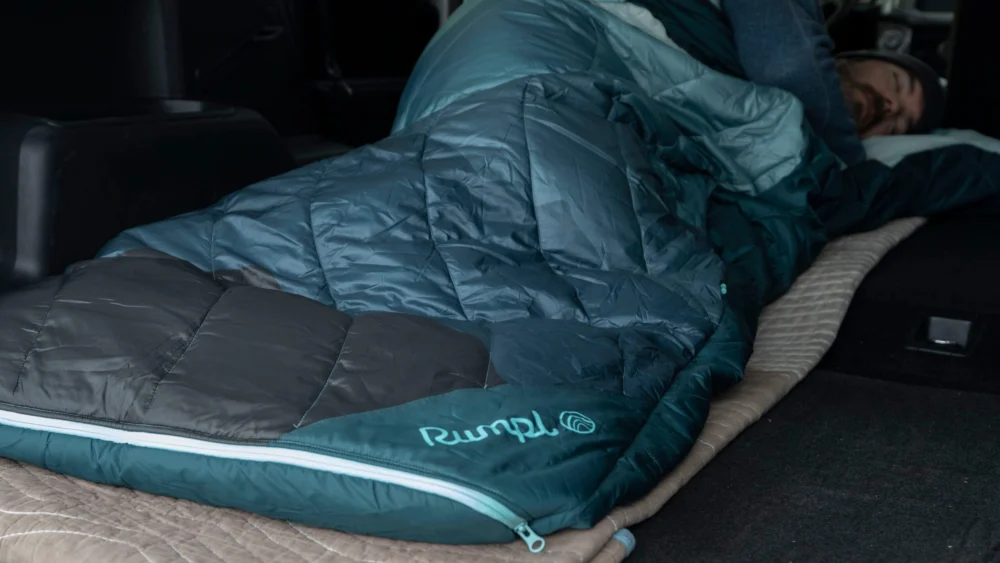
"The Rumpl Wrap Sack transcends the restrictive boundaries of traditional mummy bags by employing a modular ‘WrapAdapt’ design that offers three distinct levels of thermal regulation for multi-season utility."
As the outdoor industry shifts toward gear that emphasizes versatility and user-specific comfort, the Rumpl Wrap Sack 20° Sleeping Bag has emerged as a significant departure from conventional sleeping bag architecture. Recognized as a standout selection in the 2025 Men’s Health Outdoor Awards, this hybrid sleep system addresses a long-standing grievance among campers: the "all-or-nothing" nature of thermal insulation. By integrating the freedom of a camp quilt with the security of a zippered bag, Rumpl has created a solution tailored for car campers who prioritize sleep quality and adaptability over the ultralight constraints of backcountry trekking.
The Problem with Traditional Sleeping Bag Design
For decades, the outdoor market has been dominated by two primary silhouettes: the rectangular bag and the mummy bag. While rectangular bags offer ample room, they are notoriously inefficient at retaining heat due to the large volume of empty air the body must warm. Conversely, mummy bags are thermally efficient but notoriously restrictive, often creating a "claustrophobic" experience for side sleepers, stomach sleepers, or those who frequently shift positions during the night.
Furthermore, traditional bags are typically rated for a narrow temperature window. A bag designed for a 20°F winter night is often too cumbersome and stifling for an 80°F summer evening, while a lightweight summer bag offers zero protection during the shoulder seasons. Campers have traditionally attempted to solve this with camp quilts, which offer better ventilation but often lack the structural integrity to keep drafts out during true cold-weather excursions.

The WrapAdapt Innovation
The Rumpl Wrap Sack introduces the "WrapAdapt" system, a dual-flap design that functions similarly to a wrap or a tortilla. This design allows the user to customize their insulation level based on the ambient temperature. In its most open configuration, both flaps can be pushed aside, providing maximum ventilation for warm summer nights. As the temperature drops, the user can fold a single flap over themselves for moderate warmth, suitable for spring or autumn. For maximum heat retention in temperatures approaching 20°F, both flaps are folded over the sleeper and secured with a side zipper.
To ensure that these flaps stay in place, Rumpl integrated its proprietary Cape Clip snap closure system. This prevents the "quilt slide" common in traditional open-bed systems, where movement during the night causes the insulation to shift, exposing the sleeper to cold air. This modularity allows the Wrap Sack to function effectively across three seasons, and even into mild winters, without the need for multiple bags.
Technical Specifications and Material Science
The Wrap Sack is built with a sophisticated blend of synthetic insulations. It utilizes RenewaLoft on the outer layers and NanoLoft on the inner sections. NanoLoft is particularly notable in the industry for its ability to mimic the structure of down feathers; it consists of tiny circular clusters of fiber that trap heat more effectively than traditional continuous-filament synthetics. This combination provides a "loft" that feels premium while maintaining the benefits of synthetic insulation, such as the ability to retain warmth even when damp—a critical factor for camping in humid or snowy environments.
The shell is constructed from 30-denier (30D) ripstop polyester. In the world of textiles, denier refers to the thickness of the fibers. While 30D is lightweight and offers a "buttery soft" hand-feel that mimics home bedding, it is thinner than the heavy-duty canvases or high-denier nylons found on some ruggedized car-camping bags. This choice emphasizes comfort and skin-feel, though it requires the user to be mindful of sharp objects or abrasive surfaces.
Real-World Performance: From Nevada to New Hampshire
Field testing of the Wrap Sack highlights the distinction between "comfort" ratings and "lower limit" ratings. In a weeklong winter car-camping test in Nevada, with temperatures hovering around 30°F, the bag performed optimally. At 82 inches tall and 35 inches wide, the interior volume provided sufficient space for "flipping and flopping"—a necessity for active sleepers who find mummy bags too confining. The inclusion of a dedicated pillow pocket in the hood, designed to fit the Rumpl Camp Pillow, further enhanced the "at-home" sleep experience.

However, a secondary test in New Hampshire, where temperatures plummeted into the teens, pushed the bag beyond its advertised 20°F limit. In these conditions, the limitations of the synthetic fill and the modular flap design became apparent. While the bag is rated to 20°F, this is often considered the "survival" or "lower limit" rather than the "comfort" limit for most sleepers. For temperatures dropping below 20°F, additional layers or an external camp quilt are necessary to maintain core temperature. This underscores the Wrap Sack’s identity as a robust three-season bag rather than a dedicated deep-winter expedition tool.
Portability and Target Demographic
It is essential to categorize the Wrap Sack correctly within the gear landscape. Weighing in at five pounds and packing into a 27-liter stuff sack (approximately 17.25 x 11 inches), it is not intended for backpacking. For hikers covering ten miles a day with a pack, every ounce is scrutinized, and a five-pound sleep system would be considered prohibitively heavy.
Instead, the Wrap Sack is squarely aimed at "front-country" or car campers. For those sleeping in the back of an SUV, a van, or a large tent near their vehicle, the weight and bulk are negligible compared to the benefits of a spacious, versatile sleep system. It caters to the "glamping" movement and the growing demographic of outdoor enthusiasts who refuse to sacrifice sleep quality for the sake of being outdoors.
Critical Considerations
Despite its innovations, the Wrap Sack is not without minor engineering hurdles. The primary critique involves the side zipper. Because the 30D polyester shell is exceptionally soft and the insulation is "fluffy," the fabric has a tendency to snag in the zipper teeth. While not a structural failure, it requires a level of deliberate care when entering or exiting the bag, especially in the dark.
Additionally, while the 30D shell is a boon for comfort, its long-term durability in rugged environments remains a point of observation. Users who camp with pets or in environments with high abrasive potential (like desert sand or rocky outcrops) should treat the fabric with the same care they would a high-end down jacket.

The Future of Modular Sleep Systems
The success of the Rumpl Wrap Sack suggests a shift in the market. As consumers look for more value and utility from their purchases, the idea of a "specialist" bag that only works in one temperature range is becoming less appealing. The industry is already seeing a trend toward "quilt-bag hybrids," and Rumpl’s WrapAdapt design is at the forefront of this movement.
The Wrap Sack is a deceptively simple solution to the age-old problem of camp comfort. By prioritizing the ergonomics of movement and the physics of heat regulation through modular flaps, Rumpl has created a product that feels less like a piece of survival equipment and more like a high-performance bed for the wilderness. For the car camper, van-lifer, or backyard adventurer, it offers a compelling balance of warmth, space, and versatility that traditional bags struggle to match. As outdoor gear continues to evolve, the Wrap Sack stands as a benchmark for how brands can innovate by simply rethinking the way we wrap ourselves up at night.