
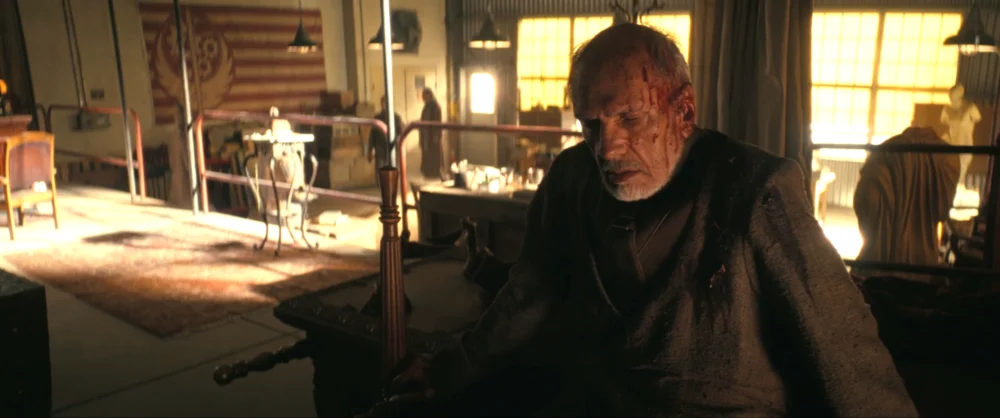
"As the Brotherhood of Steel transitions from a fractured religious order to a fascist juggernaut under Quintus the Destroyer, the reveal of the Liberty Prime Alpha signals a shift from localized survival to total ideological warfare across the American Wasteland."
The Season 2 finale of Prime Video’s Fallout, titled "The Strip," serves as both a narrative anchor and a high-octane propellant for the series’ future. By weaving together the disparate threads of Lucy MacLean’s family tragedy, Cooper Howard’s centuries-old quest for his family, and the Brotherhood of Steel’s descent into extremist militancy, the episode establishes a new status quo where the stakes are no longer merely about individual survival, but the very soul of what remains of civilization.
The Evolution of the Wasteland Narrative
Television finales often struggle to balance the need for closure with the necessity of anticipation. Fallout Season 2 manages this by providing definitive end-points for several character arcs while simultaneously broadening the scope of the world. Throughout its sophomore run, the series has excelled at making the post-apocalyptic landscape feel like a lived-in, breathing entity. We have followed Lucy (Ella Purnell), The Ghoul (Walton Goggins), and Maximus (Aaron Moten) across a landscape defined by radiation and regret, but "The Strip" suggests that the spotlight is about to expand even further.
The brilliance of the show’s structure lies in its ability to pivot. While the central trio remains the emotional heart of the story, the finale demonstrates that the Fallout universe is vast enough to support a geopolitical thriller. The transition from the desert wastes to the neon-drenched remnants of New Vegas signifies a shift in tone—from the "frontier" feel of the early episodes to a more complex, faction-based conflict.

Cooper Howard and the Ghost of Pre-War Politics
One of the most compelling aspects of the finale is the resolution of Cooper Howard’s flashback narrative. For two seasons, viewers have watched the slow-motion car crash of Cooper’s life as he realized the depth of Vault-Tec’s depravity. In "The Strip," we see the final nail in the coffin of his pre-war identity. His encounter with a sinister U.S. President, played with chilling gravitas by Clancy Brown, highlights the show’s underlying theme: the apocalypse wasn’t just an accident of history, but a calculated move by those in power.
Cooper’s eventual "fall" and his separation from his wife, Barb (Frances Turner), and daughter set the stage for his 200-year transformation into The Ghoul. In the present day, his reunion with a now-robotic Mr. House (Justin Theroux) provides the necessary bridge between the old world and the new. The revelation that Barb and his daughter may be in Colorado—rather than a standard vault—gives The Ghoul a renewed sense of purpose. He is no longer just a cynical bounty hunter; he is a father on a trail that has been cold for two centuries.
The Tragedy of Lucy and the Survival of Hank
Lucy MacLean’s journey has been one of radical disillusionment. She began the series as a "Vaultie" with a naive belief in the "Golden Rule," only to discover that her father, Hank (Kyle MacLachlan), was a primary architect of the world’s destruction. The finale brings this conflict to a head in a way that is both satisfying and narratively clever.
By having Hank wipe his own memories to escape the immediate consequences of his actions, the show creates a unique dynamic for Season 3. Hank remains alive, preserving Kyle MacLachlan’s presence on the show, but he is no longer the man Lucy once knew. This "brain wipe" serves as a metaphor for the way the powerful attempt to escape their history. Lucy, meanwhile, has fully shed her Vault 33 skin, teaming up with The Ghoul to hunt down the truth in a world that has finally broken her spirit, but not her resolve.
Maximus and the Brotherhood’s Descent
Maximus remains the most conflicted of the protagonists. His reunion with Lucy provides a rare moment of genuine romance in an otherwise bleak landscape, but their happiness is overshadowed by the looming shadow of the Brotherhood of Steel. While Maximus has found a sense of morality through his relationship with Lucy, the organization he serves has moved in the opposite direction.

The Brotherhood of Steel has always occupied a gray area in Fallout lore—somewhere between protectors of technology and religious zealots. However, under the leadership of Quintus (Michael Cristofer), the order is shedding its remaining vestiges of altruism. The finale introduces "Quintus the Destroyer," a man who has abandoned the pretense of "uniting" the wasteland in favor of absolute fascist control.
The Reveal: What is the Liberty Prime Alpha?
The most significant "seed" planted for Season 3 is the reveal of the Liberty Prime Alpha blueprints. For fans of the Fallout video games, specifically Fallout 3 and Fallout 4, this name carries immense weight.
Liberty Prime was originally conceived by the United States military and General Atomics before the Great War. Standing 40 feet tall, the robot was designed to be the ultimate weapon against the "communist threat," equipped with devastating eye-beams and a supply of Mark 28 nuclear bombs that it could hurl like footballs. However, the pre-war government could never solve the robot’s power-consumption issues, leaving it dormant beneath the ruins of the Pentagon for centuries.
In the games, the Brotherhood of Steel eventually recovers and powers the robot, using it to decimate their enemies while it shouts canned, McCarthy-era anti-communist slogans like "Democracy is non-negotiable!" and "Better dead than Red!"
The introduction of the "Alpha" version in the show suggests that Quintus has found a way to bring this titan of destruction back to life. If the Brotherhood manages to operationalize a 40-foot-tall, nuclear-armed robot, the balance of power in the Wasteland will be permanently shattered. It transforms the Brotherhood from a faction with superior armor into an unstoppable superpower capable of leveling entire cities in minutes.

A New Theater of War: Caesar’s Legion and the NCR
The introduction of Liberty Prime Alpha is not the only threat looming on the horizon. The finale also teases the arrival of Lacerta Legate, played by Macaulay Culkin, who has declared himself the new Caesar of Caesar’s Legion. This introduces a third major faction into the television mythos.
The Legion is historically the antithesis of the Brotherhood; where the Brotherhood relies on advanced technology, the Legion relies on brutal, Roman-inspired slave labor and sheer numbers. Between the Brotherhood’s technological terror, the Legion’s expansionist brutality, the remnants of the New California Republic (NCR), and the shadowy machinations of the Enclave, Season 3 is positioning itself as a story of all-out war.
Conclusion: The Stakes of Season 3
Fallout has successfully navigated the difficult transition from a "monster-of-the-week" survival story to a sprawling epic about the ideologies that survive the end of the world. By the end of "The Strip," our heroes are scattered, but their paths are more defined than ever.
The Liberty Prime Alpha represents more than just a giant robot; it represents the return of the same hubris and militarism that destroyed the world in 2077. As Quintus prepares to unleash this "Destroyer" upon the Wasteland, Lucy and The Ghoul’s journey to New Vegas will likely put them at the epicenter of a conflict that could finish what the Great War started. In the world of Fallout, war never changes—but with a 40-foot robot in the mix, it’s about to get much more explosive.
