
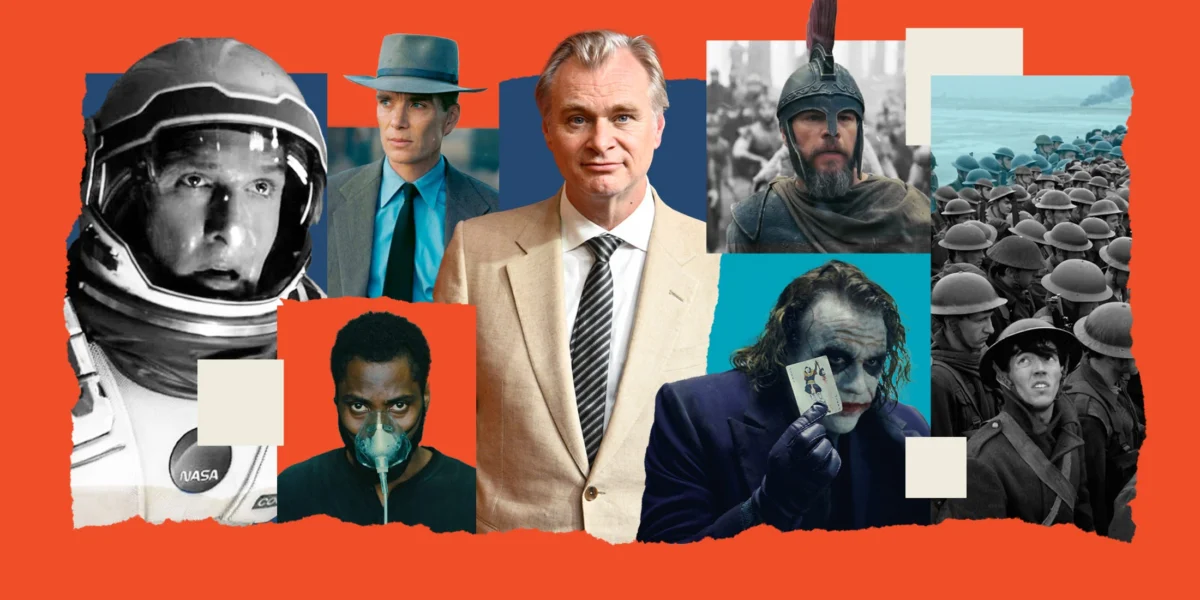
"Christopher Nolan’s filmography represents a masterclass in the manipulation of temporal perspective, proving that high-concept intellectualism can thrive within the grandest scale of global blockbuster spectacle. By treating the medium of cinema as a literal magic trick, Nolan has redefined the boundaries between the experimental and the mainstream."

The following analysis explores the evolution of a filmmaker who has spent nearly three decades reinventing the structural possibilities of the silver screen. From his origins in low-budget neo-noir to his current status as the architect of the modern historical epic, Nolan’s work is characterized by a relentless obsession with time, memory, and the subjective nature of reality. This ranking assesses his body of work not merely by box office success or cultural ubiquity, but by how effectively each film marries technical innovation with narrative depth, culminating in a legacy that has transformed the superhero genre, the biopic, and the science fiction landscape.

The Foundation: Low-Budget Origins and Studio Transitions
The journey of Christopher Nolan began not with a bang, but with a whisper in the form of Following (1998). Ranked at thirteen, this debut film was a bootstrap production, shot in black and white on 16mm film during weekends when the cast and crew were off from their day jobs. While it lacks the polish of his later multimillion-dollar ventures, Following serves as the essential blueprint for the Nolan "identity." It introduced his fascination with the "disjointed" man—a protagonist obsessed with a specific task—and a non-linear structure that rewards active viewership. It is the rawest form of his craft, where the limitations of budget forced a reliance on pure narrative ingenuity.

Moving from the fringe to the mainstream, Insomnia (2002), holding the twelfth spot, represents Nolan’s entry into the Hollywood studio system. A remake of a 1997 Norwegian film, it remains the most "traditional" entry in his filmography. Starring Al Pacino as a compromised detective and Robin Williams in a chillingly against-type role as a manipulative killer, the film excels as a high-stakes psychological thriller. While it lacks the "mind-bending" flourishes that would later become Nolan’s calling card, its mastery of atmosphere—specifically the oppressive, never-ending daylight of the Alaskan summer—showcases his ability to use environment as a psychological weapon.

The Superhero Revolution: The Dark Knight Trilogy
Christopher Nolan’s most significant cultural impact arguably resides in his reimagining of the Caped Crusader. The Dark Knight Rises (2012), ranked eleventh, was the ambitious, if occasionally overstuffed, conclusion to the trilogy. While it boasts some of the most impressive practical stunts in modern cinema—including the mid-air plane hijacking—the film suffers from a bloated narrative compared to its predecessors. However, its emotional resonance cannot be denied; the film’s final moments provide a rare sense of closure for a character usually destined for eternal conflict.

At number ten, Batman Begins (2005) is the film that saved the superhero genre from the camp and kitsch of the late 1990s. Nolan approached the source material with a grounded, "tactile" realism that had never been applied to a comic book adaptation. By focusing on the psychological trauma of Bruce Wayne and the philosophical underpinnings of fear, Nolan elevated the origin story into a serious cinematic endeavor. It proved that a director could maintain their artistic integrity while operating within the confines of a massive franchise.

The pinnacle of this era, and perhaps the most influential film of the 21st century, is The Dark Knight (2008), which earns the number two spot. It is frequently cited as the greatest superhero film ever made, but it is, in truth, a sprawling urban crime epic that happens to feature a man in a bat suit. Heath Ledger’s Joker remains a transformative performance, a chaotic force of nature that challenged the very foundations of the blockbuster villain. The film’s influence was so pervasive that it triggered a decade of "dark and gritty" reboots across Hollywood, few of which could match its perfect pacing and thematic density.

The Psychology of Memory and Perspective
Between his Batman entries, Nolan explored the fragility of the human mind. Memento (2000), ranked ninth, was the film that announced his arrival on the world stage. By telling a story of revenge in reverse, Nolan forced the audience to experience the short-term memory loss of its protagonist, Leonard Shelby. It is a masterpiece of structural engineering, a puzzle that requires the viewer to assemble the narrative alongside the character.

Nolan’s fascination with the subjective experience of time reached a fever pitch in Dunkirk (2017), holding the eighth position. Here, Nolan stripped away the traditional "war movie" tropes—backstories, political context, and gore—to focus on the visceral sensation of survival. By intercutting three different timelines (one week on the beach, one day on the sea, and one hour in the air), he collapsed time into a singular, sustained moment of suspense. It is a triumph of form over dialogue, relying on Hans Zimmer’s ticking score and breathtaking IMAX visuals to tell a story of collective heroism.

High-Concept Spectacle: Dreams, Space, and Inversion
As Nolan’s budgets grew, so did his narrative ambitions. Interstellar (2014), at number seven, is perhaps his most polarizing work. While critics often point to its nearly three-hour runtime and occasionally sentimental dialogue regarding "love as a dimension," the film’s visual and emotional scale is undeniable. It is a rare "hard" sci-fi epic that prioritizes scientific accuracy (collaborating with Nobel laureate Kip Thorne) while maintaining a heart-wrenching father-daughter story at its core.

Inception (2010), ranked sixth, is Nolan’s "heist movie in the mind." It is a feat of world-building that manages to explain complex "dream logic" without ever slowing down its breakneck pace. By blending a devastating tale of grief with high-octane espionage, Nolan created a film that is as emotionally resonant as it is intellectually stimulating. It remains a cultural touchstone, particularly for its ambiguous final shot that continues to spark debate over a decade later.

At number five is Tenet (2020), Nolan’s most ambitious and technically demanding project to date. While the mechanics of "temporal inversion" are notoriously difficult to grasp on a first viewing, the film represents the peak of Nolan’s commitment to practical filmmaking. From crashing a real Boeing 747 to filming elaborate fight sequences that occur simultaneously forward and backward in time, Tenet is an invigorating, sensory-overload experience that demands to be seen on the largest screen possible.

The Modern Masterpieces and Future Horizons
The top of the list features films that represent the absolute distillation of Nolan’s genius. Oppenheimer (2023), at number three, is the definitive biopic of the nuclear age. It is a haunting, masterful portrait of J. Robert Oppenheimer, the man who gave humanity the means to destroy itself. Sweeping the Oscars and grossing nearly $1 billion, it proved that audiences are still hungry for adult-oriented, intellectually rigorous cinema. Cillian Murphy’s performance, supported by an elite ensemble cast, anchors a film that is as much a courtroom drama as it is a psychological horror story.

Looking ahead, The Odyssey (2026) ranks at number four. This upcoming adaptation of Homer’s epic represents Nolan’s next great frontier. By taking one of the oldest stories in human history and applying his signature IMAX-scale spectacle and non-linear narrative, Nolan is set to redefine the "sword and sandal" genre. With a cast led by Matt Damon and Anne Hathaway, it promises to be a massive undertaking that explores the themes of homecoming and endurance through a modern, high-concept lens.
Finally, the number one spot belongs to The Prestige (2006). While it may not have the global footprint of The Dark Knight or the historical weight of Oppenheimer, it is the most "Nolan" of all Christopher Nolan movies. A period drama about two rival magicians, the film is itself a magic trick. It utilizes disjointed plotting and deception to manipulate the viewer’s attention, leading to a finale that is both shocking and inevitable. There is "no fat on the bone" in The Prestige; every line of dialogue and every camera angle is a clue in a grander design. It is a film about the obsession required to create art, and in that sense, it is the most personal reflection of the director himself.

Christopher Nolan’s body of work stands as a testament to the idea that cinema can be both a puzzle and a spectacle. By consistently challenging his audience to think while they watch, he has secured his place as the preeminent filmmaker of his generation, one who views time not as a linear progression, but as a canvas to be stretched, folded, and reinvented.
