
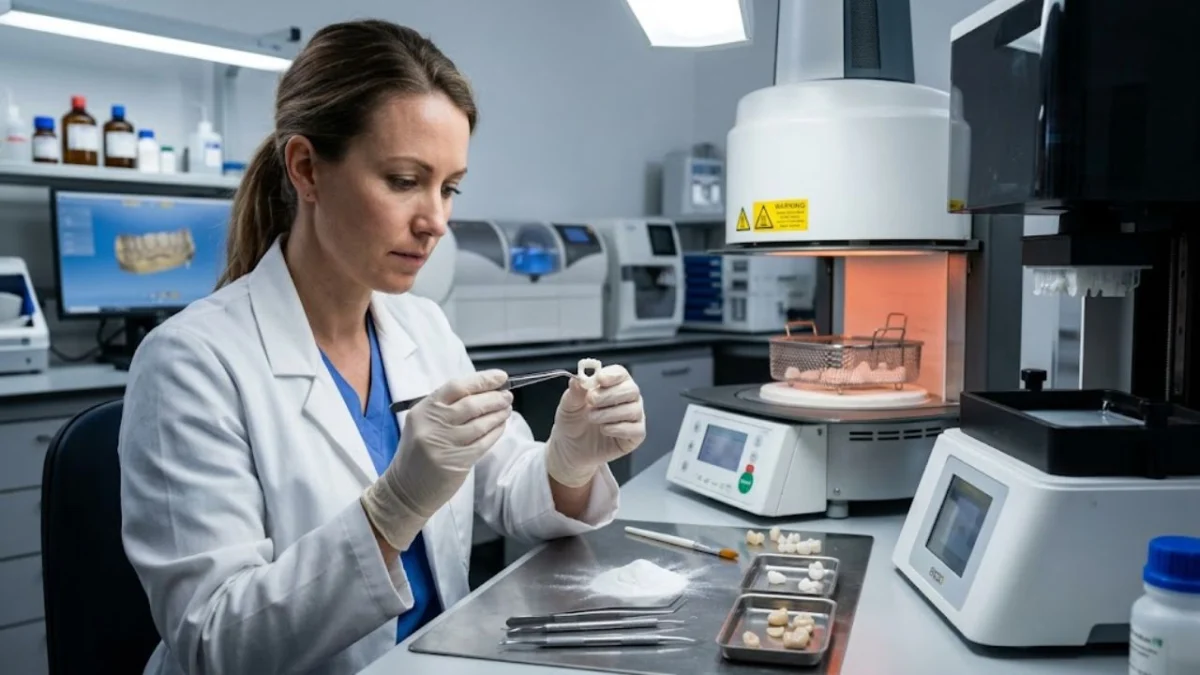
"Engineers have dramatically slashed the time needed to produce 3D-printed zirconia dental crowns, overcoming a critical manufacturing bottleneck that has historically prevented their widespread use for same-day permanent restorations."
For decades, the process of crafting a permanent dental crown has been a multi-week endeavor, often involving temporary restorations and multiple appointments. This extended timeline is not a reflection of dental professional efficiency but rather a consequence of complex laboratory procedures. A key step in creating crowns from advanced materials like zirconia, the industry standard for permanent dental work, involves a lengthy and delicate thermal process. Now, researchers at the University of Texas at Dallas have achieved a significant breakthrough, reducing a process that once took up to 100 hours to under 30 minutes, paving the way for same-day permanent zirconia crowns. This advancement, detailed in the September 2025 print edition of Ceramics International and publicly announced in October, directly addresses the primary obstacle that has kept printed zirconia from becoming a staple in dental practices.
While same-day dental crowns are not a new concept, the ability to produce them from printed zirconia, the material preferred for its durability and aesthetic properties in permanent restorations, has remained elusive. Current same-day crown technologies primarily rely on chairside milling of solid zirconia blocks or the printing of resin-based ceramics, which, while faster, do not match the strength and longevity of fully sintered zirconia. The innovation from UT Dallas focuses on optimizing the debinding stage, a crucial thermal step in the 3D printing of ceramic dental restorations.
The Debinding Bottleneck: A Slow Burn for Strength
The process of 3D printing a dental crown, particularly with zirconia, begins by creating a composite object. This object consists of fine zirconia particles suspended within a light-cured resin binder. Before the zirconia particles can be fused into a solid, monolithic ceramic structure, this resin binder must be completely removed. This removal process, known as debinding, is achieved through heat. However, it has historically been the most time-consuming and technically challenging step.
Dr. Majid Minary, a professor of mechanical engineering at UT Dallas and the corresponding author of the study, explained in a university announcement that "Debinding has been the bottleneck in the process." He elaborated on the critical nature of this step: "It must be done very slowly. If you speed it up, the polymer being burned off turns into gas, and if that gas cannot escape, the crown may crack or fracture." This slow, controlled burn-out of the resin is essential to prevent internal pressure buildup and subsequent structural damage to the delicate printed green part.
Conventional debinding processes can take anywhere from 20 to 100 hours. This extensive duration renders it impractical for same-day dental services, which typically require a complete chairside workflow. Consequently, permanent dental restorations made from 3D-printed zirconia have not yet entered the commercial market. Following debinding, a second thermal step, sintering, is required to fuse the zirconia particles together at high temperatures, further solidifying the crown into its final, robust form. This sintering process also requires significant time, adding to the overall manufacturing delay.
A Novel Thermal Protocol for Accelerated Debinding
The breakthrough achieved by the UT Dallas research team lies not in a new material but in an innovative thermal protocol. Their method utilizes porous graphite felt, a material capable of withstanding temperatures exceeding 2,550 degrees Fahrenheit, to envelop the printed zirconia restoration. This specialized felt serves a dual purpose: it transfers heat efficiently and directly into the printed part, and its inherent porosity allows the gaseous byproducts of the burning resin to escape.
The porosity of the graphite felt is the key enabler of accelerated debinding. As the resin binder burns off and turns into gas, it can readily diffuse through the felt’s open structure. Simultaneously, a vacuum system is employed to actively draw the gases away from the restoration. This combination of rapid, direct heat transfer and efficient gas evacuation prevents the buildup of internal pressure that plagued earlier methods. By eliminating the risk of cracking or fracturing, the debinding process can be dramatically accelerated.
"The combination of all of these features is what makes it work," stated Dr. Minary. He further indicated that this optimized process could enable dental practitioners to deliver a chairside printed zirconia crown within a matter of hours, rather than days or weeks. The first author of the research is doctoral student Mahdi Mosadegh, with significant contributions from collaborators including Pan-AM Dental Laboratory, 3DCeram Sinto Inc., and prosthodontist Amirali Zandinejad. This pioneering work has garnered substantial support, including a $550,000 National Science Foundation award aimed at facilitating commercialization, with additional backing from the U.S. Air Force Office of Scientific Research.
Comparing Technologies: Milling vs. Printing for Same-Day Solutions
The advent of same-day dental crowns has already transformed patient care, but the options have been limited. Current chairside milling systems, which carve a crown from a solid block of zirconia, offer speed and convenience. However, these systems come with inherent trade-offs. Material waste is a significant concern, as the milling process can discard a considerable amount of the zirconia block. Furthermore, the achievable geometric complexity can be restricted, and there is a risk of micro-cracking during the aggressive milling or subsequent sintering processes, potentially compromising the long-term durability of the restoration.
3D-printed same-day crowns do exist, but they are typically fabricated from resin-based ceramics. While offering intricate design possibilities, these materials are generally not as strong or wear-resistant as traditional sintered zirconia, making them less ideal for permanent restorations that need to withstand the rigors of chewing and biting forces over many years.
The promise of printed zirconia lies in its potential to combine the design freedom and material efficiency of 3D printing with the superior mechanical properties of zirconia. An in vitro comparison of 20 crowns, published in Dentistry Journal, found printed zirconia crowns to be comparable to milled crowns in terms of internal fit and marginal adaptation. The study indicated that printed crowns exhibited greater overall precision and superior accuracy on occlusal (biting surface) and axial (side) surfaces. Conversely, milled crowns demonstrated greater accuracy on the fitting surface that interfaces directly with the prepared tooth. This suggests that printed zirconia may offer nuanced advantages in terms of detailed reproduction and material utilization.
The Road Ahead: Clinical Validation and Regulatory Hurdles
Despite the significant manufacturing advancement, the widespread adoption of chairside printed zirconia crowns is still some way off. The UT Dallas team has been explicit that their novel debinding method will require rigorous clinical validation and regulatory approval from bodies such as the Food and Drug Administration (FDA) before it can be made available to the public. The current research addresses a critical manufacturing challenge, but it does not provide direct evidence of how these restorations will perform in real-world clinical conditions over extended periods, particularly in terms of their ability to withstand the dynamic forces of chewing.
A short-term pilot study involving 15 patients followed for 24 weeks provided some initial insights. While the study reported no deterioration of periodontal tissues around the restored teeth, one tooth was unfortunately extracted due to a vertical root fracture. While this is a starting point for understanding clinical performance, 15 patients over a six-month period is insufficient to establish a robust evidence base for the long-term efficacy and safety of printed zirconia crowns.
Another practical consideration is the equipment infrastructure required for chairside printing. Implementing this technology would necessitate dental offices investing in specialized 3D printers, debinding furnaces, and sintering furnaces, along with comprehensive training for their staff. This represents a different operational model compared to the current practice of sending digital scans to external dental laboratories for fabrication.
Market Demand and Future Outlook
The demand for dental crowns is substantial and projected to remain high. Crowns are essential for restoring damaged or decaying teeth and serve as anchors for dental bridges. The prevalence of tooth loss, particularly among older adults, underscores the ongoing need for effective and durable restorative solutions. According to CDC survey data, approximately one in five adults aged 75 and older have lost all of their natural teeth, highlighting a significant patient population that could benefit from advanced restorative options.
For the foreseeable future, patients seeking dental crowns should continue to expect the established multi-appointment process, involving temporary restorations and a second visit for the permanent crown placement. It is advisable for patients to discuss material choices and the latest technological advancements with their dentists, rather than anticipating the immediate availability of technologies that have not yet completed the necessary clinical trials and regulatory approvals. The breakthrough in debinding technology represents a significant leap forward in the potential for same-day permanent zirconia crowns, but the journey from laboratory innovation to widespread clinical application still involves crucial steps of validation and regulatory oversight.
