
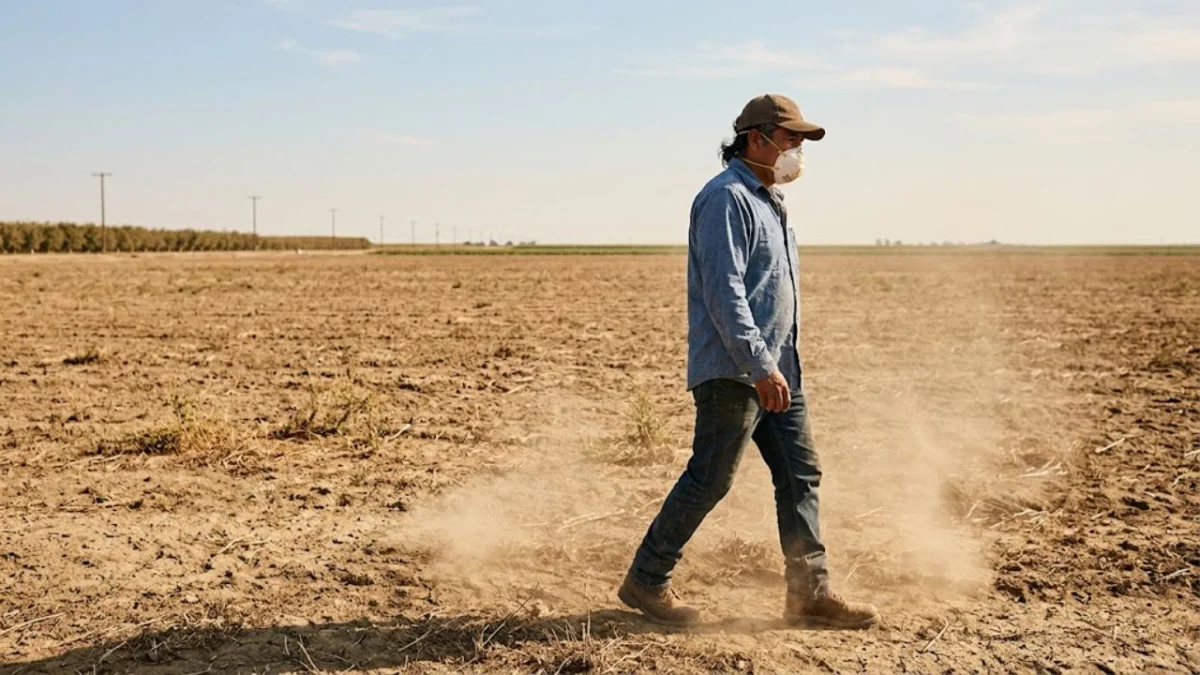
"As California reshapes its agricultural map due to drought and regulation, a new study reveals a concerning link between dry natural landscapes, certain farmland practices, and increased rates of Valley fever in nearby communities, highlighting an often-overlooked public health cost."
A groundbreaking study published in Science Advances by researchers at UC San Diego and UC Berkeley has unveiled a significant, yet often unacknowledged, public health consequence of California’s evolving agricultural and environmental landscape: a heightened risk of Valley fever in communities situated near specific types of natural vegetation and farmland. This research emerges at a critical juncture as the state grapples with the multifaceted impacts of drought, warming temperatures, and stringent groundwater regulations, which are collectively pushing substantial acreage out of active agricultural production. The findings suggest that the transition of land, particularly the practice of fallowing fields, carries a public health burden that demands consideration alongside the well-documented environmental and economic ramifications. While the study meticulously identifies associations, it emphasizes that the precise causal links between specific land use changes and a measured increase in disease cases are complex and require further investigation.
Land Use Patterns and Valley Fever Incidence: Unpacking the Associations
The research meticulously analyzed 65,657 confirmed Valley fever cases reported to the California Department of Public Health between April 2008 and March 2021, focusing on 20 counties where the disease is endemic. By integrating patient residential data with high-resolution geographical information on natural vegetation, crop types, and fallowed fields, the study controlled for crucial confounding factors such as climate, elevation, socioeconomic status, and local employment in agriculture and construction.
A striking pattern emerged: communities surrounded by greater expanses of shrubland, barren land, and grassland exhibited higher rates of Valley fever. Shrubland, in particular, demonstrated the strongest statistical association with increased disease incidence. Researchers propose two non-mutually exclusive explanations for this phenomenon. Firstly, these arid and semi-arid landscapes may naturally provide soil conditions conducive to the growth and proliferation of Coccidioides, the fungus responsible for Valley fever. Secondly, and perhaps more directly, these environments with sparse vegetation cover are inherently prone to generating more dust. Dry conditions and limited plant life allow soil particles, potentially carrying the fungal spores, to be more easily lifted by wind and transported into adjacent residential areas.
The study also revealed a nuanced relationship with different agricultural practices. Increased acreage dedicated to grain and hay fields, field crops like sorghum, soybeans, corn, and cotton, as well as land with multiple harvests per year, were associated with a higher incidence of Valley fever. Conversely, communities near larger areas of orchards, fruit and vegetable farms, flower cultivation, berry production, and rice paddies showed a lower incidence of the disease. The researchers posit that the soil-disturbing activities inherent in cultivating and harvesting these specific crops—such as tilling, plowing, and harvesting—likely play a role. Furthermore, the timing of harvests for some of these crops, often occurring in the summer and fall when fungal spores are believed to be most abundant in the soil, could exacerbate spore dispersal.
The Policy Implications of Fallowed Land
The research identified newly fallowed fields as carrying a particularly clear policy signal, especially in the context of California’s ongoing struggle with water scarcity. While the total amount of fallow land within an area did not show a significant association with Valley fever incidence, the extent of newly fallowed land did. This suggests that the transition period, when land is taken out of production, is a critical window of heightened risk. The association was further modulated by the land’s prior agricultural use: newly fallowed land that had previously supported a diverse range of crops exhibited a higher incidence of Valley fever compared to land that had been exclusively used for certain crop types.
Alexandra Heaney, the study’s first author and an assistant professor at UC San Diego’s Herbert Wertheim School of Public Health and Human Longevity Science, emphasized the profound transformation underway in California’s agricultural sector. She noted in a university release that land management decisions have far-reaching consequences beyond agricultural output and water conservation. Recognizing these broader public health implications, she suggested, opens avenues for integrating disease prevention strategies directly into landscape management planning.
Senior author Justin Remais, a professor at the UC Berkeley School of Public Health, underscored the critical need to balance the economic and environmental benefits of these land transitions with their potential public health costs. "We must weigh the public health consequences of those transitions," he stated, advocating for a holistic assessment of the trade-offs involved. This perspective is particularly pertinent as California’s Sustainable Groundwater Management Act accelerates the fallowing of farmland, especially in the vital agricultural regions of the San Joaquin Valley.
Acknowledging the Study’s Limitations
It is crucial to acknowledge the inherent limitations of observational studies. The researchers themselves are explicit that their findings, while robust in identifying associations, cannot definitively establish that particular landscapes or land use changes cause Valley fever. Several factors contribute to this complexity.
A significant limitation is the reliance on residential addresses to identify cases. Individuals can contract Valley fever anywhere they inhale contaminated dust, which includes workplaces, during commutes, or while traveling. This means a person residing in a low-risk area but working in a high-risk agricultural zone could be misclassified, potentially skewing the observed incidence rates.
Furthermore, the study does not directly measure the presence of Coccidioides spores in the soil. Instead, it infers exposure risk based on land cover characteristics. While this approach is a reasonable proxy at a broad scale, it leaves the biological link unverified for any specific field or location. The researchers advocate for future studies to incorporate direct soil sampling to confirm the presence and concentration of fungal spores.
Despite these limitations, the study’s findings are far from unusable. They provide valuable insights into environmental risk factors associated with Valley fever and offer a strong basis for developing targeted public health interventions. These could include implementing dust control measures on fallowed and recently retired fields, enhancing disease surveillance in at-risk communities, and promoting the use of respiratory protection, such as N95 masks, for outdoor workers during periods of high dust activity.
Understanding and Mitigating Valley Fever Risk: A Practical Guide
Valley fever is not a contagious disease; it cannot be transmitted from person to person. Infection occurs solely through the inhalation of Coccidioides spores, which are naturally present in the soil in arid and semi-arid regions of the southwestern United States and parts of Mexico. These spores are typically stirred into the air by wind, agricultural activities, construction, or any ground disturbance. While many individuals who inhale the spores never develop symptoms, a significant portion experience a debilitating respiratory illness that can last for weeks or months. In a small percentage of cases, the infection can become severe, spreading beyond the lungs to other parts of the body or causing chronic lung disease.
The incidence of Valley fever in California has seen a dramatic surge, increasing by over 800 percent in the past two decades. According to the California Department of Public Health, on average, more than 1,000 Californians are hospitalized with the illness annually, with approximately 10 percent of these cases proving fatal.
The risk of contracting Valley fever is not evenly distributed across the population. Outdoor workers in agriculture and construction face the highest occupational exposure risk. Residents of the San Joaquin Valley and southern inland California counties are also at elevated risk due to their proximity to endemic areas. Individuals with weakened immune systems, those with diabetes, pregnant individuals, and adults over the age of 60 are more susceptible to developing severe forms of the disease. Historically, Filipino and Black Californians have also exhibited higher rates of disseminated disease, a severe manifestation where the infection spreads beyond the lungs.
Fortunately, several practical steps can be taken to reduce exposure and mitigate risk, particularly for those living in or traveling to endemic areas. On windy days, closing windows and doors and utilizing air conditioning on the recirculate setting can significantly reduce indoor dust exposure. Wetting down soil before digging or engaging in other ground-disturbing activities can help suppress airborne spore release. Outdoor workers should proactively inquire about their employers’ policies regarding respiratory protection, as California workplace regulations address these concerns in agricultural and construction settings.
Perhaps the most critical action involves prompt medical attention. Anyone in or returning from an endemic area who experiences persistent symptoms such as a cough, fever, fatigue, or chest discomfort lasting more than a week should consult a healthcare provider and specifically ask whether Valley fever has been considered. The disease is frequently misdiagnosed as community-acquired pneumonia, and specific testing, which often needs to be requested by the patient, is generally required for accurate diagnosis. Past reports have highlighted instances where such testing is overlooked in hospitals located within endemic regions, underscoring the importance of patient advocacy.
