
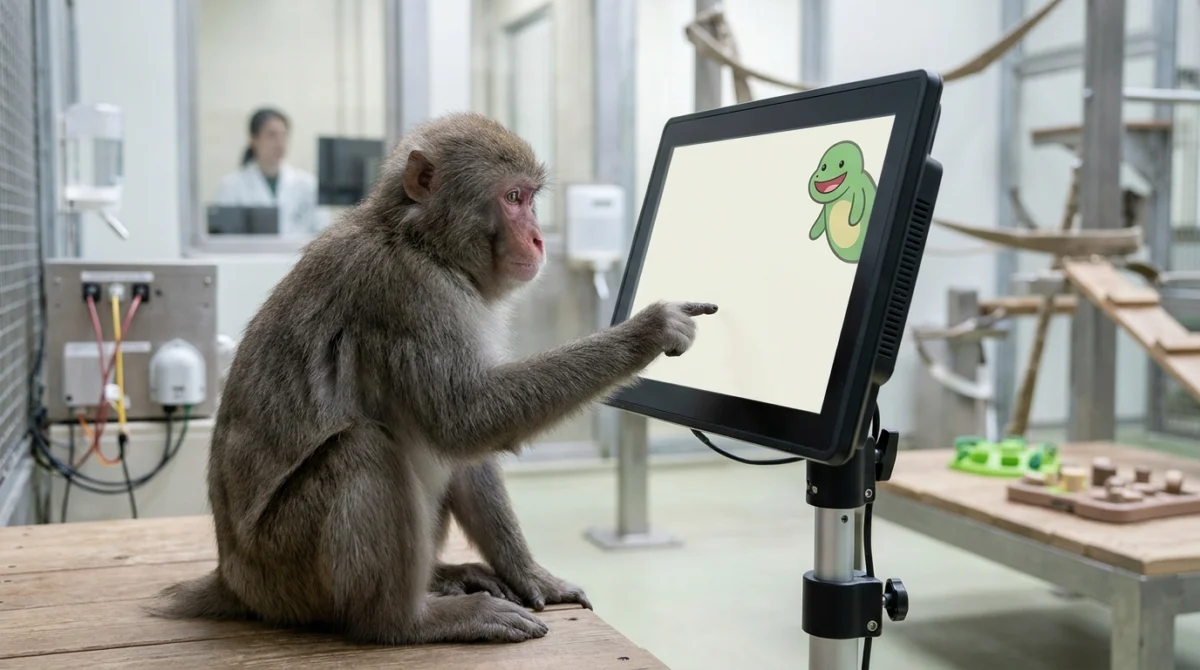
A groundbreaking study shows that monkeys, like humans, are drawn to novelty that is neither too predictable nor entirely random, suggesting a fundamental "Goldilocks principle" of curiosity shared across species.
Researchers at Kyoto University have unveiled a fascinating study that sheds light on the intrinsic motivations behind curiosity, revealing a shared preference for "just right" levels of unpredictability between Japanese macaques and humans. The experiment, designed as a reward-free video game, demonstrated that these primates actively sought out interactive elements that offered a moderate degree of surprise, rather than those that were either overly repetitive or completely chaotic. This discovery, published in the journal iScience, has significant implications for understanding cognitive development, animal enrichment, and even the design of engaging learning experiences for both animals and humans.
The study, conducted by scientists at Kyoto University’s Institute for the Evolutionary Origins of Human Behavior, challenged the long-held assumption that animal engagement in cognitive tasks is solely driven by external rewards, such as food. By developing a novel touchscreen video game for Japanese macaques, researchers observed their voluntary participation and choices when presented with varying degrees of unpredictability in visual stimuli. The game involved a simple hide-and-seek mechanic where pressing different buttons on a touchscreen caused a cartoon puppet to appear. The crucial element was the nature of the puppet’s appearance: each button was associated with a specific rule governing the puppet’s location, ranging from highly predictable to completely random.
Eleven Japanese macaques were involved in the experiment, which was meticulously designed to isolate genuine interest from mere habit. The core of the investigation lay in understanding how the animals responded to different levels of "noise," a term used here in a statistical sense to denote the variability in the puppet’s appearance location. A "low-noise" button ensured the puppet appeared in a similar location each time, offering high predictability. Conversely, a "high-noise" button made the puppet’s location entirely random, representing maximum unpredictability. An "intermediate-noise" button struck a balance, incorporating a degree of predictability while introducing moderate uncertainty. To ensure the monkeys were responding to the novelty of the puppet’s appearance rather than simply pressing buttons, control sessions were implemented where the puppet did not appear, rendering the differences between buttons imperceptible.
The results, detailed in the study abstract, indicated a modest yet consistent preference among the macaques. When the puppet’s movements were visible, the animals demonstrably shifted their choices towards the intermediate-noise button. This preference was observed both when comparing intermediate-noise against low-noise options (a 9.6% shift) and when pitting intermediate-noise against high-noise options (a 13.5% shift). Furthermore, the macaques were observed to return to the intermediate-noise button more quickly, a behavior the researchers interpret as a sign of heightened motivation and engagement.
Sakumi Iki, the first author of the study and a researcher with prior experience studying play behavior in wild monkeys, expressed initial skepticism about the animals’ willingness to engage in the game without any food reward. He noted that cognitive tasks typically rely on reinforcement to elicit participation. However, the macaques’ behavior defied these expectations, with some individuals continuing to play for nearly 100 rounds, even in the absence of any tangible reward. This finding underscores the presence of intrinsic motivational drives that can propel animal behavior beyond immediate gratification.
The observed preference for intermediate unpredictability aligns remarkably with what cognitive scientists refer to as the "Goldilocks principle" of curiosity. This principle suggests that organisms, including humans, are most engaged by stimuli that are neither too simple nor too complex. Previous research has supported this notion in human infants, with a 2012 study demonstrating that babies pay the most attention to visual sequences that fall within a specific range of complexity. More recent work in 2022 found that macaques themselves preferentially attend to information that is "intermediately surprising."
What distinguishes the current study is its focus on action rather than passive observation. While prior research often measured how long an animal looked at a particular stimulus, this experiment required the macaques to actively engage – to press buttons – to recreate these moderately uncertain events. The researchers posit that this behavioral tendency may be an evolutionary adaptation that helps animals focus their learning efforts on information that is most beneficial for adaptation and survival, avoiding stimuli that are either trivial or impossible to decipher. This suggests that the drive to explore and learn is finely tuned to optimize the acquisition of useful information from the environment.
The implications of these findings extend beyond fundamental cognitive science. The researchers envision that reward-free interactive games could serve as valuable enrichment tools, significantly improving the quality of life for animals in laboratory settings, zoos, and even domestic environments for pets like cats and dogs. By providing stimulating and intrinsically motivating activities, these games could help alleviate boredom and stress, promoting better psychological and physical well-being. The next steps for the research team include investigating whether the macaques experience positive emotional states while playing these games and designing even more engaging games that can amplify curiosity.
However, the study acknowledges its limitations. The current research focused on a single primate species, a specific type of unpredictability (visual location), and a relatively small group of captive animals. Further investigation is needed to determine if this preference for moderate uncertainty extends to other sensory modalities, such as sound, or to different forms of complexity, and if it is a universal trait across diverse species.
Despite these constraints, the findings resonate with established principles in human education and game design. Educators and game developers have long observed that optimal engagement occurs when challenges are sufficiently difficult to be interesting but not so overwhelming as to induce frustration or a sense of hopelessness. The macaque study provides compelling evidence that this "sweet spot" of engagement may not be a uniquely human characteristic but rather a fundamental trait shared with our primate relatives. This shared mechanism of curiosity could be a foundational element in the evolution of complex cognition and learning across the animal kingdom, highlighting a deep biological imperative to explore and understand the world in a balanced, nuanced way. The research offers a powerful lens through which to re-examine our understanding of animal cognition and develop more effective and humane approaches to animal care and welfare.
