
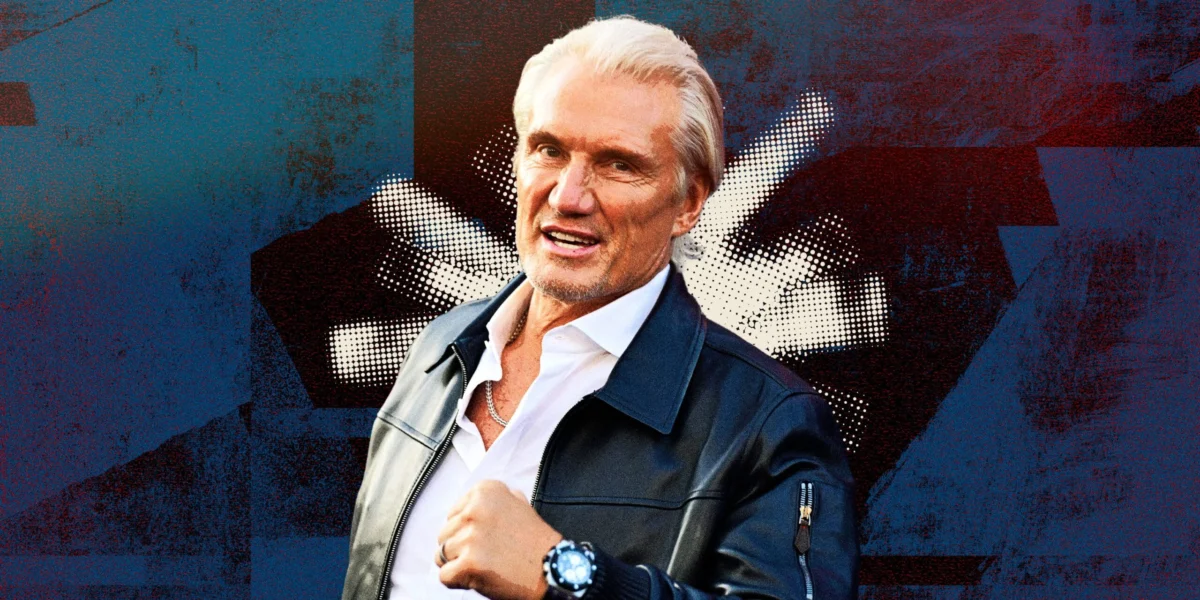
"The cancer journey made me realize I am not invincible, keeping me honest about enjoying the present moment and focusing only on the fights truly worth fighting."
This perspective marks a profound shift for Dolph Lundgren, the Swedish powerhouse who transitioned from an MIT chemical engineering scholar to a global action superstar. After facing a life-threatening cancer diagnosis that once gave him only months to live, Lundgren is now three years into "No Evidence of Disease" (NED) status, using his platform to share a raw, vulnerable look at a life defined as much by internal struggle and childhood trauma as by cinematic triumphs.
The Architect of an Action Legend
For decades, the public perception of Dolph Lundgren was synonymous with the "Siberian Express," Ivan Drago. Standing 6’5” with a physique that seemed chiseled from granite, Lundgren arrived in Hollywood as the quintessential 1980s antagonist. However, the reality of his journey was far more complex than the stoic, monosyllabic characters he often portrayed.
Lundgren was a Fulbright scholar, a master of chemical engineering who was headed for a prestigious career in academia before a chance encounter with Grace Jones led him into the world of modeling and, eventually, the orbit of Sylvester Stallone. His casting in Rocky IV was a watershed moment, not just for his career, but for the action genre itself. He represented a new breed of "hyper-adversary"—one who combined elite athleticism with a terrifying, machine-like discipline. Yet, as revealed in the new documentary Dolph: Unbreakable, this outer shell of perfection masked a history of childhood abuse and a lingering sense of inadequacy that he would spend years attempting to outrun.

The Battle for Health: A Superhuman Vulnerability
Perhaps the most jarring revelation in Lundgren’s recent public discourse is his battle with cancer. For a man who built a career on the image of physical invulnerability, the diagnosis was a sobering confrontation with mortality. At its most dire point, medical professionals suggested he had very little time left. This crisis serves as the emotional scaffolding for Dolph: Unbreakable, providing a lens through which he views his entire life.
Now 69 years old, Lundgren reports that he has been in a state of "No Evidence of Disease" for three years. This health journey has fundamentally altered his psychological approach to life. He speaks of a newfound "honesty" that the diagnosis forced upon him. When the facade of invincibility is stripped away, what remains is a heightened appreciation for the mundane and a rejection of the "digital noise" that complicates modern existence. His survival is not just a medical victory but a philosophical one, leading him to focus on legacy, family, and authentic artistic expression.
The Evolution of Fitness: Efficiency Over Ego
Lundgren’s approach to physical maintenance has undergone a radical transformation. In his youth, his training was defined by the grueling standards of Kyokushin karate—a full-contact style known for its extreme toughness—and the high-volume bodybuilding required for Hollywood roles. He would often spar with men half his age and push his body to the point of structural failure.
Post-cancer, the "crazy stuff" has been excised in favor of intelligence and efficiency. Lundgren now advocates for a streamlined fitness philosophy, which he is currently developing into a personal fitness app. Unlike the broad, all-encompassing platforms offered by peers like Arnold Schwarzenegger, Lundgren’s program is distilled into 30- to 40-minute sessions performed a few times a week.
This "clever" program prioritizes strength training and mobility, drawing on his martial arts background while acknowledging the limitations of an aging, recovering body. It is a workout designed for longevity rather than vanity, focusing on what works without the risk of injury. This shift reflects a broader trend in senior health: the transition from "more is better" to "better is better."

Artistic Redemption and the Direct-to-Video Era
Lundgren is remarkably candid about the middle period of his career. Following the heights of Universal Soldier and Masters of the Universe, he entered a long stretch of direct-to-video (DTV) projects. While these films maintained a dedicated cult following, Lundgren admits that many were produced primarily for financial reasons rather than artistic merit.
However, he distinguishes between "work for hire" and the projects where he took the helm as a director. Films like Command Performance and Wanted Man represent his efforts to exert creative control and inject genuine narrative stakes into the action genre. He views these years not as a decline, but as a period of "learning on the job." Unlike Sylvester Stallone, who was a writer and actor from the outset, Lundgren felt he was "thrown into the deep end" with Rocky IV without the fundamental acting training necessary to navigate Hollywood’s complexities.
His later-career resurgence in Creed II and Aquaman allowed him to finally marry his imposing physical presence with a matured dramatic sensibility. In Creed II, his return as an older, broken Ivan Drago was hailed by critics as a masterclass in understated pathos. He credits this growth to working with high-caliber directors who pushed him to explore the "inner life" of his characters rather than just their physical output.
Memories of Brandon Lee and the Martial Arts Bond
In reflecting on his career, Lundgren often returns to his collaboration with the late Brandon Lee in the 1991 cult classic Showdown in Little Tokyo. Their chemistry on screen was bolstered by a genuine off-screen friendship and a shared heritage. Lundgren recalls their bond over Lee’s quarter-Scandinavian descent—Lee’s mother, Linda Lee Cadwell, has Swedish roots—and their shared language of martial arts.
Lundgren’s memories of Lee are tinged with the tragedy of what might have been. He describes Lee as a man destined for superstardom, someone who bridged the gap between the legendary legacy of his father, Bruce Lee, and a modern, charismatic Hollywood appeal. The "freak accident" that claimed Lee’s life on the set of The Crow remains a poignant point of reflection for Lundgren, serving as another reminder of the fragility of life in an industry that often feels larger than life.

The Future: A Focus on Drama
Looking forward, Lundgren is not content to simply rest on his laurels as an action icon. His memoir, Fights Worth Fighting: Finding Strength in Struggle, and his documentary both signal a desire to be known for his resilience and intellect. He is actively seeking out dramatic roles that allow him to utilize the emotional depth he has gained through his health struggles.
"I’m interested in applying myself, post-cancer, to dramatic roles to see what happens," he says. This next chapter is less about the punch and more about the person behind it. By opening up about his childhood trauma and his battle with cancer, Lundgren has humanized the "Iron Man" of the 80s, transforming himself from a static symbol of strength into a dynamic example of survival.
Dolph Lundgren’s story is no longer just about the height of his kicks or the size of his biceps. It is a narrative about the endurance of the human spirit, the importance of intellectual curiosity, and the courage required to be vulnerable when the world expects you to be unbreakable. As he moves into his 70s, Lundgren remains a formidable force, proving that the most significant fights are often the ones fought within.
