

"When basic needs like food and shelter are unmet, even the most compassionate listening can fall short. Addressing the fundamental economic hardships that drive despair is not just a supplemental approach to suicide prevention; it’s a critical, often overlooked, foundation."
For individuals grappling with suicidal ideation, the conventional pathways to help often involve mental health professionals, crisis hotlines, and therapeutic interventions. However, a growing body of evidence and the lived experiences of many suggest that these vital resources may not be enough when underlying economic instability creates an unbearable weight. This perspective challenges the traditional framing of suicide as solely a medical or psychological issue, advocating for a broader understanding that encompasses economic factors as powerful determinants of mental well-being and, ultimately, life itself. The conversation is shifting to acknowledge that poverty, unemployment, and financial insecurity can be direct contributors to despair, and that addressing these root causes may be among the most effective suicide prevention strategies.
Rei Scott’s teenage years were marked by profound instability, a period where homelessness was a constant shadow. Living in a car with family members and their dog, the daily anxiety of finding a place to sleep was relentless. This precarious existence, coupled with long-standing family struggles with poverty—manifesting as dilapidated housing, lack of privacy, and food insecurity—took a severe toll on Scott’s mental health, leading to frequent suicidal thoughts. A call to a national suicide hotline, while met with kindness, underscored a critical realization: while emotional support is invaluable, it cannot fully address the tangible crises of lacking basic necessities.

"It can definitely help to have someone who can listen, but when you’re struggling to eat and you don’t have a roof to be under, I honestly don’t think words can go as far as you need them to," Scott, now a social work student at Capital University, reflected. This sentiment highlights a crucial disconnect in many suicide prevention efforts: a focus on treating the symptoms of distress without adequately addressing the systemic economic conditions that often precipitate it. Hospitals and therapists, while offering essential care, often cannot resolve issues like a broken-down car or an eviction notice, which are the immediate stressors contributing to profound despair. Scott’s stark realization that "$5,000 could potentially prevent me from being suicidal right now" powerfully illustrates the direct link between financial security and mental survival for many.
Decades of research robustly support the notion that economic factors are inextricably linked to suicide risk. Studies consistently demonstrate that unemployment, low income, high debt, unstable housing, and food insecurity are significant predictors of increased suicide rates. Conversely, interventions aimed at alleviating economic burdens—such as raising the minimum wage, expanding food assistance programs, offering tax credits, and broadening health insurance coverage—are correlated with lower suicide rates. This data suggests a pragmatic truth: when individuals can meet their basic needs, their overall sense of well-being and their capacity to cope with life’s challenges are significantly enhanced.
While many other countries have begun to integrate economic policy into their suicide prevention frameworks, the United States has historically viewed suicide primarily through a medical lens. This perspective has placed the responsibility on clinicians to provide medication or therapy, often leaving economic solutions on the periphery. Advocates and individuals with lived experience, like Scott, are now pushing for a paradigm shift, arguing that decades of a medically-centric approach have failed to curb the persistently high suicide rate in the U.S., which remains among the highest in developed nations.
Benjamin Miller, a national expert in mental health policy and an adjunct professor at Stanford University School of Medicine, emphasizes the need to "broaden our aperture, to broaden the lens of what is mental health." He posits that the most impactful interventions may not solely involve expanding crisis lines or increasing emergency room screenings. Instead, Miller suggests that alleviating poverty could be the single most powerful strategy, as it directly addresses the conditions that foster despair and can help reconcile the fundamental issues that lead individuals to such dire circumstances. "I don’t know what stronger intervention one could possibly have," he stated, underscoring the profound impact of economic stability.
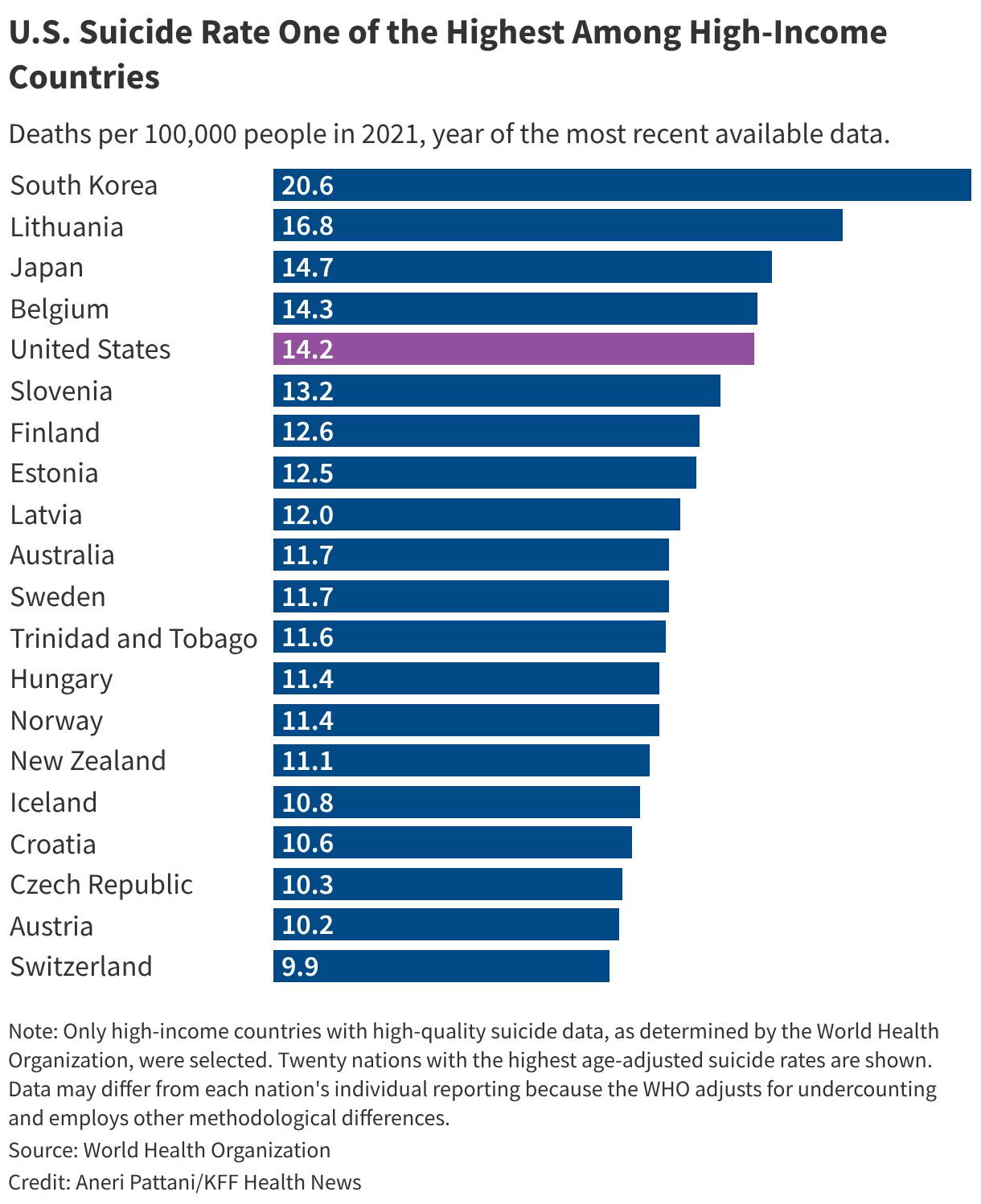
It is important to acknowledge that suicide is a multifaceted issue, and economic factors are not the sole determinants. Suicides occur across all socioeconomic strata, arising from a complex interplay of biological predispositions, relationship challenges, trauma, abuse, and access to lethal means. Therefore, a comprehensive approach to suicide prevention necessitates a diverse range of strategies. However, the argument for integrating economic policy is compelling: policies that affect broad populations, even with a seemingly small impact, can lead to a significant number of lives saved.
Despite the growing understanding of economic factors in suicide prevention, the current policy landscape presents significant challenges. Recent policy decisions, particularly those influenced by the Trump administration, have created "gale-force headwinds" against the push for economic solutions. Unpredictable tariff actions and geopolitical conflicts like the war with Iran have exacerbated economic pressures. Simultaneously, there have been increased hurdles for vital safety net programs, including the Supplemental Nutrition Assistance Program (SNAP) and Medicaid. Projections indicate that millions of individuals could lose access to these essential benefits in the coming years.
Furthermore, the administration has expressed objections to certain housing programs, advocating for stricter requirements for individuals experiencing homelessness, such as mandatory treatment or employment to receive support. The proposed 2027 budget also signals a priority to cut programs that assist low-income households with energy costs. These policy directions run counter to research indicating that such conditions increase suicide risk. Miller observes that "anytime there is economic uncertainty, people will fear for their future and livelihood," and the recent period has been particularly "terrifying."
The administration’s actions stand in stark contrast to the recommendations of leading health organizations. The Centers for Disease Control and Prevention (CDC) explicitly lists "Strengthen economic supports" as the No. 1 evidence-based strategy for suicide reduction, citing SNAP benefits and housing-first policies as examples. While the CDC does not directly engage in economic policy, it encourages state and local governments to consider the intricate relationship between health and economic well-being. The Department of Health and Human Services (HHS) supports suicide prevention through initiatives like the 988 national crisis hotline and investments in mental health care, particularly in rural areas. The Agriculture Department, responsible for SNAP, has stated its commitment to supporting the health and well-being of Americans while providing guidance on program changes.

The precise impact of recent policy shifts on suicide rates remains to be seen, and establishing direct causal links is inherently challenging due to the complex nature of suicide. However, the most recent available data indicates that nearly 49,000 people died by suicide in 2024, a slight decrease from previous years but still a high toll. Suicide prevention has historically garnered bipartisan support, yet the specific policy details can become contentious. For instance, the strong evidence linking minimum wage increases to reduced suicide rates is often met with resistance from lawmakers concerned about budget balancing and small business impacts. Jonathan Purtle, a researcher at New York University who has highlighted public policies that reduce suicide, warns that "we’ll see suicide get polarized" if prevention efforts become too closely tied to politically charged economic issues, leading to a continued focus on less controversial areas like crisis hotlines.
Kacy Maitland, Chief Clinical Officer at Samaritans, a Boston-based suicide crisis hotline, witnesses the direct impact of economic instability on individuals reaching out for help. While many assume crisis calls are solely about acute mental health emergencies, Maitland notes that a significant portion of callers are grappling with everyday challenges like financial problems, housing insecurity, and unemployment. "Whatever is going on in the world, we absolutely hear about that in real time," she stated. The delay in SNAP benefits during a government shutdown, for example, led to a surge in calls, highlighting how disruptions to basic needs can have immediate and devastating consequences for suicide prevention. Maitland’s observation, "If people don’t have access to eat, to feed their children, to be alive, quite frankly, how are they able to move further through anything else?" powerfully articulates the primacy of basic needs.
Samaritans volunteers provide compassionate listening and validation, helping callers feel less alone. However, Maitland often feels a desire to "dig in and fix" the underlying issues. Research supports this instinct: a study found that a 5% increase in SNAP benefit recipients could have prevented nearly 32,000 suicides over 15 years, and a $1 increase in the minimum wage has been linked to approximately 8,000 fewer suicide deaths annually. While Maitland cannot directly alter federal policies, her organization has initiated local efforts, such as providing essential items to those experiencing homelessness, recognizing that "suicide prevention doesn’t always look like a crisis helpline." She asserts that "having your basic needs is also a form of suicide prevention."
In the years following her high school crisis call, Rei Scott has utilized a variety of resources, including crisis lines, hospitalization, medication, and therapy, to manage recurring suicidal thoughts. However, the most significant positive impact came from programs that directly addressed fundamental needs, such as LGBTQ+ youth housing initiatives and support for former foster care students in college. By securing stable housing through the foster care program, Scott is no longer burdened by the constant worry of where to sleep, a relief that has profoundly improved mental well-being. Despite the threats to such programs from current policy directions, Scott remains hopeful for their persistence and rebuilding. The experience of navigating and surviving profound hardship has instilled a sense of resilience. "Despite the policies and legislation that harm us, we continue to live, and I think that’s really important," Scott concluded, finding hope in the possibility of a different future.
