

"While England’s NHS has narrowly met a crucial interim target for reducing elective waiting times, achieving 65.3% of patients treated within 18 weeks, the milestone is immediately overshadowed by the dramatic resignation of Health Secretary Wes Streeting, sparking a leadership challenge and raising serious questions about the long-term sustainability of healthcare improvements."
This significant achievement, marking a crucial step towards fulfilling a key manifesto pledge to drastically cut NHS waiting lists, was celebrated by government officials as evidence of effective investment and modernisation. However, the triumph was quickly eclipsed by a seismic political development: the resignation of Health Secretary Wes Streeting, who cited a loss of confidence in the Prime Minister and called for a leadership challenge. This abrupt departure transforms what would have been a moment of national pride for the government into a period of intense scrutiny and political uncertainty, casting a long shadow over the future direction of health policy and the ambitious goals set for the National Health Service.
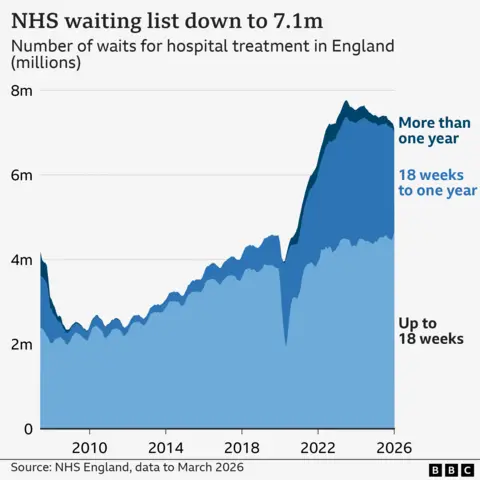
The National Health Service in England has announced it has successfully met an interim target to speed up hospital treatment, with 65.3% of patients now receiving elective care within 18 weeks by the March 2026 deadline. This figure, though marginally above the 65% goal, represents a tangible improvement from the less than 59% performance recorded when the current Labour government assumed office. The target was envisioned as the first critical stepping stone towards achieving a more ambitious 92% treatment rate within 18 weeks by the end of the parliamentary term in 2029, a cornerstone of the ruling party’s electoral promises.
The news broke just hours before Health Secretary Wes Streeting tendered his resignation, igniting a political firestorm that threatens to destabilise the government. Prior to his departure, Streeting lauded the accomplishment, asserting that it positioned the NHS "right on track to deliver the fastest reduction in waiting times in the history of the NHS." He attributed this progress to the government’s strategic investments, modernisation initiatives, and the "remarkable efforts of staff right across the country." Despite the achievement, his subsequent resignation to challenge the Prime Minister on grounds of lost confidence has dramatically shifted the narrative, transforming a moment of departmental success into a broader crisis of leadership.
The 18-week waiting time standard has long been a key performance indicator for the NHS, designed to ensure timely access to non-urgent, elective procedures such as hip replacements, cataract surgery, and hernia repairs. Introduced initially in the mid-2000s, the target aimed to prevent prolonged suffering, reduce the risk of conditions worsening, and improve patient quality of life. Over the past decade, and particularly exacerbated by the COVID-19 pandemic, performance against this target deteriorated significantly, leading to an unprecedented backlog of patients awaiting care. The recent reduction in the overall waiting list, which saw a drop from 7.2 million to 7.1 million in a single month – the lowest figure in three and a half years – underscores the scale of the challenge that has been tackled.
Sir Jim Mackey, Chief Executive of NHS England, echoed Streeting’s sentiments, describing the interim target as a "huge moment." He highlighted that this accomplishment transcended mere statistics, reflecting "real inroads on the things that matter to our patients and communities." Mackey also acknowledged the extraordinary circumstances under which this progress was made, specifically noting the repeated strike action by resident doctors, which has undeniably placed immense pressure on an already stretched healthcare system. These industrial actions, stemming from disputes over pay and working conditions, have led to widespread cancellations of appointments and procedures, making the reported improvements even more remarkable in the eyes of NHS leadership.
However, beneath the headline figures, a more complex picture emerges. While the national target was met, the improvements were not uniformly distributed across the country. Data reveals that four out of every ten hospital trusts failed to meet their own individual waiting time targets, and in a concerning development, ten trusts actually reported a worsening of their performance. This disparity suggests that while certain areas of the NHS have excelled, others continue to grapple with significant challenges, potentially due to varying local factors such such as staffing levels, infrastructure limitations, demographic pressures, or the specific mix of specialist services they provide. Addressing these regional inequalities will be crucial for sustainable, system-wide improvement.

Health experts and professional bodies have cautioned against overstating the success, highlighting the formidable journey still ahead to reach the 92% target, a benchmark that has not been consistently achieved for more than a decade. Tim Mitchell, a spokesperson for the Royal College of Surgeons of England, acknowledged the "flat out" efforts of NHS staff but warned that their dedication was being undermined by "long-standing under-investment in buildings and equipment." Mitchell emphasised that "too many teams are still working in ageing buildings with too few theatres and beds," constraints that he believes render progress "fragile" unless fundamentally addressed. The lack of modern facilities directly impacts surgical capacity, patient flow, and the ability to adopt new, more efficient medical technologies.
Sarah Woolnough, Chief Executive of the King’s Fund, provided further critical analysis, suggesting that the interim target was primarily met through a surge of "extra funding" injected into hospitals since January. She referred to this as "spring funding," allowing trusts to undertake "elective sprints" – concentrated efforts to reduce backlogs in specific areas. Woolnough raised serious doubts about the sustainability and financial feasibility of this approach for reaching the ultimate 92% target. She questioned "whether reaching the eventual 92% target by rinsing and repeating this sequence of ‘elective sprints’ is financially feasible or manageable for already stretched NHS staff." This suggests a concern that such short-term, intensive campaigns could lead to staff burnout and may not be a cost-effective long-term strategy.
Furthermore, Woolnough pointed out a critical oversight in the government’s strategy: the narrow focus on the 18-week elective care target might be masking deterioration in other crucial areas of healthcare. She highlighted that "several other waiting lists continue to grow," indicating that a single-minded pursuit of one metric could inadvertently divert resources and attention from other essential services, such as mental health care, community diagnostics, or primary care access. A holistic approach, she argued, is necessary to ensure the overall health and resilience of the entire NHS system.
The political ramifications of Wes Streeting’s resignation are profound. His departure, immediately after a touted departmental success, suggests deep-seated dissatisfaction within the ruling party regarding the Prime Minister’s leadership. A leadership challenge at this juncture could trigger significant instability, potentially leading to a shift in government priorities, including those related to health. New leadership might either double down on the current strategy or pivot to an entirely different approach, further complicating the already challenging task of NHS reform and waiting list reduction. The 2029 92% target, a key Labour pledge, now appears even more precarious, dependent not only on operational success but also on political stability and consistent policy direction.
Looking ahead, the NHS faces a daunting task. Beyond the immediate political upheaval, structural issues persist. Tackling the underlying causes of staffing shortages, modernising crumbling infrastructure, and investing in preventative care will be crucial. The "elective sprints" model, while effective in the short term, requires careful evaluation for its long-term viability and impact on staff morale. Moreover, a broader perspective is needed to ensure that improvements in elective care do not come at the expense of other vital health services. The public, having witnessed a glimmer of progress, will now be keenly observing how the government navigates this dual challenge of political crisis and ongoing healthcare reform, demanding sustained and equitable access to timely, high-quality care across all aspects of the National Health Service. The path to a truly recovered and resilient NHS remains long and fraught with both operational and political hurdles.
