
Modern leg training has evolved beyond mere vanity, serving as a critical foundation for metabolic health, cognitive preservation, and lifelong functional mobility. By prioritizing compound movements and strategic recovery, athletes can build a resilient lower body that supports both peak performance and long-term vitality.

While the fitness world once prioritized upper-body aesthetics—the classic "beach body" look—a paradigm shift is underway that places the lower body at the center of human performance. Driven by both cultural trends and emerging longevity science, the "New Rules of Leg Day" provide a structured approach to building the quadriceps, hamstrings, and glutes without the debilitating fatigue often associated with high-intensity lower-body workouts. This methodology moves beyond the traditional "squat until you drop" mentality, instead utilizing biomechanically efficient movements and targeted nutrition to maximize hypertrophy and strength while safeguarding the joints.
The Cultural and Scientific Shift
The resurgence of lower-body training is visible across the cultural landscape. From the glute-centric training highlighted in HBO’s Heated Rivalry to the frequent discussions of "hockey butt" during the Olympic Games, the aesthetic appeal of a powerful lower body has reached a fever pitch. However, the motivations for "chasing god-level quads" extend far beyond the mirror.

Current longitudinal studies suggest a profound link between leg strength and systemic health. Because the legs house the body’s largest muscle groups, training them serves as a massive metabolic engine. Maintaining lower-body musculature is associated with improved glucose regulation, lower body fat percentages, and enhanced bone density. Perhaps most surprisingly, research has identified a correlation between leg power and cognitive health in aging populations; the mechanical stress of resistance training triggers the release of neurotrophic factors that support brain plasticity.
The challenge, historically, has been the "recovery cost." A traditional leg day can leave an athlete exhausted for the remainder of the week. The "New Rules" program, developed through years of collaboration with professional athletes and elite trainers—including insights from the original Glute Lab in Florida and the specialized regimens used to prepare actors for physically demanding superhero roles—aims to mitigate this "soul-crushing" fatigue through smarter programming.

The Four-Week Blueprint
This program utilizes a four-day training split, alternating between "Lower Body Blitz" sessions and "All-Around Upper Body" sessions. This frequency ensures that the lower body is stimulated twice per week, which is the optimal frequency for muscle protein synthesis, while allowing sufficient time for the nervous system to recover.
Weekly Schedule:

- Monday: Lower Body Blitz
- Tuesday: All-Around Upper Body
- Wednesday: Active Recovery (20-minute walk or light run)
- Thursday: Lower Body Blitz
- Friday: All-Around Upper Body
- Saturday/Sunday: Rest or Optional 10-minute Hip Thrust EMOM
Workout 1: The Lower Body Blitz
The goal of this session is to target the posterior chain (hamstrings and glutes) and the anterior chain (quadriceps) using varied ranges of motion and mechanical tension.
1. Hip 90-90 with Reach (Warmup):
Internal and external hip rotation are often the "bottlenecks" of leg training. This movement opens the hip capsule, allowing for deeper squats and safer deadlifts. By flipping the knees in a 90-90 position and reaching across the lead leg, you engage the adductors and glute medius, preparing the pelvis for heavy loading.

2. Half-Full Romanian Deadlift (RDL):
The RDL is the gold standard for hamstring development, but the "half-full" variation adds a layer of difficulty. By performing a partial rep (to the knee) before a full rep, you increase the time under tension in the "stretched" position of the hamstring. This is where the most muscle damage and subsequent growth occur.
3. Bulgarian Split Squat:
Often cited as the most "hated" exercise in the gym, the Bulgarian split squat is unrivaled for correcting muscle imbalances. By elevating the rear foot, you force the lead leg to stabilize the entire load, hitting the glutes and quads while stretching the hip flexor of the trailing leg.

4. Somersault Squat:
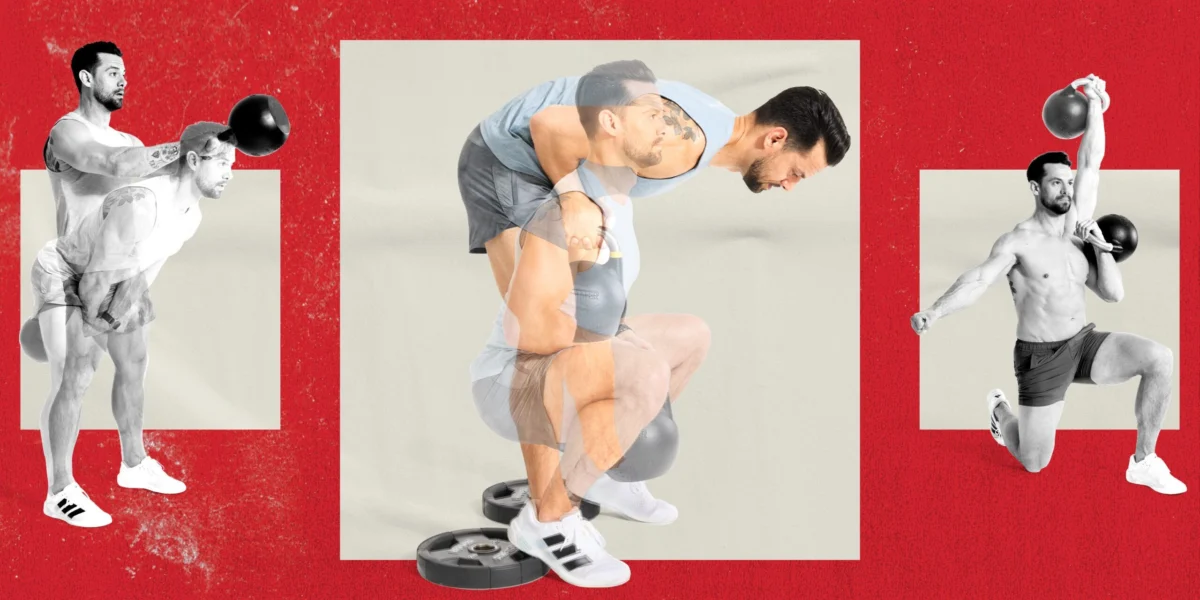
This is a specialized tool for quadriceps isolation. By elevating the heels on wedges or plates and maintaining a rounded back, you shift the center of gravity forward. This mimics the mechanics of a hack squat machine using only a kettlebell, providing a massive pump to the teardrop muscle (vastus medialis) of the quad.
5. Kettlebell Swing:
To finish the session, the kettlebell swing provides a "hinge" movement performed at high velocity. This trains the glutes to produce power explosively, which is essential for athletic performance and metabolic conditioning.

Workout 2: All-Around Upper Body and The Finisher
While the focus is on the legs, maintaining upper-body strength is vital for holding heavy weights during lunges and deadlifts. This session utilizes a circuit format (Gorilla Rows, Pushups, and Half-Kneeling Overhead Presses) to maintain muscle tone and heart rate.
The true "secret sauce" of the program, however, is the EMOM (Every Minute on the Minute) Hip Thrust Finisher. The hip thrust is the most effective movement for glute isolation because it keeps the glutes under constant tension without being limited by back strength or grip. By performing 10 reps every minute for 10 minutes, you accumulate 100 high-quality reps in a very short window, creating the "juiced glute" aesthetic and functional power that defines modern fitness.

The "Grow-Them-Wheels" Nutrition Strategy
Training the body’s largest muscles requires a massive influx of resources. According to nutrition experts like Dezi Abeyta, RD, a generic diet will not suffice for this level of lower-body volume. The program recommends a baseline of 1 gram of protein per pound of goal body weight, complemented by 400 grams of carbohydrates and 80 grams of fat daily.
Tip 1: Carb Front-Loading
Legs require glycogen. Unlike smaller muscles, the quads and glutes can deplete the body’s energy stores rapidly. To avoid "hitting the wall" mid-workout, athletes should consume 1.5 to 2 grams of carbs per pound of body weight before the session. Slow-burning fuels like oats and rice ensure that energy levels remain stable through the final sets.

Tip 2: Tendon Insurance via Collagen
Muscle tissue heals faster than connective tissue. The heavy load of RDLs and split squats puts immense stress on the patellar and Achilles tendons. Research suggests that consuming 10 to 15 grams of collagen paired with Vitamin C (which acts as a catalyst) roughly 30 to 60 minutes before a workout can spike collagen synthesis, essentially "fortifying" the joints from the inside out.
Tip 3: The Pre-Lift Setup
The 90 minutes leading up to a leg session are critical. The goal is high energy and low gastric distress. This means choosing "fast" carbs—white rice, pasta, or fruit—and keeping fiber low to avoid bloating. A moderate amount of protein (20–30g) triggers muscle protein synthesis early, while a pinch of salt aids in cellular hydration and prevents cramping.

Tip 4: Training the Gut
Many athletes struggle to consume the necessary 400 grams of carbs due to digestive discomfort. However, the digestive tract is as adaptable as a skeletal muscle. By gradually increasing pre-workout carb intake by 10 grams each week, the body becomes more efficient at transporting glucose to the muscles, eventually allowing the athlete to eat for performance without the "bloat."
Conclusion
The "New Rules of Leg Day" represent a shift toward a more intelligent, sustainable form of bodybuilding. By focusing on hip mobility, time-under-tension variations, and a rigorous nutritional framework, it is possible to build a lower body that is as functional as it is aesthetic. Whether the goal is to improve longevity, increase athletic power, or simply fill out a pair of jeans, the foundation remains the same: treat your legs like the engine of your health, and the rest of your fitness will follow.
