
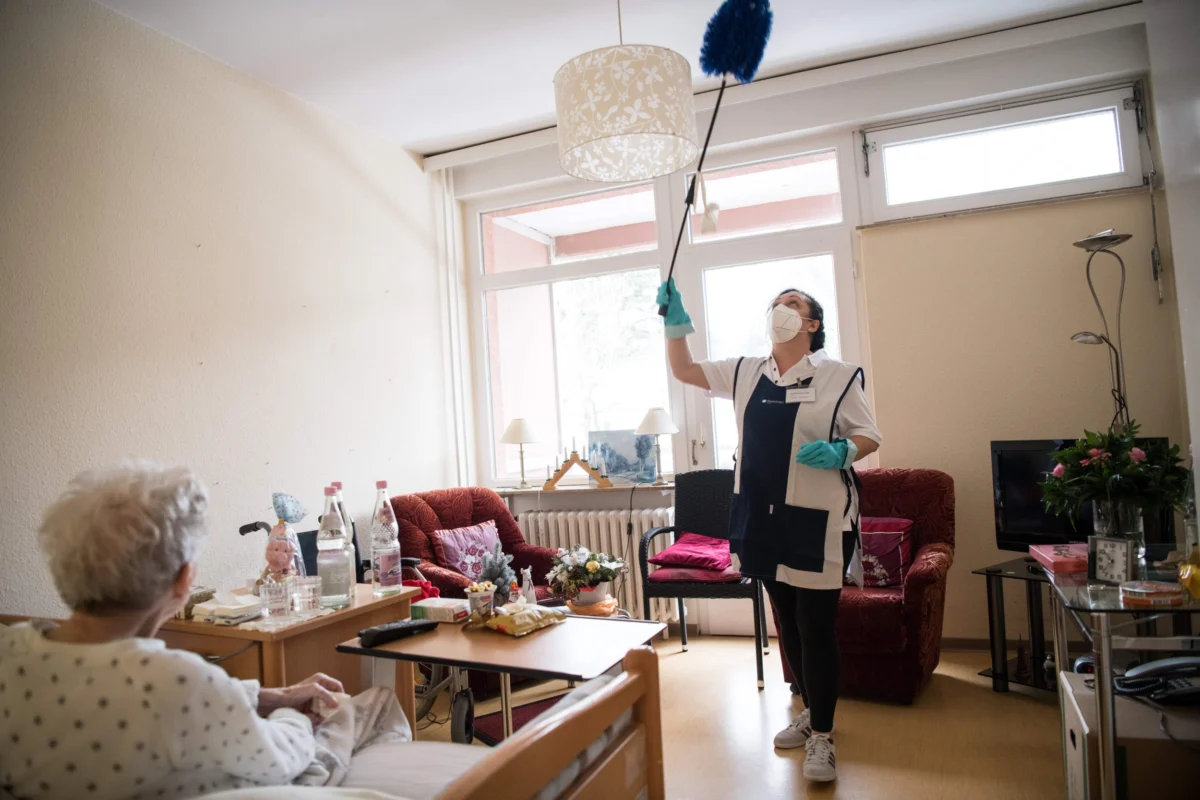
"In the fight against drug-resistant bacteria in nursing homes, focusing solely on decolonizing residents yields significant results, with enhanced daily cleaning offering no measurable additional benefit. This finding carries crucial implications for infection control strategies and family inquiries regarding elder care."
A recent study conducted at two Southern California nursing homes has illuminated a critical distinction in combating the pervasive threat of multidrug-resistant organisms (MDROs) within long-term care facilities. Published on August 5 in JAMA Network Open, the research suggests that decolonization protocols—interventions aimed at eliminating bacteria carried on residents’ skin—are far more effective in reducing MDROs than routine enhanced environmental cleaning alone. This insight is particularly vital given the often-constrained budgets of infection control programs in nursing homes, where facilities are frequently tasked with implementing multiple strategies simultaneously. The study’s findings indicate that when resources necessitate a choice between decolonization and enhanced cleaning, the former appears to be the more impactful investment for reducing MDRO carriage on residents and within their immediate living spaces.
For families with loved ones residing in nursing homes, this research translates into a vital area of inquiry. MDROs are alarmingly common in these settings, with existing studies indicating that over half of residents may carry these resistant bacteria on their skin, a precursor to potential infections. Understanding what a facility prioritizes and implements to address this endemic issue is a legitimate and important question for families to raise during care conferences. The study’s rigorous design and clear outcomes offer a data-driven perspective on how to best protect vulnerable individuals from the growing threat of antibiotic resistance.
The Four-Phase Design and the Main Findings
The research, spearheaded by investigators at the University of California Irvine School of Medicine, employed a meticulous four-phase quality-improvement study design across two nursing homes. Data collection spanned from March 2019 to April 2021, allowing for a sequential implementation and evaluation of different infection control approaches. The phases were structured as follows: universal decolonization of residents as the primary intervention, a control phase representing routine care, a phase focusing solely on once-daily enhanced environmental cleaning, and finally, a combined phase integrating both decolonization and enhanced cleaning.
The study meticulously measured two primary outcomes: the prevalence of MDRO carriage on resident skin and within their nostrils, and the level of contamination on frequently touched surfaces in both private bedrooms and common areas. These metrics were chosen to provide a comprehensive understanding of how interventions affected both the human reservoir of bacteria and the environmental spread.
Upon rigorous statistical analysis, the results painted a clear picture. In adjusted models, the implementation of decolonization alone demonstrated a significant impact, associated with a 59 percent reduction in MDRO carriage compared to the baseline routine care phase. Furthermore, this reduction was even more pronounced when compared to the phase focused on enhanced cleaning alone, showing a 64 percent decrease in carriage. This finding, as summarized by CIDRAP, underscores the direct effectiveness of resident-focused decolonization. Conversely, enhanced cleaning as a standalone strategy failed to achieve any statistically significant reduction in MDRO carriage. Crucially, when enhanced cleaning was combined with decolonization, it did not provide any additional benefit, suggesting that the gains were primarily attributable to the decolonization component.
The protocol for decolonization in this study involved a systematic approach to resident care. It typically entailed the use of chlorhexidine for routine bathing and showering, coupled with the application of a nasal iodophor, such as povidone-iodine, according to a defined schedule. This strategy is fundamentally a resident-level intervention, targeting the bacteria directly on individuals rather than solely focusing on the broader environment. This distinction is key to understanding why the findings are so informative, highlighting the efficacy of direct intervention on the human host.
Shared Spaces Told a Different Story
The impact of the interventions extended beyond individual residents to their immediate living environments. Contamination levels within resident bedrooms mirrored the trends observed in skin carriage. Decolonization, when implemented alone, led to an impressive 84 percent reduction in bedroom contamination compared to the control phase. When compared to enhanced cleaning alone, the reduction was 74 percent. Similar to the findings on resident skin, enhanced cleaning by itself did not yield any discernible reduction in bedroom contamination, nor did it enhance the effectiveness of decolonization when used in conjunction.
However, the dynamics shifted when examining common areas, which serve as high-traffic zones for multiple residents and staff. In these shared spaces, the combined intervention of decolonization and enhanced cleaning proved to be more effective in reducing contamination than either approach implemented in isolation. This outcome is logically explained by the nature of bacterial transmission in these environments. If bacteria on surfaces largely originate from the individuals who touch them, then reducing what residents carry will inherently decrease the amount of bacteria transferred to surfaces like bed rails. Common areas, by their nature, aggregate contact from a diverse group of individuals throughout the day. In such settings, surface disinfection can effectively address contamination that resident-level treatments alone might not fully capture, particularly when multiple individuals contribute to the bacterial load.
The authors of the study astutely framed the practical implications of these findings in terms of resource allocation. Writing in JAMA Network Open, they emphasized that implementing multiple infection control strategies can be both expensive and resource-intensive. Therefore, they argued, "it is necessary to prioritize the most effective strategies." Their conclusion strongly suggests that facilities operating with limited resources should prioritize decolonization as a core strategy, complemented by targeted disinfection efforts specifically in shared spaces, especially after periods of high activity.
Families Choosing or Monitoring a Facility
It is imperative to underscore that the information presented here is not intended as medical advice or a directive for independent treatment. Families should not attempt to implement decolonization protocols on their own. The antiseptic agents used in these protocols, such as chlorhexidine and nasal antiseptics, are administered within a structured facility program under clinical oversight. Attempting to replicate these protocols without professional guidance carries inherent risks, including potential skin reactions and allergic responses.
What families can and should do is engage in informed inquiry. During care conferences, posing pertinent questions can provide valuable insights into a facility’s commitment to infection prevention. Reasonable questions include whether the facility routinely utilizes chlorhexidine bathing protocols, if a nasal decolonization program is in place, how residents returning from hospital stays are managed in terms of infection control, and what methods are employed to monitor infection rates. Facilities that actively implement robust infection prevention programs are typically transparent and readily provide answers to these questions.
The stakes associated with MDROs are particularly high for individuals with frequent exposure to healthcare settings. Residents who transition between hospitals and nursing homes, those with indwelling medical devices such as urinary catheters or feeding tubes, individuals with open wounds or pressure injuries, and those who have undergone multiple courses of antibiotics are at the greatest risk of both colonizing with and subsequently developing infections from resistant organisms.
Older adults, as a demographic, disproportionately bear the burden of resistant infections. When a resistant organism leads to an infection, treatment options become more limited, hospital stays tend to be prolonged, and patient outcomes are generally poorer. Therefore, intervening at the stage of carriage—before an infection even develops—represents the most effective preventative measure.
The implications of MDROs also extend to the household environment. Residents who return home for weekend visits or are discharged to family care can inadvertently carry these organisms with them. For relatives, standard advice remains crucial, albeit unglamorous: diligent hand hygiene before and after contact, meticulous wound care under the direction of a clinician, and clear communication with any new healthcare provider about a known history of colonization. This ensures that treatment decisions are informed and appropriate, mitigating further spread and risk.
Limits of a Two-Facility Study
While the findings of this study are significant, it is essential to acknowledge its design limitations to provide a complete and balanced perspective. The study was conducted as a quality-improvement initiative within two specific nursing homes, rather than a large-scale, multi-site randomized controlled trial. This distinction, noted by McKnight’s Long-Term Care News, means the results may not be universally generalizable to all nursing home settings.
The sequential implementation of the study phases over approximately two years also introduces potential confounding factors. Any other changes that occurred during this period—such as variations in staffing levels, resident turnover, seasonal influences, or evolving pandemic-era infection control practices—could have contributed to the observed differences. Furthermore, the specific characteristics of the two Southern California nursing homes, including their staffing ratios, resident demographics, and pre-existing practices, might not be representative of facilities in other regions.
Another important consideration is that the study measured MDRO carriage and surface contamination, rather than direct clinical outcomes like infections, hospitalizations, or mortality. While carriage and contamination are recognized as valid surrogate outcomes because they precede infection, they are not direct measures of clinical impact.
Crucially, this research builds upon an existing and strengthening body of evidence rather than standing in isolation. A substantial cluster-randomized trial previously conducted in nursing homes found that universal decolonization was associated with a reduction in infection-related hospital transfers. In that trial, MDRO carriage prevalence decreased from approximately 49 percent to 32 percent in the decolonization group, while remaining near 47 percent in the routine care group. The current study addresses a more focused question: how does decolonization compare to enhanced cleaning when resource limitations necessitate a prioritization of strategies?
An accompanying commentary in JAMA Network Open framed this work as a valuable contribution to hypothesis-driven research in nursing home infection prevention, rather than a definitive set of guidelines. Current infection control guidance has not been altered based solely on this study, and further multi-site investigations would be beneficial to ascertain the broader applicability of these findings. Nevertheless, for facility administrators tasked with allocating limited infection prevention budgets, this study provides a critical data point that was previously absent, guiding more effective resource allocation.
Key Questions Answered
What did the study find? Universal decolonization of residents was associated with a significant 59 percent reduction in multidrug-resistant organism carriage compared to routine care. In contrast, enhanced daily cleaning implemented alone showed no reduction and provided no additional benefit when combined with decolonization.
What is decolonization? In this context, decolonization refers to a protocol involving the use of chlorhexidine for routine bathing and showering, coupled with the application of a nasal iodophor such as povidone-iodine on a defined schedule. This is applied universally to all residents, irrespective of whether they are known carriers.
Did cleaning help at all? Enhanced cleaning demonstrated efficacy only in common areas, where combining it with decolonization resulted in better contamination reduction than either intervention alone. However, for resident skin and bedrooms, cleaning alone did not contribute to reducing contamination and offered no added benefit when used with decolonization.
How strong is the evidence? This study was a four-phase quality-improvement study conducted at two nursing homes, not a large-scale randomized controlled trial. It focused on measuring carriage and surface contamination rather than direct clinical outcomes like infections or deaths.
Should families try this at home? No. The protocols described are facility-level interventions requiring clinical oversight. Families should not attempt decolonization independently due to potential risks.
What can a family actually do? Families can inquire about the facility’s specific infection prevention practices. Key questions include whether the facility uses chlorhexidine bathing, has a nasal decolonization protocol, how it manages residents returning from hospitals, and how it tracks infection rates.
Which residents face the highest risk? Residents with frequent healthcare exposure are at higher risk. This includes those moving between hospitals and nursing homes, individuals with indwelling devices (catheters, feeding tubes), residents with wounds or pressure injuries, and those who have received multiple courses of antibiotics.
