

"Aging is not a mandate for physical decline, but a call to evolve your training from raw intensity to strategic precision."

As the human body transitions through the middle decades, the physiological requirements for maintaining muscle mass and joint integrity undergo a significant shift. While the drive to remain athletic remains, the methodology must adapt to accommodate changes in recovery capacity and connective tissue elasticity. By prioritizing explosive power, intelligent exercise selection, and a rigorous approach to recovery, men can bypass the traditional pitfalls of aging to achieve a level of fitness that rivals their younger counterparts while ensuring long-term functional health.
The New Paradigm of Mature Fitness
For decades, the prevailing narrative suggested that a man’s physical peak was a fleeting moment in his 20s, followed by a slow, inevitable slide into "maintenance" and eventually, decline. However, the modern fitness landscape tells a different story. Today, men in their 50s and 60s are not only finishing grueling Ironman triathlons and Hyrox races but are also maintaining physiques that challenge the aesthetic standards of men half their age. High-profile examples like Lenny Kravitz, who maintains a shredded physique well north of 60, or Hugh Jackman, who continues to perform heavy deadlifts to maintain his "Wolverine" frame, prove that the "half-century mark" is no longer a barrier to making significant gains.

Achieving this requires more than just grit; it requires a fundamental shift in mindset. According to Bryan Krahn, C.S.C.S., author of Muscle After 40, the secret isn’t necessarily working harder, but working smarter. This evolution of training involves four critical mental and physical adjustments that transition a trainee from a "gym warrior" to a "master athlete."
Step 1: The Psychological Pivot
The first hurdle to training after 50 is the ego. Many men attempt to replicate the high-impact, high-volume routines of their youth, only to find themselves sidelined by joint pain or chronic fatigue. To thrive, one must embrace a new set of training principles.

Prioritizing Dumbbells Over Barbells
The barbell is often hailed as the gold standard for strength, but its fixed path can be unforgiving. As we age, connective tissues lose some of their natural elasticity. Barbells lock the hands and shoulders into a rigid position, which can exacerbate wear and tear on the rotator cuffs and elbows. Dumbbells, conversely, allow for a more natural, individualized range of motion. By switching from a barbell bench press to a dumbbell press, you allow your limbs to move through a path that suits your specific anatomy, reducing the risk of impingement.
The Strategic Value of Isolation Exercises
While functional, total-body movements like cleans and heavy squats are excellent for metabolic health, they carry a high "recovery cost." For the mature lifter, bodybuilding-style isolation moves—such as biceps curls, lateral raises, and leg extensions—provide a crucial advantage. These exercises allow you to stimulate muscle hypertrophy (growth) without overtaxing the central nervous system or placing extreme stress on the spine. Integrating isolation work twice a week ensures you continue to build muscle mass while allowing your body the bandwidth to recover.

The 2:1 Recovery Rule
In your 20s, you can often train through a lack of sleep or poor nutrition. After 50, recovery becomes as active a pursuit as the workout itself. Trainer Bobby Maximus suggests a radical but effective ratio: for every 30 minutes spent in the gym, one should spend an hour on recovery. This includes foam rolling, yoga, sauna sessions, and, most importantly, sleep. When you dial in sleep and stress management, you create the hormonal environment necessary for muscle protein synthesis to occur.
Step 2: Combatting the Biological Enemy
The primary biological threat to the aging male is sarcopenia—the age-related loss of skeletal muscle mass. Research indicates that men lose between 3 percent and 8 percent of their muscle mass every decade starting as early as their 30s. This process accelerates after 50, leading to a decrease in metabolic rate and functional strength.

However, muscle researcher Brad Schoenfeld, Ph.D., notes that building "power" is just as important as building "strength." While strength is the ability to move a heavy load, power is the ability to move that load quickly. Sarcopenia preferentially affects Type II (fast-twitch) muscle fibers, which are responsible for explosive movements and preventing falls.
To combat this, incorporate power training twice a week. Use lighter weights—roughly 50 to 60 percent of your maximum—and focus on the tempo. Take two seconds to lower the weight (the eccentric phase) and no more than one second to accelerate it upward (the concentric phase). This "intent to accelerate" recruits those high-threshold motor units that are most susceptible to age-related loss.
Step 3: Nutritional Support for Muscle Retention
Training is merely the stimulus; growth happens in the kitchen. A common mistake among older lifters is failing to adjust their protein intake to account for "anabolic resistance"—the phenomenon where the body becomes less efficient at utilizing protein to build muscle as it ages.
Schoenfeld recommends a target of 35 to 40 grams of high-quality protein per meal. This ensures that each meal triggers a "bolus" of leucine, an amino acid that acts as a primary signal for muscle growth. Whether through lean meats or high-quality protein supplements, meeting this threshold is non-negotiable for those looking to maintain a muscular frame into their 60s.

Step 4: The "Nerdy" Essentials for Injury Prevention
Trainer Kirk Charles, who continues to train at a high level well into his 60s, emphasizes the "little things"—exercises that focus on stability and joint health. These movements may not look impressive on social media, but they are the insurance policy that allows you to keep lifting heavy weights.
- Elevated Hip Bridge Hold: This targets the hamstrings and glutes, providing essential support for the lower back. By holding the bridge for 20 to 30 seconds with heels elevated, you build the posterior chain endurance required for daily activities and heavy lifting.
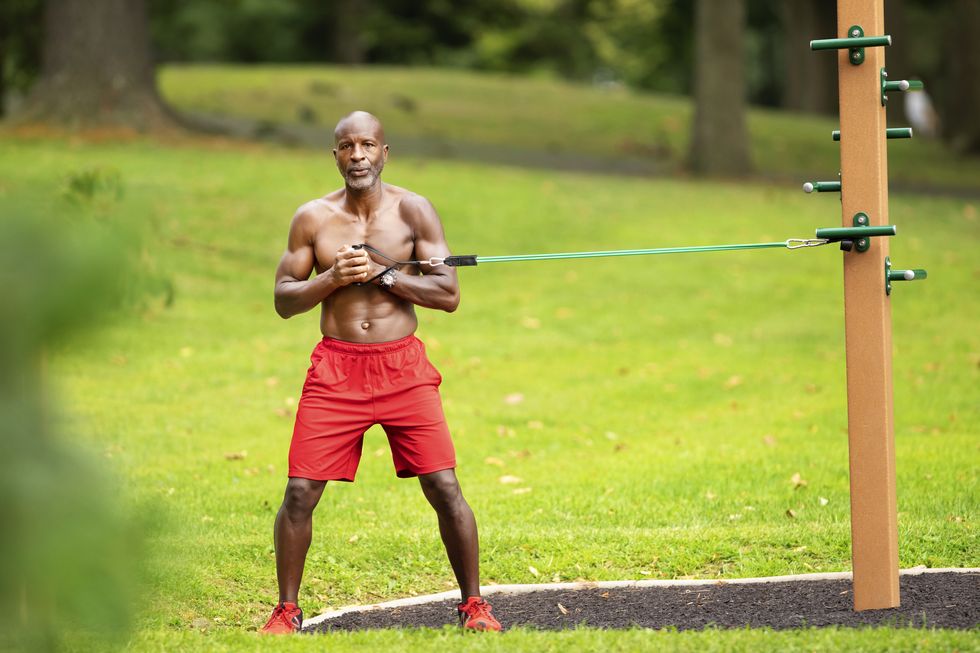
- Pallof Press: This is a premier "anti-rotation" movement. By resisting the pull of a cable or band, you force the core to stabilize the spine. This is a critical weapon against the lower-back pain that plagues many aging athletes.
- Resistance Band Pull-Apart: Shoulder health is often the first thing to go in an aging lifter. Pull-aparts strengthen the rhomboids and rear deltoids, pulling the shoulders back and counteracting the "slumped" posture that comes from decades of desk work.
Step 5: Strategic Exercise Selection
The final step in ageless power is knowing which exercises to keep, which to tweak, and which to trade. Your body does not care about the "coolness" of an exercise; it only cares about the tension placed on the muscle and the safety of the joints.

Moves to Embrace:
- Romanian Deadlift (RDL): Unlike the traditional deadlift from the floor, which requires immense hip mobility, the RDL starts from a standing position. It allows you to load the hamstrings and glutes with much less risk to the lumbar spine.
- Floor Press: By lying on the floor instead of a bench, the floor naturally limits the range of motion of your elbows. This prevents the shoulders from entering a vulnerable, over-extended position while still providing the chest-building benefits of a press.
- Hollow Hold: A gymnastics staple, this move builds deep core stability that translates to every other lift in your program.
Moves to Modify:

- Max-Height Box Jumps: High-impact landings are a recipe for Achilles or knee issues. Instead, jump onto a box 10 inches lower than your maximum, or focus on "box drops" to practice landing softly and absorbing force.
- Wide-Grip Pullups: These can be brutal on the shoulders. Switching to a "neutral grip" (palms facing each other) places the shoulder in a more stable position and allows for a greater range of motion without the risk of impingement.
- Overhead Military Press: Many men lack the thoracic mobility to press a barbell directly overhead without arching their lower back. The Landmine Press—where one end of a barbell is anchored in a corner—allows you to press at an upward angle, which is much friendlier to the shoulder joint.
Conclusion: The Long Game
The quest for muscle and power after 50 is not about recapturing youth; it is about defining a new kind of strength. It is a philosophy that values consistency over intensity and longevity over a one-rep max. By respecting the body’s changing needs—through dumbbells, explosive power training, high protein intake, and meticulous recovery—you don’t just stay in shape. You become a testament to the idea that the human body is capable of thriving, gaining, and kick-assing at any age. Training smartly today ensures that you are not just strong for your age, but strong for life.
