
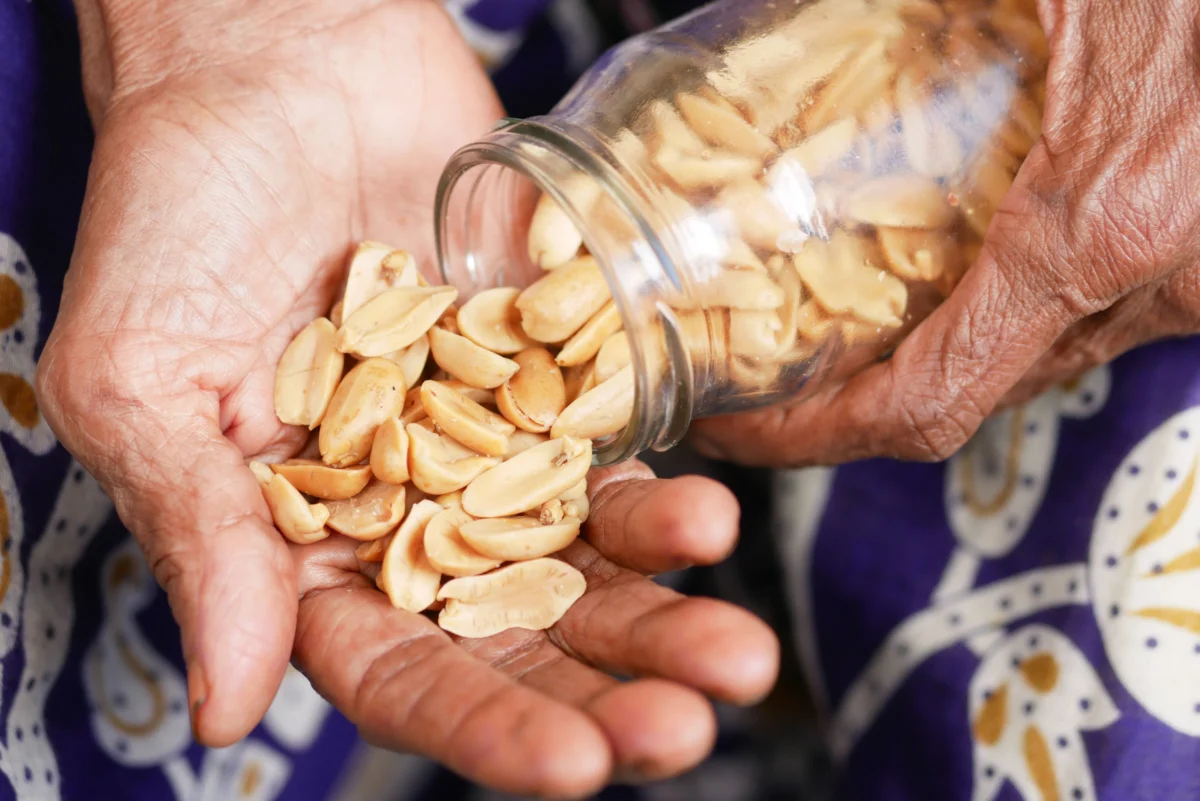
"A man’s consumption of a large bag of peanuts, a seemingly innocuous dietary choice, led to a life-threatening intestinal obstruction, highlighting the rare but serious phenomenon of bezoars and the complex interplay of diet, anatomy, and prior medical history."
A man in his 70s found himself in a Canberra hospital experiencing severe abdominal pain and vomiting, a condition that initially baffled medical professionals. His symptoms, including an inability to pass gas or stool, pointed towards a serious intestinal blockage. While the immediate cause was traced back to the consumption of an entire bag of peanuts, the underlying mechanism, a bezoar, is a fascinating medical anomaly. This case, documented in the Journal of Surgical Case Reports, serves as a stark reminder that even common foods, when combined with specific individual vulnerabilities, can precipitate severe health crises. The journey from a casual snack to a surgical emergency underscores the importance of understanding how our digestive systems work and the potential complications that can arise when they falter.
The man’s ordeal began with an ordinary decision: finishing a bag of peanuts before they expired. Within 24 hours, however, he was admitted to a Canberra hospital presenting with acute abdominal pain and vomiting, unable to pass flatus or stool. Initial diagnostic imaging, a CT scan, revealed dilated loops of the small bowel, with what was interpreted as ordinary fecalization at a transition point, suggestive of an adhesional obstruction. Despite two days of conservative management, his condition deteriorated, leading to the development of peritonitis, a serious inflammation of the abdominal lining. This necessitated surgical intervention.
During the operation, surgeons discovered a firm mass palpable through the bowel wall. Upon opening a healthy segment of the bowel, they extracted approximately 500 milliliters of undigested peanuts. The patient was subsequently discharged on the eighth day of hospitalization. This extraordinary case, described as the third documented instance of a peanut bezoar in medical literature, brings to light the phenomenon of bezoars – solid masses of indigestible material that can form and obstruct the gastrointestinal tract.
A bezoar is, in essence, a concretion that fails to pass through the digestive system, instead accumulating and solidifying. The most common type is the phytobezoar, composed of plant matter such as fiber, skins, and seeds. Other forms include trichobezoars (hair), pharmacobezoars (undissolved medication), and lactobezoars (milk protein and mucus, typically seen in infants). While the stomach is the most frequent site for bezoar formation, they can migrate and cause obstruction in the intestines.
The formation of phytobezoars is often linked to the inability of the stomach to adequately grind or empty indigestible plant components like cellulose, hemicellulose, lignin, and fruit tannins, which are resistant to gastric acid. Over time, these materials can aggregate and harden into a solid mass. Persimmons are particularly notorious for causing diospyrobezoars due to shibuol, a soluble tannin in unripe fruit skins that reacts with stomach acid, polymerizes, and traps cellulose and protein, creating a remarkably hard and treatment-resistant mass. The medical literature also lists a variety of other foods implicated in bezoar formation, including celery, pumpkin, grape skins, prunes, oranges, coconut, various seeds, and mushrooms. Peanuts, however, are a rare culprit, making this case particularly noteworthy.
Bezoars represent a relatively uncommon cause of mechanical intestinal obstruction, accounting for an estimated 0.4% to 4% of such cases. While the vast majority of individuals who consume large quantities of peanuts experience no adverse effects, certain predisposing factors increase the risk of bezoar formation. These include a history of gastric surgery, impaired gastrointestinal motility, intestinal strictures, hypothyroidism, poor chewing ability, and a diet high in fiber.
In the case of the 70-year-old man, while he did not present with the typical gastrointestinal motility issues, he had a complex surgical history. He had undergone a cholecystectomy (gallbladder removal) that converted from a laparoscopic procedure to an open surgery due to significant adhesions. This was further complicated by bleeding requiring a massive blood transfusion and two subsequent return trips to the operating room. His surgeons hypothesized that an adhesion to the anterior abdominal wall may have created a narrowing in the bowel, providing a site for the peanuts to coalesce and form the bezoar.
Diagnostic imaging, such as CT scans, can present challenges in differentiating a phytobezoar from retained bowel content, a difficulty that has been explicitly described in radiological literature. This similarity can lead to misdiagnosis, with radiologists sometimes interpreting the bezoar as fecalization. In retrospect, the fecalization observed on this patient’s scan was indeed the bezoar. This highlights the crucial role of clinical history, specifically inquiring about recent dietary intake, in the diagnosis of bezoars.
The treatment approach for bezoars varies significantly depending on their location within the gastrointestinal tract. For bezoars lodged in the small intestine, surgery is often the only recourse. However, for masses remaining in the stomach, a more unusual and often effective treatment involves the use of Coca-Cola. A systematic review of 24 papers encompassing 46 patients found that dissolving gastric phytobezoars with Coca-Cola was successful in 91.3% of cases. This success was attributed to the beverage’s acidity, which closely mirrors gastric acid, its mucolytic properties, and the mechanical action of carbon dioxide bubbles. While effective for ordinary phytobezoars, dissolution with Coca-Cola was less successful for persimmon-derived diospyrobezoars.
When dissolution therapies fail, endoscopic techniques can be employed to fragment the mass using snares, baskets, or lithotripsy. Surgery remains the definitive treatment for bezoars that are too large or too hard to break down endoscopically, or for those that have already caused complications such as perforation or bleeding. When surgical intervention is necessary, surgeons often attempt to fragment the mass and gently milk it into the cecum, where it is less likely to cause further obstruction. Bowel incision is typically reserved for situations where this approach is not feasible. Laparoscopic surgery has also been found to be a safe and effective option for selected patients, potentially leading to shorter hospital stays.
It is important to emphasize that the occurrence of bezoars does not imply that consuming fruits, vegetables, or nuts is inherently dangerous. Medical case reports, like this one, describe specific events rather than statistical frequencies, and none of these studies quantify the likelihood of bezoar formation following the consumption of particular foods.
Instead, these cases underscore a narrower but critical point: individuals with a history of gastric surgery, a complicated surgical abdomen, diabetic gastroparesis, or significant dental issues should exercise caution when consuming large quantities of fibrous food rapidly. Furthermore, if they experience symptoms such as abdominal pain and vomiting, they should promptly inform their healthcare providers about their recent dietary intake. Persistent vomiting after meals accompanied by unrelenting upper abdominal pain warrants a thorough medical evaluation rather than a "wait-and-see" approach.
Following the successful treatment of a bezoar, clinicians typically advise patients to reduce their intake of high-fiber foods and to pay closer attention to chewing their food thoroughly. This is because recurrence is possible if the underlying predisposing condition remains unaddressed. Any individual identified as being at risk who has concerns about their diet should consult with a physician rather than making dietary adjustments based solely on isolated case reports. The case of the peanut bezoar, while rare, serves as a powerful illustration of how seemingly benign dietary habits can, in the context of specific anatomical and physiological vulnerabilities, lead to severe medical emergencies.
