
“The transition of Green Lantern from cosmic space opera to grounded prestige drama marks a pivotal shift in how DC adapts its most complex mythologies for a modern television audience.”

This evolution reflects a broader movement within superhero media to prioritize character-driven narratives and thematic depth over purely spectacle-based action. By stripping away the intergalactic clutter and refocusing on a gritty, terrestrial mystery, the new HBO series Lanterns aims to reclaim a legacy that has struggled to find its footing in live-action for over a decade.
Since 1940, the Green Lantern mantle has served as a cornerstone of the DC Comics universe, representing an ever-evolving symbol of willpower and duty. The identity of the Lantern has never been static; it began as Alan Scott, a blond magician in a flowing red shirt and purple cape, before being reimagined in the late 1950s as Hal Jordan, a sleek test pilot in emerald and black. Later iterations introduced John Stewart, a disciplined Marine and architect, and Guy Gardner, a brash everyman with a singular attitude. Despite this rich history and the concept’s enduring popularity on the comic book page, translating the "Space Cops" mythos to the screen has proven notoriously difficult.

The franchise’s most public struggle remains the 2011 Green Lantern film starring Ryan Reynolds. The movie was a critical and commercial disappointment, so much so that it became a recurring punchline in Reynolds’ subsequent Deadpool films. The 2011 effort struggled to balance wonky cosmic lore—including an intergalactic police force, immortal blue Guardians, and rings vulnerable to the color yellow—with a narrative that felt palatable to mass audiences. While the character John Stewart found success as a mainstay of the beloved Justice League animated series in the early 2000s, the live-action potential of the property remained dormant until the recent restructuring of the DC Universe under James Gunn and Peter Safran.
The answer to this long-standing adaptation challenge is Lanterns, a prestige HBO series that signals a departure from the traditional superhero formula. The creative pedigree of the show suggests a shift toward the "prestige TV" model; it is led by Chris Mundy, a veteran producer of the gritty crime drama Ozark, alongside Damon Lindelof, the visionary co-creator of Lost, The Leftovers, and the Emmy-winning Watchmen series. Adding further depth to the writing team is Tom King, one of the most acclaimed modern comic book writers, known for his ability to humanize god-like figures.

Lanterns stars Kyle Chandler as a veteran, cocky Hal Jordan and Aaron Pierre as John Stewart, a young recruit trained to be Jordan’s backup—and perhaps his replacement. The dynamic between the two is central to the show’s "buddy-cop" structure. Rather than patrolling the far reaches of space, the duo finds themselves investigating an unlikely murder in a small Nebraska town. This creative choice serves a dual purpose: it keeps the weirder, more alienating parts of the mythos on the periphery while allowing the show to function as a character-focused detective story in the vein of True Detective.
To understand the foundations of Lanterns, one must look at the decades of comic book history that informed its creation. The Green Lantern saga is effectively divided into eras that reflect the changing tastes of the American public. The first Green Lantern, Alan Scott, debuted in 1940’s All-American Comics #16. Created by Martin Nodell and Bill Finger, the character was rooted in the Aladdin myth, utilizing a magical wishing ring forged from a green asteroid. However, when DC Comics editor Julius Schwartz led a science-fiction reimagining of the company’s heroes in the 1950s, the character was fundamentally altered.

The modern iteration began in Showcase Comics #22 (1959) by writer John Broome and artist Gil Kane. In this issue, the alien Abin Sur crash-lands near a California air strip and uses his power ring to find a successor who is "utterly honest and born without fear." He chooses test pilot Hal Jordan. This established the Green Lantern Corps as an intergalactic police force, patrolling space sectors with rings that create hard-light constructs limited only by the wearer’s imagination.
As the 1960s progressed, the mythos expanded to include alien members of the Corps like Katma Tui and Tomar-Re. It also introduced Guy Gardner in Green Lantern #59 (1968). Interestingly, Gardner was revealed to be Abin Sur’s second choice; Hal Jordan only received the ring because he happened to be closer to the crash site. While modern audiences may know Gardner as the brash doofus played by Nathan Fillion in the 2025 Superman film, his early appearances depicted him as a more traditional, heroic figure before a coma and subsequent brain damage altered his personality into the "lovable galoot" fans recognize today.

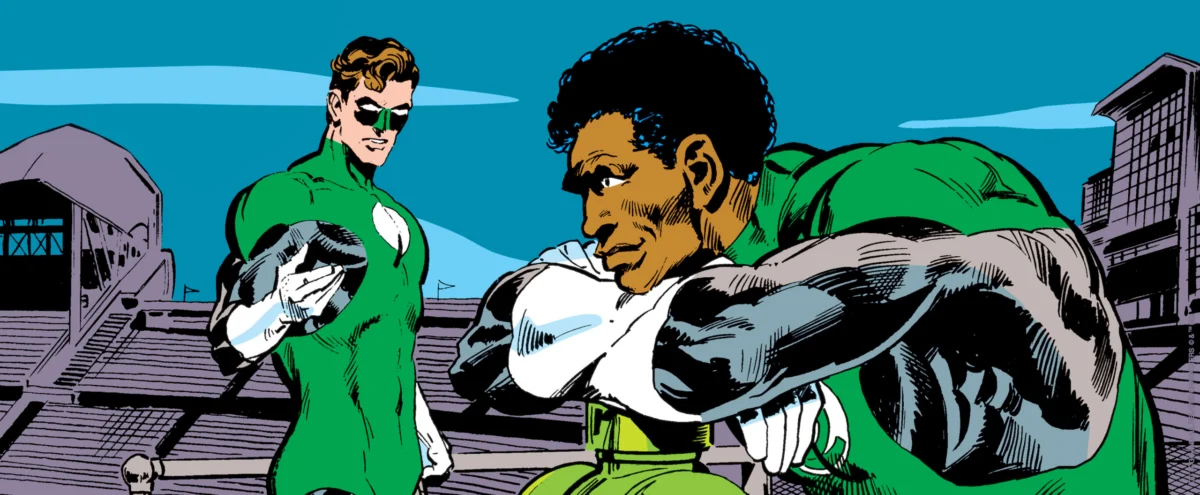
The most significant shift in the franchise’s social consciousness occurred in 1972 with Green Lantern #87. Written by Dennis O’Neil and illustrated by Neal Adams, this issue introduced John Stewart as a new backup for Jordan. O’Neil and Adams were pioneers in diversifying the DC roster, though their initial depiction of Stewart as an "angry young man" is often viewed today as a well-meaning but somewhat uninformed attempt at social commentary by white creators. Nevertheless, Stewart evolved into one of the most nuanced characters in the DC pantheon—a transition that Aaron Pierre’s performance in Lanterns aims to solidify.
The aesthetic of the HBO series—which features the heroes in plainclothes rather than emerald spandex—draws heavy inspiration from the "Hard-Traveling Heroes" era of the early 1970s. In Green Lantern #76–81, O’Neil and Adams paired the authoritarian Hal Jordan with the liberal Green Arrow for a cross-country road trip. They traveled across America in a beat-up truck, confronting real-world issues like racism, poverty, and drug addiction. This era stripped away the cosmic escapism to ask what superheroes owed to the people on the ground, a theme that resonates deeply in the new television adaptation.

While Lanterns grounds itself in a Nebraska mystery, it does not entirely ignore the franchise’s high-concept roots. A major antagonist looming in the series is the Manhunters. Long before the Guardians of the Universe created the Green Lantern Corps, they built a legion of android peacekeepers known as Manhunters. When these robots malfunctioned and decimated an entire space sector, the Guardians realized that protectors needed a moral compass—leading to the recruitment of living beings. The Manhunters remain a fundamental threat in the comics, most notably in Geoff Johns’ 2005 relaunch, Green Lantern: Rebirth, which brought Hal Jordan back to prominence and restored the character’s status as a top-tier hero.
The modern era of Green Lantern comics continues to push boundaries, providing a roadmap for where the TV series could go. Phillip Kennedy Johnson’s Green Lantern: War Journal (2023) explores John Stewart not just as a soldier, but as a man dealing with family and the burden of near-godlike power. Simultaneously, the Absolute Green Lantern line by Al Ewing and Jahnoy Lindsay offers a radical reimagining of the lore, placing familiar characters in a sci-fi horror setting.

Even Jeremy Adams’ current run on the main Green Lantern title demonstrates the concept’s versatility, blending old-school adventure with a modern mystery involving a quarantined Earth and the return of Hal’s arch-nemesis, Sinestro. This wealth of source material ensures that while Lanterns begins as a grounded murder mystery, it has a vast universe of cosmic horror and political intrigue to draw from in future seasons.
Ultimately, Lanterns represents a sophisticated gamble for HBO and DC. By moving away from the "wonky lore" that hobbled previous adaptations and embracing the gritty, investigative storytelling that has defined the "Golden Age of Television," the series seeks to prove that the Green Lantern concept is more than just a toy-friendly gimmick. It is a story about legacy, the friction between veteran experience and youthful idealism, and the courage required to face the darkness—whether that darkness is found in the far reaches of a distant nebula or the quiet corners of a small American town. Through this lens, the Green Lantern’s light has never been more focused.
