
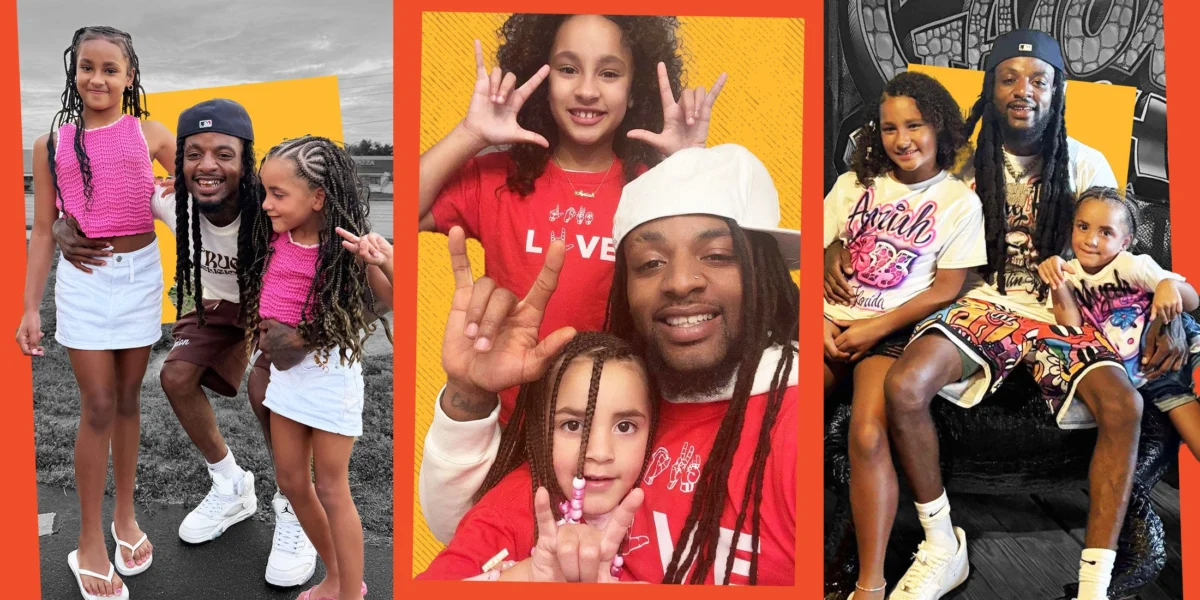
"Disability has never stopped me from being a father; the greatest challenge is not the physical limitation itself, but a society that often refuses to see the person behind the diagnosis."
Ronnie McKenzie, known to millions online as "King Ron," serves as a powerful counter-narrative to the medical limitations often placed on individuals with Usher syndrome. By documenting his journey as a Black, deaf-blind father of two, McKenzie is dismantling antiquated perceptions of disability, proving that the essence of parenthood lies in presence, character, and emotional connection rather than sensory or physical perfection.
The Prognosis and the Reality
When Ronnie McKenzie was a child, medical professionals offered a bleak outlook on his future. He was told that the traditional milestones of adulthood—specifically parenthood—would likely remain out of reach. This prognosis was rooted in the challenges associated with Usher syndrome, a rare genetic disorder that serves as a leading cause of combined deafness and blindness. For many, such a diagnosis is framed as a series of "cannots." However, at age 32, McKenzie stands as a living refutation of those early limitations. He is the father of two daughters, ages 10 and 5, and has built a digital community of over two million followers who look to him for insight into a life lived at the intersection of disability and devotion.
McKenzie’s journey into fatherhood began at 22. By his own admission, he was still navigating the transition from adolescence to adulthood, focused on basketball and gaming. The birth of his first daughter forced an immediate evolution, shifting his focus from self-interest to a purpose larger than himself. Today, he identifies not just as a parent, but as an advocate for accessibility, utilizing his platform to speak for those who communicate through non-traditional means, including the deaf, blind, autistic, and nonverbal communities.
Understanding Usher Syndrome
To understand McKenzie’s daily life, one must understand the clinical reality of Usher syndrome. It is a condition characterized by hearing loss—often from birth—and a gradual loss of vision due to retinitis pigmentosa (RP). RP causes the retina’s light-sensing cells to gradually deteriorate, typically beginning with night blindness and the loss of peripheral vision, eventually leading to "tunnel vision" or total blindness.
For McKenzie, navigating this landscape requires a sophisticated blend of technology and adaptation. He utilizes a cochlear implant and a hearing aid to facilitate communication, but these tools have limitations. When the devices are removed—such as during sleep, showering, or swimming—he enters a world of total silence. This sensory flux requires a heightened level of intentionality in parenting. While a hearing parent might respond to a child’s cry from another room through sound, McKenzie must rely on established routines, tactile cues, and assistive technology to ensure his daughters are safe and supported.
The Social Model of Disability in Parenting
McKenzie’s experiences highlight the distinction between the "medical model" of disability, which focuses on "fixing" the individual, and the "social model," which suggests that people are disabled by barriers in society. He notes that the easiest part of his life is the core of parenting: loving, encouraging, and being present for his daughters. The difficulty arises from external perceptions and a lack of systemic support.

He frequently encounters "benevolent ableism"—instances where strangers or other parents assume he is incapable of performing "regular dad things" or offer unsolicited help. These interactions stem from a societal bias that equates physical disability with a lack of agency. McKenzie argues that disabled parents are parents first. The "disability" often comes from the environment: the lack of accessible parenting classes, the scarcity of adaptive parenting equipment (such as vibrating baby monitors or tactile safety markers), and the absence of representation in schools and community programs.
Redefining Masculinity and Fatherhood
One of the most profound aspects of McKenzie’s advocacy is his critique of traditional masculinity. In many cultures, the "ideal" man is defined by physical strength and the role of the "sighted protector." For a man with progressive vision and hearing loss, these outdated metrics can be damaging. McKenzie asserts that true masculinity is found in character and the ability to show up for one’s family regardless of physical constraints.
"Being a man isn’t about having a perfect body," McKenzie explains. It is about the emotional labor of parenting—changing diapers, cooking meals, comforting a crying child, and teaching life lessons. By refusing to hide his disability and by asking for help when necessary, McKenzie is helping to model a more inclusive version of fatherhood for the next generation. He wants his daughters to grow up in a world where everyone is afforded respect, regardless of how they communicate or what physical challenges they face.
The Power of Representation
Growing up, McKenzie rarely saw Black, disabled fathers in the media. This lack of representation can lead to internalizing the "can’t" messages delivered by doctors and society. By becoming "King Ron," he has turned his personal life into a public educational tool. His content is not merely about the struggle; it is about the joy, the humor, and the mundane reality of raising two girls.
With over 1.1 million followers on specific platforms, McKenzie recognizes that his influence is a tool for change. He uses his voice to demand better communication access and more inclusive healthcare environments. For young disabled people, seeing a man who is not only surviving but thriving provides a blueprint for their own futures. It shifts the conversation from "How will I cope?" to "What can I achieve?"
Navigating the Future
As Usher syndrome is often progressive, McKenzie continues to adapt to changing vision levels. This requires a constant cycle of problem-solving. Yet, his focus remains on the legacy he leaves for his daughters. He aims to raise them to be compassionate and confident, ensuring they understand that fear should never be a barrier to chasing dreams.
His story serves as a reminder that the human spirit is remarkably resilient when provided with the right tools and a supportive community. McKenzie’s "proof" that the doctors were wrong is not found in a medical miracle, but in the laughter of his children and the strength of the community he has built. He continues to challenge the world to look past the white cane or the cochlear implant to see the father, the advocate, and the man who refused to let a diagnosis define his worth.
In the broader context of public health and social equity, McKenzie’s message is clear: accessibility is not a luxury; it is a fundamental requirement for a just society. Whether it is through better infrastructure in hospitals or more inclusive representation in digital media, the goal is to ensure that no parent is ever told that their disability makes them "incapable" of the most universal of human experiences—raising a family.
