
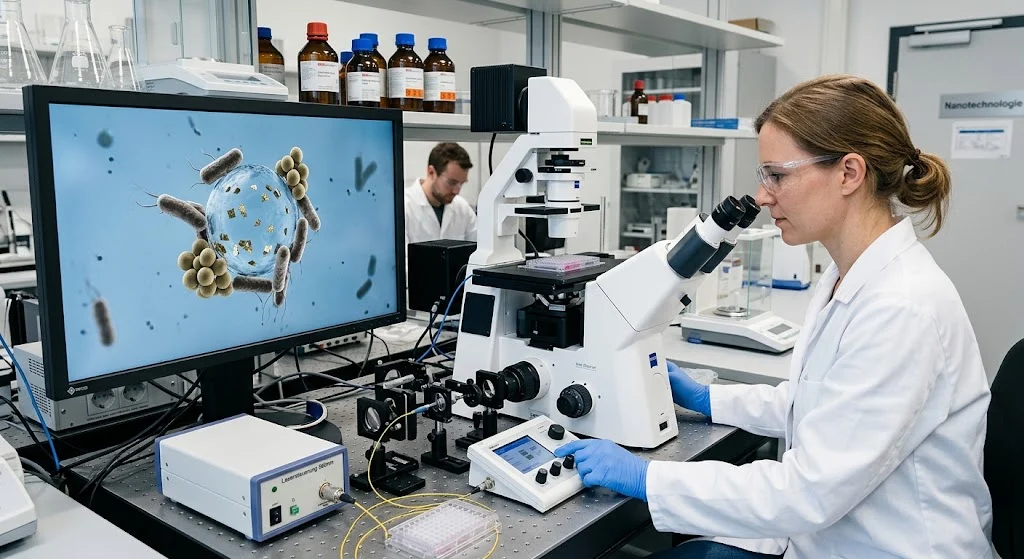
"Scientists have engineered nanorobots, smaller than a micrometer, that are propelled and steered by light, enabling them to capture and transport bacteria through controlled physical forces rather than conventional mechanical means."
In a remarkable feat of miniaturization and precision engineering, researchers have unveiled microscopic robots capable of navigating fluid environments and collecting bacterial cells. These light-powered machines, measuring less than a micrometer in width, represent a significant leap forward in the manipulation of microorganisms at the nanoscale. While still in the experimental phase and not yet tested for medical applications, this groundbreaking technology demonstrates a novel approach to controlling and moving biological entities, opening new avenues for scientific inquiry and potential future applications in fields ranging from bioengineering to environmental cleanup.
The development, spearheaded by scientists from Julius-Maximilians-Universität Würzburg and the Leibniz Institute of Photonic Technology in Germany, challenges the conventional understanding of robotic locomotion and manipulation. Traditional robots rely on intricate mechanical components, motors, and power sources, which become impractical at the nanoscopic scale. Instead, these innovative nanorobots leverage the power of light to achieve movement and to interact with their environment, specifically targeting and gathering bacteria. The findings, published in the esteemed journal Nature Communications, detail a system that could redefine how we approach microscopic manipulation.
The smallest of these newly developed robots boasts a diameter of approximately 920 nanometers, or 0.92 micrometers. To provide perspective, a human hair typically measures tens of micrometers in width, meaning these nanorobots are roughly 50 times smaller in diameter than a single strand of hair. Their construction involves sophisticated design, incorporating tiny gold structures known as plasmonic antennas. These antennas are embedded within a transparent body and are specifically engineered to interact with laser light. The entire nanorobot is incredibly light, with a mass of only about 0.26 picograms, underscoring the challenges of equipping such minuscule devices with conventional power and propulsion systems.
The ingenious solution lies in the utilization of light as both the motive force and the steering mechanism. Researchers employ an unfocused 980-nanometer laser to propel these nanorobots through aqueous environments. When the laser beam strikes the robot’s plasmonic structures, these gold antennas scatter light asymmetrically. This asymmetric scattering alters the momentum of the light, generating a small but consistent recoil force that propels the nanorobot forward. Furthermore, the orientation of the robot can be precisely controlled by manipulating the polarization of the light. This allows for remote steering without any physical contact or the need for the laser beam to constantly chase the robot, offering a high degree of maneuverability. In laboratory settings, these nanorobots have successfully navigated programmed paths, including rectangular trajectories and even forming intricate patterns that spelled out "EP5." Their peak speed achieved in these experiments was around 50 micrometers per second, demonstrating their potential for rapid movement within their microscopic domain.
The mechanism by which these nanorobots collect bacteria is equally sophisticated and does not involve any physical grasping appendages like tiny claws or arms. Instead, bacteria are drawn towards the illuminated robot through physical forces generated around its surface. The gold plasmonic structures not only scatter light for propulsion but also absorb some of the laser energy, leading to localized heating. This creates a subtle temperature gradient in the surrounding liquid. This temperature difference drives a phenomenon known as thermophoresis, which exerts a force that attracts bacteria towards the warmer, illuminated robot. As the bacteria get very close to the robot’s surface, an additional force, known as optical trapping, helps to firmly hold them in place.
Researchers have validated this collection capability through experiments conducted in aqueous suspensions containing common bacteria such as Escherichia coli and Staphylococcus carnosus. They observed bacteria being effectively captured and held around the nanorobots before being transported through the liquid. It is crucial to clarify the term "hunt" in this context. These robots do not possess sophisticated sensing capabilities to detect individual bacteria or make independent decisions about pursuit. Their movement is entirely under the control of researchers, and the bacteria are attracted and held through passive physical effects induced by the light and the robot’s structure.
A remarkable aspect of this technology is the robots’ capacity to carry significant bacterial loads. Even when laden with hundreds of times their own mass in bacteria, the nanorobots remain maneuverable. However, an increased bacterial payload does introduce greater drag in the surrounding liquid, consequently reducing the robot’s speed. Demonstrations have shown a single nanorobot successfully transporting an E. coli bacterium along a path shaped like the numeral five. Similarly, a larger microrobot, used for easier observation of interactions, was employed to transport clusters of S. carnosus bacteria along rectangular and "6"-shaped trajectories.
The bacteria are not permanently affixed to the nanorobots. Their attachment is facilitated by the aforementioned optical and thermophoretic forces, rather than a chemical or mechanical bond. This allows for controlled release of the collected bacteria. By altering the illumination conditions, researchers can change the forces acting on the bacteria, causing them to detach from the robot. This ability to collect, transport, and then release bacteria at a desired location adds another layer of utility to the technology. The researchers have demonstrated this by using the robots to gather bacteria from a specific area and relocate them. They have also shown that a nanorobot can systematically sweep through a larger region of liquid, effectively concentrating the bacteria in a designated spot. This function has been described as a form of nanoscale robotic cleaning.
The concept of these microscopic robots acting as mobile cleaners is particularly compelling. The laser illumination is confined to a limited area, necessitating a combined approach of robot movement and precise movement of the sample stage. This allows the nanorobot to effectively cover a larger area than it could if it were restricted to a single, stationary laser spot. As the robot traverses the liquid, it continuously gathers bacteria in its vicinity. In one compelling demonstration, this method proved capable of substantially clearing a targeted area of bacteria, showcasing its potential for localized decontamination or sample preparation. This capability moves beyond simply transporting individual cells and highlights the potential for systematic manipulation of microorganisms within microscopic environments by remotely controlled nanoscale machines.
The scientific community’s interest in this technology stems from its potential to provide researchers with an unprecedented tool for handling biological materials in highly confined spaces. While conventional optical tweezers can manipulate individual bacteria, they typically rely on tightly focused light beams and are limited to trapping single entities. The nanorobot approach, in contrast, utilizes a mobile platform that can collect multiple bacteria in its proximity and transport them collectively. Moreover, the laser intensity employed in these experiments is significantly lower—two orders of magnitude less—than that typically required for optical trapping of bacteria, suggesting a gentler interaction with biological samples. The researchers estimate that the temperature increase under their experimental conditions remained below 10 Kelvin, minimizing potential damage to the cells. The authors envision that this platform could eventually contribute to advancements in biological manipulation, localized sensing, bioengineering, and targeted drug delivery, although these remain future possibilities rather than immediate applications.
The idea of microscopic robots entering the human body to combat infections is an intuitive and exciting prospect. However, it is crucial to emphasize that this research has not yet demonstrated such capabilities. The experiments were conducted in controlled laboratory environments using aqueous suspensions. The study did not establish the robots’ ability to navigate complex biological systems, locate infections within the human body, or eliminate harmful bacteria in vivo. Translating this technology into medical applications would necessitate overcoming substantial challenges, including developing methods for controlling robots in dynamic and complex biological environments, ensuring their safe delivery to specific target sites, and understanding their potential interactions with living tissues and the implications of laser illumination within the body.
For the present, the significance of this research lies in its fundamental scientific achievement. Scientists have successfully engineered a machine smaller than a micrometer that can be propelled and steered by light while simultaneously manipulating living microorganisms. This is achieved without the need for miniature motors, claws, or other conventional robotic components. Light provides the propulsion and directional control, while physical forces generated around the robot’s surface attract and capture bacteria. The researchers’ precise control over the robot’s trajectory transforms this minuscule object into a sophisticated tool, akin to a microscopic cleaning device. While the technology is still a considerable distance from treating infections or operating within the human body, it offers a compelling glimpse into the future of robotics, where machines are small enough to interact directly with and manipulate the microbial world.
