
"True physical longevity is built through the integration of foundational strength and dynamic mobility, proving that a high-efficiency 20-minute window can yield greater results than hours of unfocused training."

As Men’s Health celebrates its 38th anniversary, the landscape of fitness has undergone a radical transformation from the aesthetic-heavy bodybuilding trends of the late 1980s to the performance-driven, functional longevity models of today. This 20-minute full-body workout represents a synthesis of that evolution, curated by a "brain trust" of six elite trainers who have shaped the magazine’s fitness philosophy over four decades. By combining traditional resistance training with multi-planar movements, this protocol offers a scalable solution for the modern man who requires maximum physiological return on a minimal time investment.
The Legacy of Men’s Health Fitness
Since its inception in 1986, Men’s Health has served as a primary chronicle for the evolution of the male physique and the science of wellness. In the early years, the focus often mirrored the "Golden Era" of bodybuilding, emphasizing isolation movements and hypertrophy. However, as sports science matured, the editorial direction shifted toward "functional fitness"—the idea that strength should not just look good but should also improve one’s ability to move through the world.

This anniversary workout is a tribute to that journey. It doesn’t just ask you to lift weights; it asks you to stabilize, rotate, hinge, and press in ways that mirror real-world demands. To build this routine, the editors reached back through the archives, recruiting voices like Lou Schuler, the magazine’s fitness director during the pivotal late 90s, and David Otey, a modern specialist in strength and conditioning. The result is a workout that is both a history lesson and a high-performance blueprint.
The Science of the 20-Minute Window
The modern fitness enthusiast often faces the "time-crunch paradox": the desire for elite results despite a schedule that rarely allows for ninety-minute gym sessions. Research in exercise physiology suggests that metabolic conditioning and high-intensity resistance training can trigger significant hormonal responses—such as increased growth hormone and testosterone—within a relatively short timeframe, provided the density of the work is high.

This protocol utilizes a 40/20 work-to-rest ratio. By working for 40 seconds and resting for only 20, you maintain an elevated heart rate, crossing the threshold into aerobic and anaerobic conditioning simultaneously. This "Concurrent Training" model ensures that you are building muscle while burning fat and improving cardiovascular efficiency.
The Foundation: A Dynamic Warmup
Before diving into the weighted movements, the protocol begins with a 60-second block of the Walkout to Spiderman Lunge. This is not merely a stretch; it is a full-body "diagnostic" move.

The walkout phase activates the core and prepares the shoulders for weight-bearing. As you transition into the Spiderman lunge—stepping one foot outside the hand—you address the two most common areas of tightness in the modern male: the hips and the thoracic spine. By rotating the torso toward the lead leg, you unlock the mid-back, which is essential for safe overhead pressing and rowing. One minute of this movement signals the central nervous system to prepare for high-intensity output.
The Workout: A Collaborative Circuit
1. Romanian Deadlift to Alternating Row
Curated by Ebenezer Samuel, C.S.C.S. (Fitness Director, 2018–Present)

This movement represents the pinnacle of modern "compound" programming. The Romanian Deadlift (RDL) targets the posterior chain—the hamstrings, glutes, and lower back—which are often neglected in favor of the "mirror muscles" on the front of the body. By adding an alternating row at the bottom of the hinge, Samuel introduces a significant stability challenge. Your core must work overtime to prevent the torso from rotating as the weight shifts from side to side. This builds a "bulletproof" back and teaches the body to maintain tension under load.
2. 3-Point Dumbbell Row
Curated by Lou Schuler, C.S.C.S. (Fitness Editor, 1995–2004)

Schuler brings a classic, foundational perspective to the circuit. The 3-point row is a staple of strength training because it allows for heavy loading with a reduced risk of spinal injury. By using a bench or a rack for support, you create a stable tripod. This isolation allows you to focus entirely on the latissimus dorsi and the rhomboids. In an era where many exercises have become overly complex, Schuler’s inclusion of the 3-point row reminds us that basic pulling strength is the cornerstone of a powerful upper body.
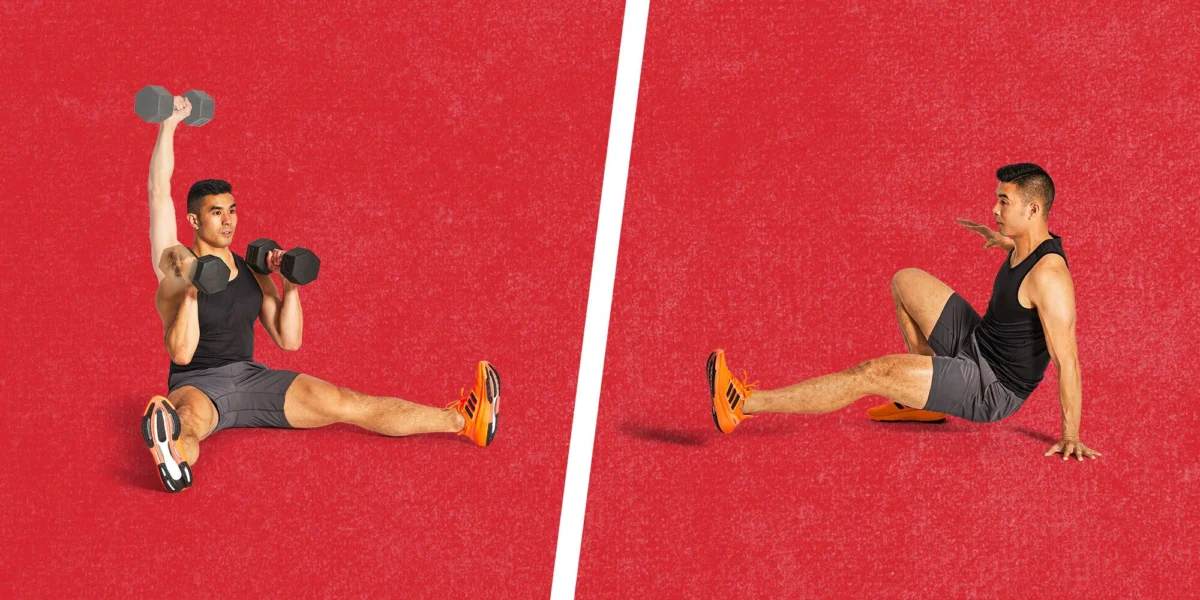
3. Sit-Through
Curated by Milo F. Bryant, C.S.C.S. (Contributor, 2019–Present)

The sit-through is a departure from traditional weightlifting, leaning into the world of wrestling and martial arts. This bodyweight move requires you to support your weight on all fours and "sit" one leg through to the opposite side while lifting the hand. It is an masterclass in shoulder stability, hip mobility, and rotational core power. As fitness has evolved, we have learned that being "strong" is useless if you cannot move your own body weight through space. The sit-through ensures that your strength is athletic, not just static.
4. Alternating Reverse Lunge
Curated by Bobby Maximus (Contributor, 2012–Present)

Bobby Maximus is known for a "no-frills" approach to mental and physical toughness. The reverse lunge is his choice for lower-body development because it is generally safer for the knee joint than the forward lunge. By stepping backward, you ensure the shin of the front leg remains vertical, putting the emphasis on the glutes and hamstrings rather than the patellar tendon. It is a high-repetition burner that tests balance and unilateral (one-sided) strength, correcting imbalances that often lead to injury.
5. Reciprocating Dumbbell Press
Curated by David Otey, C.S.C.S. (Contributor, 2017–Present)

While a standard chest press is effective, David Otey’s "reciprocating" variation adds a layer of coordination. As one dumbbell is lowered, the other is pressed upward. This constant motion eliminates the "rest" phase of a standard lift, keeping the pectoral muscles under continuous tension. Furthermore, the reciprocating action forces the core to stabilize the shifting weights, preventing the ribcage from flaring and ensuring that the force is generated from a stable, integrated base.
6. Alternating Z Press
Curated by Adam Bornstein, C.S.C.S. (Fitness Editor, 2008–2011)

The Z Press is perhaps the most demanding shoulder exercise in the routine. By sitting flat on the floor with your legs extended, you remove the ability to use your legs or "cheat" by arching your back. This forces the shoulders and the entire core to do 100% of the work. If your core is weak or your posture is poor, the Z Press will immediately expose it. Bornstein’s selection highlights the modern emphasis on "pure" strength and postural integrity, ensuring that the 20-minute session ends with a high-intensity challenge to the body’s vertical stability.
Implementation and Long-Term Strategy
To maximize the benefits of this 38th-anniversary protocol, consistency is paramount. The recommendation is to perform the circuit four times per week. This frequency allows for sufficient recovery while maintaining a high enough volume to stimulate muscle growth and cardiovascular adaptations.

On the three "off" days, the focus shifts to active recovery. A 20-minute walk or light run serves two purposes: it aids in the removal of metabolic waste from the muscle tissue and maintains a baseline of aerobic fitness. This holistic approach—combining intense, multi-planar resistance work with steady-state cardio—mirrors the most current advice for long-term health and heart disease prevention.
The Future of the Discipline
As we look toward the next 38 years, the lesson of this workout is clear: the most effective fitness programs are those that respect the foundations of the past while embracing the movement science of the future. By bringing together these six experts, Men’s Health has created more than just a workout; they have provided a roadmap for sustainable, high-level physical performance. Whether you are a beginner or a seasoned athlete, this 20-minute protocol proves that with the right movements and the right intensity, the best version of your physique is always within reach.
