
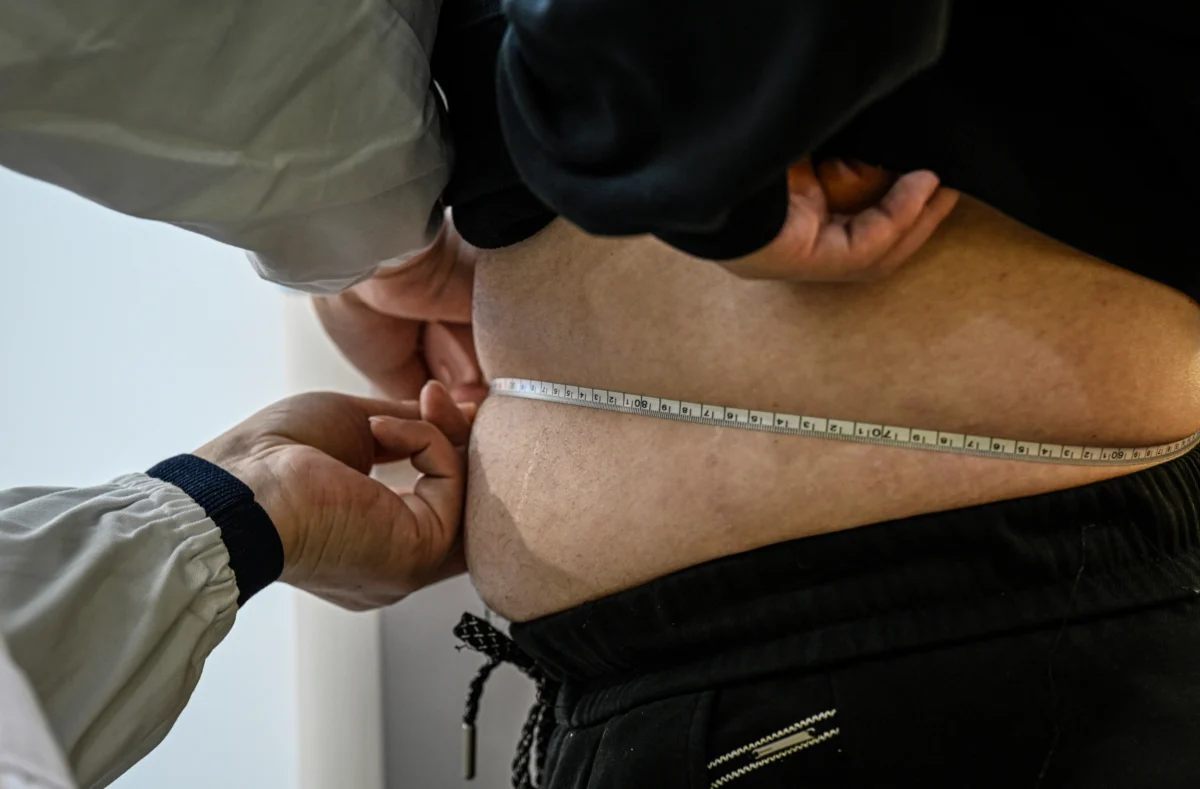
"A simple waist circumference measurement, easily taken at home, performs nearly as well as a sophisticated, multi-measurement approach for identifying unhealthy body fat levels, according to a new Rutgers Health analysis. This finding challenges the need for overly complex screening tools and highlights the limitations of Body Mass Index (BMI) alone."
A groundbreaking analysis by Rutgers Health has revealed that a straightforward waist measurement, a metric readily accessible to individuals at home with a simple tape measure, demonstrates remarkable efficacy in identifying unhealthy levels of body fat. This accessible method performs comparably to a far more intricate framework involving multiple measurements, a finding published in the esteemed journal JAMA Network Open. The research also underscored a significant deficiency in the commonly used Body Mass Index (BMI) metric, revealing its failure to identify a substantial portion of individuals who meet established criteria for obesity based on body fat percentage. This suggests that relying solely on BMI may lead to a considerable underestimation of the prevalence of obesity and its associated health risks.
The study, conducted by researchers at Rutgers Health, delved into data from 1,900 U.S. adults aged 20 to 59 who participated in the National Health and Nutrition Examination Survey. These participants underwent DXA (dual-energy X-ray absorptiometry) scans, a highly precise imaging technique that provides a detailed breakdown of body composition, including lean mass, bone density, and fat mass. For the purpose of this study, obesity was defined by established body fat percentages: 25% or higher for men and 35% or higher for women. This rigorous definition, derived from direct body fat measurement, serves as a more accurate benchmark than indirect methods like BMI.
The practical implications of these findings are significant and immediately actionable. A single, easily captured metric – the waist circumference – that can be measured in seconds by clinicians and approximated by patients themselves, appears to encapsulate a substantial amount of the health information provided by a more cumbersome, four-measurement framework. This suggests a potential shift towards simpler, more accessible screening protocols in clinical settings and empowers individuals with a more reliable tool for self-awareness.
Simple Measures Held Their Own Against Complex Frameworks
One of the key components of the Rutgers analysis involved evaluating a recently proposed obesity identification framework developed by an expert commission. This sophisticated framework integrates several key metrics: Body Mass Index (BMI), waist circumference, waist-to-height ratio, and waist-to-hip ratio. While this comprehensive approach did succeed in identifying a greater number of individuals with excess body fat compared to simpler methods, the Rutgers team discovered that the gains in identification accuracy were not commensurate with the added complexity.
Crucially, the Rutgers researchers found that employing either BMI or waist circumference individually yielded a more favorable balance between correctly identifying individuals with obesity and minimizing false positive diagnoses. This means that while the multi-measurement framework might catch slightly more cases, it also generated more instances where individuals were incorrectly flagged as having obesity. In contrast, waist circumference, when used in isolation, performed remarkably close to the multi-measurement approach. Furthermore, the simpler methods, particularly waist circumference, proved more effective at flagging visceral obesity, a particularly harmful type of abdominal fat that surrounds internal organs and is strongly linked to metabolic dysfunction.
The emphasis on feasibility, as highlighted in a Rutgers summary of the findings, is a critical aspect of this research. The proposed expert commission framework requires the measurement of hip circumference, a metric that is not routinely recorded during typical clinical visits. Waist circumference, on the other hand, is significantly easier to measure and is increasingly being incorporated into established clinical guidelines. This ease of measurement translates directly to improved adherence and practicality in real-world healthcare settings.
Lead author Aayush Visaria, a faculty member at the Rutgers Health and RWJBarnabas Health Center for Climate, Health, and Healthcare and an instructor in the Department of Medicine at Rutgers Robert Wood Johnson Medical School, articulated a clear argument against unnecessary complexity. He stated that "A waist measurement provides much of the information needed and is feasible" for both healthcare providers and patients. This sentiment underscores the study’s core message: effective health screening does not always necessitate elaborate protocols.
Where BMI Fell Short: A Significant Blind Spot
Perhaps the most consequential finding of the Rutgers analysis is the revelation of BMI’s significant blind spot. When used as a standalone indicator, BMI proved inadequate in identifying a substantial proportion of individuals who met the study’s body fat criteria for obesity. This observation adds further weight to a long-standing critique of BMI as a sole diagnostic tool.
BMI, calculated as a ratio of weight to height, is inherently limited because it cannot differentiate between lean muscle mass and body fat. Moreover, it offers no insight into how body fat is distributed within the body. This means that two individuals with identical BMI scores can possess vastly different amounts of visceral fat. Visceral fat, accumulating around abdominal organs, is recognized as the most potent contributor to metabolic health risks, including insulin resistance, type 2 diabetes, and cardiovascular disease.
The fact that fat distribution is a critical determinant of health provides the mechanistic explanation for why waist measurement offers valuable information that BMI fails to capture. Visaria effectively conveyed this point with a relatable analogy, advising individuals to pay attention to signs like needing to loosen a belt or purchase larger pants. However, he also cautioned that clothing size is not a substitute for a standardized waist measurement taken correctly.
Measuring at Home: A Useful Screening Signal, Not a Diagnosis
The utility of waist measurement as a screening tool at home is significant, but it is crucial to understand its limitations. A high waist circumference reading should be interpreted as a signal to initiate a conversation with a healthcare provider, rather than as a definitive diagnosis of any specific health condition. It does not, in itself, establish the presence of diseases such as diabetes, heart disease, or other chronic ailments.
A number derived from a tape measure cannot be interpreted in isolation. It must be considered within the broader context of an individual’s overall health profile, which includes vital signs like blood pressure, blood sugar levels, cholesterol readings, and personal medical history. This caution extends to the proliferation of consumer health technologies, including food logging applications that have been shown in controlled testing to inaccurately estimate calorie and fat content.
The technique employed during measurement is also more critical than many individuals realize. Variations in where measurements are taken on the torso, whether over clothing, or shortly after a large meal, can all lead to different readings. This is precisely why standardized protocols are employed in clinical settings. A single home measurement that appears high should serve as a prompt to seek a professional measurement, not as grounds for drawing definitive conclusions about one’s health status.
For individuals with a history of disordered eating or those who find body measurements distressing, a different approach is warranted. In such cases, it is advisable to discuss health monitoring strategies with a clinician rather than engaging in frequent self-measurement at home. The psychological impact of constant self-monitoring can be detrimental for some individuals, and a personalized approach guided by a healthcare professional is essential.
Limitations of the 1,900-Person Sample
While this analysis provides valuable insights, it is important to acknowledge its limitations. The study included 1,900 adults between the ages of 20 and 59. It did not encompass adults aged 60 and older, a demographic where body composition naturally changes with age, nor did it include individuals under the age of 20. Therefore, the findings may not be directly applicable to these age groups without further investigation.
This study represents a cross-sectional comparison of screening methods against a body fat reference standard. Its primary objective was to assess how well each approach identifies excess body fat at a single point in time. It does not involve tracking participants over extended periods to determine which measurement best predicts the development of diseases such as diabetes, heart disease, or stroke. Addressing those predictive questions requires prospective research, where individuals are followed over time and health events are meticulously recorded. Such studies, for example, might investigate how different exercise regimens impact various metabolic markers or explore the long-term cardiovascular implications of blood levels of common sweeteners.
Furthermore, the study does not establish a specific waist measurement threshold that individuals should universally apply to themselves. Appropriate cutoffs for waist circumference vary significantly based on sex, ethnicity, and broader population characteristics. The determination of such thresholds is a complex task typically undertaken by guideline-setting bodies, rather than by a single research analysis.
There is also a significant coverage angle to consider. The definitions used for screening can directly influence who qualifies for medical treatment. Broader obesity criteria can expand eligibility for essential services such as counseling, medication, and surgical interventions, while narrower criteria can restrict access. Consequently, the measurement approaches adopted by guideline bodies carry implications that extend beyond mere accuracy, impacting insurance coverage and the number of individuals who receive a formal diagnosis.
The researchers propose that their findings could inform future recommendations for obesity screening and advocate for the routine incorporation of waist circumference measurement into clinical care. However, it is crucial to note that current medical guidance has not yet been updated based on this study. Individuals who are concerned about their metabolic risk should continue to raise these concerns during their routine clinical visits. At such appointments, waist circumference will be considered as one of several important factors alongside laboratory results and family history, contributing to a comprehensive assessment of an individual’s health status.
