
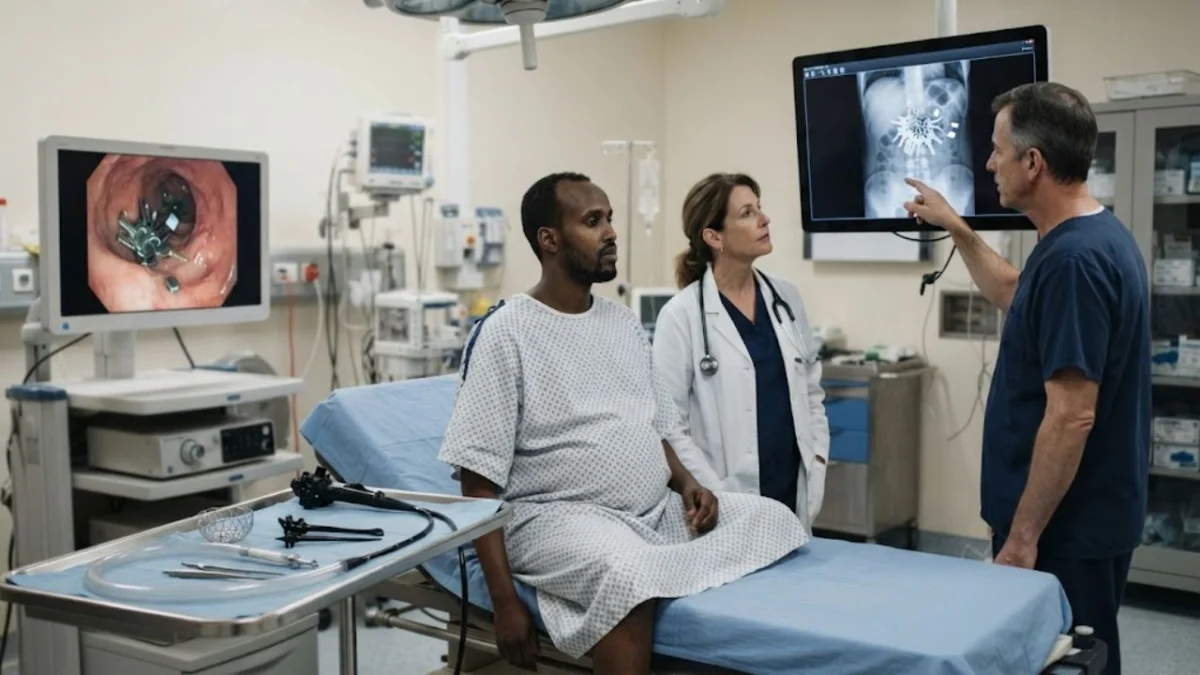
"In a remarkable medical feat, doctors in Mogadishu successfully removed 30 metal keys and two magnets from a patient’s stomach using endoscopy, highlighting the power of minimally invasive procedures while underscoring the serious risks associated with ingested magnets."
A 35-year-old man presented to an emergency department in Mogadishu, Somalia, exhibiting a distressing combination of symptoms: persistent vomiting, severe abdominal pain, and a progressively distended abdomen. These signs prompted medical professionals to investigate the underlying cause, leading to the discovery of a significant metallic mass lodged within his stomach. An initial X-ray clearly visualized a dense, sharply demarcated metallic object situated in the upper left quadrant of his abdomen, consistent with the location of the stomach. Further endoscopic examination revealed the astonishing contents: 30 metal keys and two magnets, tightly packed and beginning to cause ulceration of the stomach lining. In a testament to the efficacy of modern endoscopic techniques, all foreign bodies were successfully retrieved through the patient’s mouth, eliminating the need for surgical intervention. This highly unusual case, detailed in the Journal of Surgical Case Reports, is notable not only for the sheer volume and nature of the swallowed objects but also for the minimally invasive approach employed for their removal.
The retrieval of this substantial metallic burden was achieved using a flexible gastroscope, a sophisticated instrument that allowed physicians to navigate the digestive tract without invasive surgery. The medical team employed specialized tools, including rat-tooth forceps and a retrieval basket, to grasp and extract each object. To facilitate repeated passage of the gastroscope and protect the delicate esophageal tissue from abrasion, an overtube was threaded down the esophagus. This meticulously executed procedure ensured that each of the 30 keys and two magnets were removed one by one, under direct visual guidance, minimizing trauma to the patient’s internal organs. Following the endoscopic removal, a follow-up abdominal X-ray confirmed the complete absence of foreign bodies from the stomach, providing immediate post-procedural reassurance. The patient was subsequently admitted for observation and referred for psychiatric evaluation, given the extraordinary nature of the ingestion and the patient’s reportedly unreliable account of the events. To ensure no objects were missed and to further assess the extent of any damage, a repeat endoscopy was performed the following day, which revealed a normal stomach lining, suggesting the initial ulceration was minor and responsive to prompt intervention.
Radiographic imaging, specifically plain radiography, remains the cornerstone of initial investigation when the ingestion of metallic foreign bodies is suspected. This non-invasive technique is highly effective in detecting radiopaque objects, such as keys and magnets, and in delineating their location. Computed tomography (CT) scans are typically reserved for cases where plain X-rays are inconclusive, such as when non-metallic objects are involved, or when there is a high suspicion of complications like perforation. In this instance, the conventional X-ray served its purpose admirably, pinpointing the metallic mass within the stomach before any endoscopic exploration was undertaken. Endoscopic retrieval of swallowed foreign bodies boasts an impressive success rate, often exceeding 95 percent, and is associated with a significantly lower risk of complications compared to procedures involving rigid instruments. Surgical intervention is generally reserved as a last resort, reserved for situations where endoscopic retrieval proves unsuccessful or in cases of documented perforation or obstruction, which were thankfully averted in this scenario.
The clinical presentation of swallowed foreign bodies can vary significantly, often leading to a misperception that such incidents are primarily confined to the throat. While indeed the upper esophagus is the most common site for lodgment, manifesting as painful swallowing and a sensation of a stuck object, the location of the obstruction dictates the symptomatology. The patient in this case presented with symptoms that pointed to a lower gastrointestinal issue: vomiting, abdominal pain, and progressive abdominal distension. This constellation of symptoms is indicative of an obstruction within the stomach or intestines, rather than a simple esophageal blockage. Preoperative blood work revealed no abnormalities, and the visible injury upon endoscopy was limited to minor ulceration at the gastroesophageal junction (cardia) and within the body of the stomach. The precise duration for which the keys had been present within the stomach remained undetermined. However, the authors hypothesized that the patient’s relatively prompt arrival at the hospital and the swift endoscopic intervention likely contributed to the limited extent of mucosal damage.
While the sheer number of keys undeniably forms the most striking aspect of this case, the presence of two magnets introduces a far more significant element of medical concern. Generally, the vast majority of ingested foreign bodies, estimated at 80 to 90 percent, pass through the digestive system spontaneously without requiring any medical intervention. A smaller proportion, approximately 10 to 20 percent, necessitate endoscopic removal, and a mere 1 percent require surgical intervention. However, the nature of the ingested material plays a critical role in determining the urgency and complexity of management. Objects like button batteries pose a severe risk due to their potential to cause chemical burns and esophageal perforation. Similarly, sharp objects such as fish bones can readily perforate the gastrointestinal tract. Magnets, however, present a unique and potentially life-threatening hazard. When two or more magnets are ingested, they can exert strong magnetic forces on each other, attracting through separate loops of bowel wall. This can lead to bowel obstruction, compromise blood supply to the affected segments of the intestine, resulting in tissue necrosis, the formation of abnormal connections between organs (fistulas), or complete perforation of the bowel. Consequently, the ingestion of even a single magnet is often considered a reason for prompt medical intervention rather than a ‘watchful waiting’ approach. Guidelines from organizations like the U.S. National Library of Medicine categorize magnets alongside long or sharp objects and disk batteries as indications for proceeding directly to endoscopic evaluation, bypassing the expectant management typically employed for less dangerous foreign bodies. Fortunately, in this specific case, both magnets were within the reach of the gastroscope, allowing for their safe retrieval.
The patient’s history revealed a known diagnosis of schizophrenia, which had been untreated for 11 years. Deliberate ingestion of foreign bodies, a phenomenon known as pica or foreign body ingestion, is a well-documented behavior associated with various psychiatric and cognitive disorders, as well as substance abuse. While it can occur in children and adolescents, adults, particularly males, are also affected, with some reports indicating a male-to-female ratio of approximately 1.5 to 1 for such ingestions. Intentional foreign body ingestion is recognized as a recurring and resource-intensive clinical challenge. Furthermore, managing patients who repeatedly ingest objects due to underlying psychiatric conditions can be exceptionally difficult. While the immediate task of clearing the stomach of foreign objects is relatively straightforward from a technical standpoint, addressing the underlying behavioral drivers and preventing future episodes poses a significant therapeutic challenge. This underscores the importance of the psychiatric referral in this case, which the authors emphasized as strongly as the endoscopic procedure itself.
This case report, while representing a single patient, offers valuable insights into the potential outcomes of extreme ingestions. It demonstrates that even a substantial accumulation of metallic objects within the stomach can, in some instances, be managed successfully without resorting to surgery. The case serves as a critical reminder that anyone who has swallowed a sharp object, a magnet, a battery, or who experiences symptoms such as abdominal pain, vomiting, or distension after ingesting an object, should seek immediate emergency medical evaluation. Delaying treatment in such circumstances could have severe and potentially fatal consequences. A comprehensive review of endoscopic management strategies for foreign body ingestion provides further depth into the clinical approaches employed in these complex situations.
