
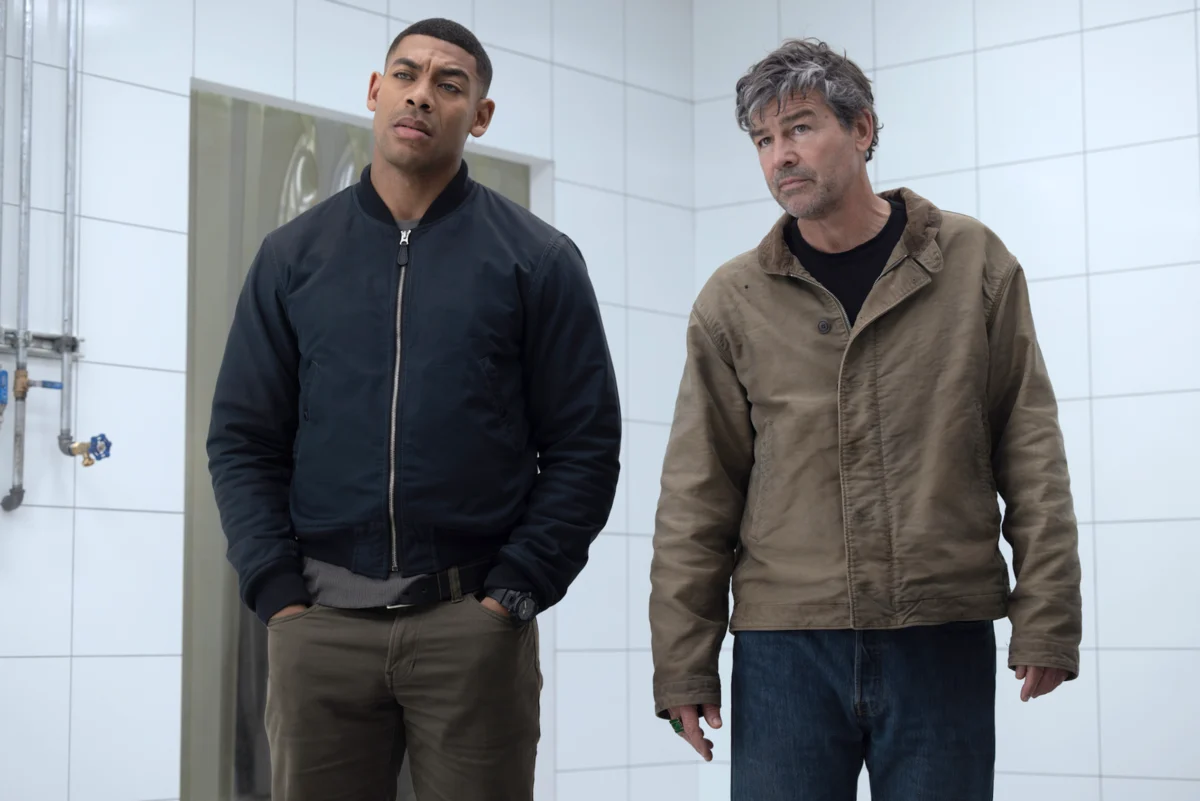
"As HBO’s Lanterns mirrors the slow-burn noir of True Detective, the series suggests that the true antagonist remains hidden in plain sight, weaving a complex web of cosmic horror and grounded political corruption."

The mid-season climax of HBO’s Lanterns has fundamentally shifted the trajectory of the series, moving it from a standard procedural into a labyrinthine conspiracy that bridges Earth-bound politics with cosmic existentialism. By episode four, "The Weenie," the investigation led by Hal Jordan and John Stewart has unmasked several layers of deception, yet the core mystery regarding the "Manhunter" and the ultimate architect of the chaos remains intentionally obscured, inviting a deeper analysis of the show’s literary and cinematic inspirations.
The True Detective Blueprint
To understand the narrative architecture of Lanterns, one must look toward the prestige crime dramas that define the HBO brand. Showrunner Chris Mundy and the creative team have explicitly utilized the first season of True Detective as a roadmap. That series was famous for its "Yellow King" mystery—a slow-burn reveal where the ultimate villain was someone the audience had encountered briefly in an earlier, seemingly inconsequential scene.

In Lanterns, the investigation into a grisly murder in the American heartland is merely the entry point. The show utilizes the tropes of the "buddy cop" genre to explore deeper themes of systemic rot. Just as Rust Cohle and Marty Hart discovered that their case was linked to a powerful family with deep roots in the community, Hal Jordan (Kyle Chandler) and John Stewart (Aaron Pierre) are finding that the "Macon" family and the local law enforcement are inextricably tied to a threat that predates the Green Lantern Corps itself. The question facing viewers now is whether the show will follow the True Detective model by revealing a "hidden in plain sight" antagonist or if it will lean into its comic book roots to introduce a cosmic threat like Lex Luthor or Brainiac.
The Zoe Macon Revelation: Villain or Victim?
The conclusion of "The Weenie" provided what appeared to be the show’s biggest breakthrough: Zoe Macon (Poorna Jagannathan) was revealed as the Manhunter. In DC Comics lore, the Manhunters were the Guardians of the Universe’s first attempt at an interstellar police force—androids devoid of emotion who eventually turned against their creators, concluding that the only way to eliminate crime was to eliminate life.

However, the reveal in Lanterns is more nuanced. Zoe has been portrayed as a sympathetic, kind-hearted figure throughout the first three episodes. Her "death" and the subsequent realization by Hal and John that she was the Manhunter in disguise suggest a more complex dynamic. It is highly probable that Zoe is not the primary antagonist but rather a sleeper agent or a pawn in a much larger game. In the world of high-stakes television, when a character is "revealed" as the villain by the midpoint of a season, they are often a distraction from the real threat. Zoe may eventually align with our heroes to stop the entity that is truly pulling the strings.
Will Macon and the Infrastructure of Evil
Garret Dillahunt’s Will Macon represents the grounded, "human" side of the series’ villainy. With his private militia and shadowy "benefactor," Will embodies the type of local corruption that makes the Manhunter’s infiltration possible. While he is clearly an antagonist, he lacks the cosmic scale required to be the series’ "Final Boss."

In many ways, Will Macon serves as a secondary antagonist—the "muscle" or the political cover for the true threat. His role highlights the series’ interest in how cosmic threats exploit human weaknesses like greed, xenophobia, and the desire for power. He is a "what you see is what you get" villain, which, in a show built on layers of deception, almost certainly disqualifies him from being the mastermind.
The Shadow of Sinestro
Ulrich Thomsen’s Sinestro remains the most compelling candidate for the role of the ultimate puppet master. Though currently incarcerated, Sinestro’s psychological hold over Hal Jordan is palpable. In DC history, Sinestro is the ultimate fallen angel—a former Green Lantern who embraced the power of fear.

In Lanterns, Sinestro appears to be playing a long game. His presence suggests that the Manhunter conspiracy might be a tool he is using to destabilize the Green Lantern Corps from within. If the show follows the trajectory of a classic noir, the man behind the bars is often the one holding the keys to the entire mystery. His "tomato-colored" menace is a constant reminder that the greatest threats to the Lanterns often come from those who once wore the ring.
The Hector Hammond Red Herring
One of the most intriguing elements of the series is the introduction of "Hector Guttierez," who claims to be Hector Hammond. For fans of the source material, the name Hector Hammond carries significant weight; he is a telepathic genius with an oversized cranium and a vendetta against Hal Jordan.

The version of the character seen in episode four seems far removed from the psychic powerhouse of the comics. This leads to two possibilities: either this Hector is a complete fake-out designed to distract the Lanterns, or the real Hector Hammond is someone else entirely, operating under a different name. The show’s penchant for identity swaps and "Manhunter" disguises makes the latter a distinct possibility. Is there a character currently in the periphery of the story who possesses the genius-level intellect and manipulative streak associated with Hammond?
Billy Macon: The Hidden Genius?
Jason Ritter’s Billy Macon has, until now, been relegated to comic relief. He is the "sleazy lawyer" and the bumbling son, a archetype often used in mystery writing to hide a killer or a mastermind. Ritter is an actor of significant range, and casting him in a purely comedic role in a show this dark feels like a strategic choice.

If the show intends to deliver a "shattering" twist, turning the most unassuming character into the primary villain would be the most effective way to do it. If Billy Macon were revealed to be the true Hector Hammond—or perhaps the human host for a Manhunter consciousness—it would retroactively change the meaning of every scene he has been in, a hallmark of great prestige television.
Sheriff Kerry Kane and the 2026 Timeline
The inclusion of Sheriff Kerry Kane (Kelly Macdonald) adds a layer of chronological complexity to the mystery. The series utilizes a dual-timeline structure, with parts of the story taking place in 2026. In this future, Kerry Kane is still an ally to John Stewart, and Hal Jordan is conspicuously absent (and presumed dead).

Kerry passed the "Manhunter test" by proving her existence prior to 1986, which seemingly clears her of being an android infiltrator. However, in a world of cosmic rings and psychic manipulation, physical evidence can be forged. If the Sheriff were involved in the conspiracy, it would be the ultimate betrayal for John Stewart, who views her as one of the few people he can trust. Her survival into the 2026 timeline suggests she is integral to the endgame, whether as a hero or a traitor.
The Guy Gardner Factor and the DCU Connection
Finally, we must consider the broader DC Universe (DCU) context. We know that Guy Gardner (portrayed by Nathan Fillion in the wider franchise) will eventually appear. The mystery of how Gardner obtained a ring that should belong to Hal or John suggests a departmental shift within the Guardians of the Universe.

This points toward a "political" villainy within the Green Lantern Corps itself. The Guardians may be using the Manhunter threat as a pretext to phase out "troublesome" Lanterns like Jordan and Stewart in favor of more compliant agents like Gardner. This would elevate the conflict from a simple murder mystery to a battle for the soul of the Corps.
As Lanterns moves into its final acts, the tension between the grounded detective work and the looming cosmic horror continues to tighten. Whether the villain is a Macon, a fallen Lantern, or a psychic entity, the series has successfully modernized the Green Lantern mythos into a sophisticated, high-stakes thriller that demands close attention to every shadow.
