
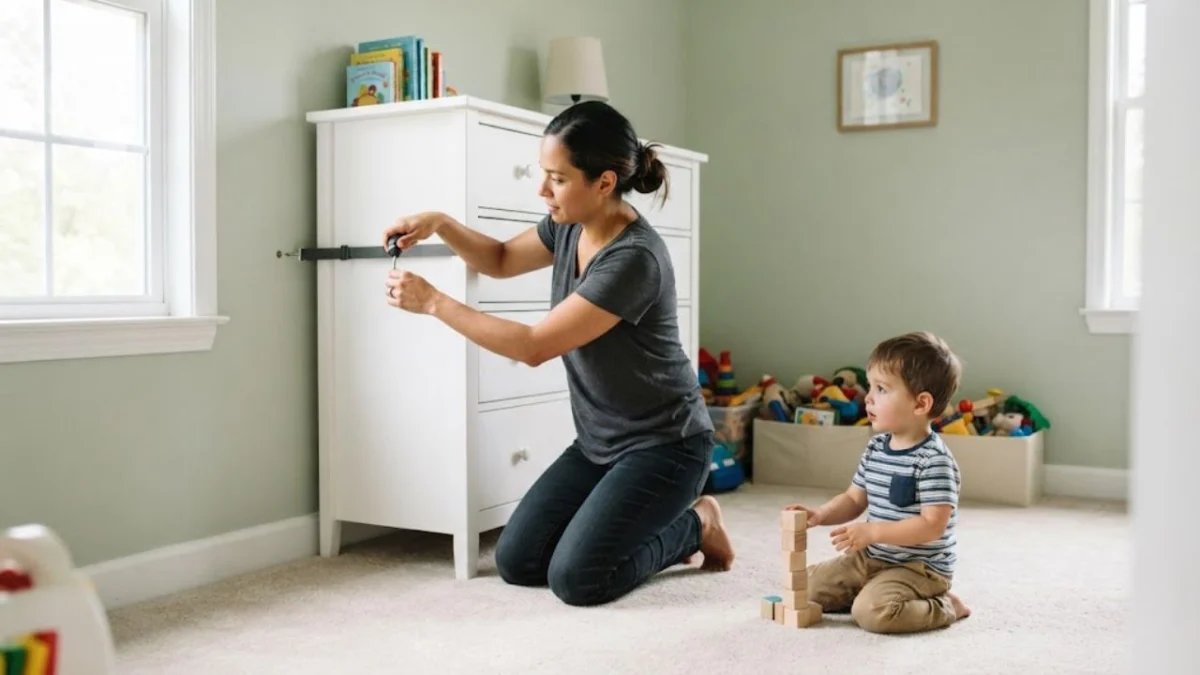
"Parents purchasing low-cost dressers online should be vigilant, as recent recalls highlight the ongoing risk of furniture tip-overs, even after federal safety standards have been implemented. Anchoring all tall furniture remains the most critical step in preventing potentially fatal accidents."
A significant recall impacting approximately 9,000 FJTJBSI six-drawer dressers underscores a persistent safety concern for children: the risk of furniture tip-overs. These dressers, sold exclusively on Amazon, have been flagged by the U.S. Consumer Product Safety Commission (CPSC) for failing to meet the mandatory federal safety standard for clothing storage units, established under the STURDY Act. This violation means the dressers, if not properly anchored to a wall, pose a severe risk of tipping over, potentially trapping and causing serious injury or death to young children.
The recall of FJTJBSI dressers is not an isolated incident; it follows a pattern of similar recalls issued in recent weeks. On August 13, the CPSC announced the recall of nearly 9,000 DUMOS nine-drawer dressers, and on September 3, approximately 4,400 Gizoon six-drawer dressers were also recalled. Both of these earlier recalls involved units sold on Amazon and cited the same violation of the STURDY Act. Additionally, on September 3, a separate recall involved about 261 Alanca six-drawer dressers sold on Wayfair. Collectively, these three distinct recalls encompass over 22,000 individual dressers. Encouragingly, no injuries have been reported in connection with any of these specific recalls to date. However, the frequency of these recalls, particularly for items purchased online, raises critical questions for parents about how to ensure the safety of furniture already in their homes, beyond simply checking a brand’s packaging code.
A 68-Pound Dresser Sold for Nearly Two Years
The specific FJTJBSI dressers subject to this recall are described as black or white wooden units featuring six drawers and either silver or black handles. Measuring approximately 42.2 inches in height, 27.6 inches in width, and 15.1 inches in depth, these dressers weigh a substantial 68 pounds. Consumers can identify the recalled units by checking the code on the packaging, which will be either LBS-XD-4-2-BLK-023 for black units or LBS-XD-4-2-WIT-024 for white units.
These dressers were available for purchase on Amazon.com from November 2024 through July 2026. The manufacturer is identified as Fujian Laobosi Cross-Border E-commerce Co., Ltd., a company based in China operating under the business name FJTJBSI. The official recall number assigned by the CPSC is 26-764.
The CPSC’s recall notice provides a stark warning: "stop using the recalled dressers immediately if they are not anchored to the wall." Consumers are advised to move the dressers to an area inaccessible to children while awaiting a resolution. To receive a full refund, owners must follow a specific procedure: they are instructed to write the word "RECALLED" in permanent marker on the dresser, take a photograph of the marked dresser, and email this photo to [email protected]. Upon completion of these steps, the dresser should be disposed of.
The extended sales window for these dressers is particularly concerning, given the timeline of the federal safety standard. The STURDY Act’s mandatory safety requirements for clothing storage units apply to products manufactured after September 1, 2023. The fact that the FJTJBSI dressers remained on the market and were sold to consumers for over a year after this effective date indicates that noncompliant furniture continues to reach online shoppers long after the safety regulations have been put in place. This prolonged availability of unsafe products highlights a potential gap in enforcement or awareness within the online retail ecosystem.
The Stability Tests a Compliant Dresser Must Pass
The U.S. Consumer Product Safety Commission’s requirements for clothing storage units, governed by the STURDY Act, are designed to prevent tip-overs and entrapment hazards. For a free-standing unit to be considered compliant, it must meet specific criteria regarding its dimensions and weight, and then successfully pass a series of rigorous stability tests. A compliant dresser must be at least 27 inches tall and weigh at least 30 pounds, while also offering at least 3.2 cubic feet of enclosed storage space. The FJTJBSI dresser, with its height of 42.2 inches and weight of 68 pounds, significantly exceeds these minimum thresholds, making its failure to meet stability requirements even more critical.
The mandated stability tests are designed to simulate real-world conditions and potential misuse. The first test involves opening the drawers and loading them with a weight equivalent to clothing, calculated at 8.5 pounds per cubic foot of storage capacity. This loaded state is then held for 30 seconds to assess structural integrity. The second test applies a horizontal force of 10 pounds to the highest accessible hand-hold, up to a height of 56 inches, to simulate someone pulling on the unit. The third, and perhaps most critical, test involves placing the rear legs of the dresser on a block to mimic the uneven surface of carpet. A 60-pound weight, representing the approximate weight of a young child, is then hung from the drawer or door that is most likely to cause a tip-over, to determine the unit’s resistance to such an event.
While parents cannot replicate these tests in their homes, the CPSC has identified other indicators that can help consumers assess the safety of their furniture. A compliant dresser must be packaged with an anti-tip device that meets a separate ASTM standard. Furthermore, the unit must bear specific warning labels, including both written statements and pictograms, clearly articulating the tip-over hazard and necessary precautions. Another safety feature to look for is the presence of interlocks, which are mechanisms designed to limit the number of drawers that can be opened simultaneously. These interlocks must function automatically without requiring any additional action from the user.
The absence of a warning label or an empty hardware bag for an anti-tip kit does not definitively prove that a dresser fails to meet the safety standard, as there could be other reasons for missing components. Conversely, the presence of a label alone does not guarantee compliance. However, any indication of a missing safety component or label should serve as a significant red flag. In such instances, consumers are strongly advised to immediately consult recall lists and, as a proactive safety measure, anchor the dresser to the wall.
Toddlers Who Climb Face the Greatest Danger
The statistics surrounding furniture tip-overs paint a grim picture of the potential dangers, particularly for young children. According to CPSC data, from January 2000 through April 2022, an estimated 234 deaths were attributed to clothing storage unit tip-overs, with 199 of these fatalities involving children. Furthermore, from 2006 through 2021, an estimated 84,100 tip-over injuries were treated in hospital emergency departments across the United States, averaging approximately 5,300 injuries per year. A striking 72 percent of these injuries involved children.
It is important to note that these figures largely predate the implementation of the mandatory STURDY Act standard. Therefore, they primarily illustrate the magnitude of the hazard that existed prior to the new regulations, rather than reflecting the rate at which compliant dressers might fail. As mentioned, the recall notices for the FJTJBSI, Gizoon, and DUMOS dressers all state that no incidents or injuries have been reported for those specific products.
The CPSC emphasizes that young children, especially toddlers, are at the highest risk of severe injury or death from furniture tip-overs. This heightened vulnerability stems from their natural curiosity and inclination to explore, which often leads them to pull out drawers and attempt to climb furniture as if it were a ladder. The danger is compounded by the risk of entrapment, where a child can be pinned beneath a fallen dresser, leading to crushing injuries, in addition to being struck by the falling furniture. To mitigate this risk, the CPSC strongly advises parents to keep toys and other attractive items off the tops of furniture, as these can serve as a tempting lure for children to climb.
Refunds Run Through an Email Inbox, So Keep Records
For families who have purchased dressers from the recalled brands, particularly those bought online, a thorough search of their order history on platforms like Amazon can be crucial. Many consumers discard product packaging shortly after receiving it, making order confirmation emails or digital purchase records the most reliable way to identify a specific item. While awaiting a refund or resolution, any recalled dresser that has not been secured to the wall should be moved to a room where children cannot access it.
The current recall procedure for FJTJBSI dressers exclusively involves an email address for communication, with no phone number provided. This necessitates diligent record-keeping by consumers. It is advisable to save all relevant documentation, including the initial order confirmation, the photograph submitted of the marked dresser, and any correspondence received from the company regarding the recall and refund process. The CPSC offers a recall complaint form on its website for consumers who believe a company is not adequately addressing their remedy requests. Additionally, any injuries or near misses related to product safety can be reported to the agency via SaferProducts.gov.
The most effective measure to address the tip-over hazard, regardless of whether a dresser has been recalled, is to anchor it securely to the wall. The CPSC’s "Anchor It" campaign provides comprehensive resources and instructions on how to properly secure furniture and televisions to prevent accidents. This is a universally applicable safety recommendation that all households with young children should consider.
It is also imperative to note that recalled dressers should not be resold or given away. Federal law explicitly prohibits the sale of products that are subject to a CPSC recall, as this would place another consumer at risk.
At this time, the CPSC has not indicated whether additional marketplace dresser recalls are anticipated. Consumers are encouraged to remain vigilant and to continue checking for updates from the CPSC and other reputable consumer safety organizations. For parents of toddlers and young children, a proactive approach involving checking purchase histories, diligently anchoring all tall furniture, and removing climbing temptations from furniture tops remains the most effective strategy for safeguarding their families.
Key Questions Answered
Which dressers are being recalled? Approximately 9,000 FJTJBSI six-drawer wood dressers, available in black or white, sold on Amazon from November 2024 through July 2026. Consumers should look for packaging codes LBS-XD-4-2-BLK-023 or LBS-XD-4-2-WIT-024.
Has anyone been hurt? According to the U.S. Consumer Product Safety Commission (CPSC), no incidents or injuries have been reported in connection with this specific recall.
What is the hazard? The recalled dressers are unstable if not anchored to a wall, posing significant tip-over and entrapment hazards that could lead to serious injury or death for children.
Are the other recent dresser recalls connected? While the FJTJBSI recall involves a different seller, it is connected in that the DUMOS nine-drawer dressers (recalled August 13) and Gizoon six-drawer dressers (recalled September 3) were also sold on Amazon and violated the same mandatory safety standard under the STURDY Act.
How can I tell if my dresser meets the standard? Compliant clothing storage units should come packaged with an anti-tip device and display warning labels. However, neither of these guarantees compliance. Consumers should always check recall lists and, as a precautionary measure, anchor all tall furniture.
How do I get my money back? For the FJTJBSI recall, consumers must email FJTJBSI at [email protected]. They will need to write "RECALLED" on the dresser, provide a photo of the marked dresser, and then dispose of it. If a seller fails to respond adequately, the CPSC offers a complaint form.
Should I anchor dressers that were not recalled? Yes. The CPSC’s "Anchor It" campaign strongly recommends that all families anchor dressers, other tall furniture, and televisions to the wall as a critical safety measure to prevent tip-overs.
