
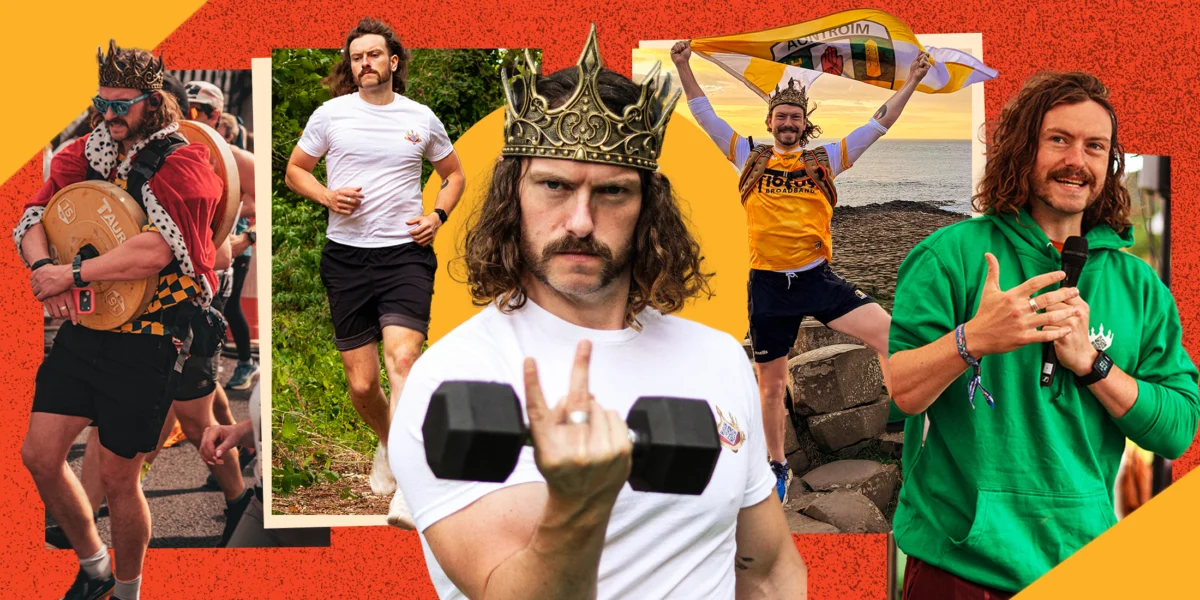
"Iain Ward’s journey transforms a terminal diagnosis from a sentence of despair into a catalyst for unprecedented physical endurance and charitable impact, proving that the search for purpose can be the most potent medicine of all."
When Iain Ward was diagnosed with terminal brain cancer in 2019, he chose to reject the traditional narrative of the "cancer patient" in favor of a self-constructed identity as an elite athlete and digital fundraiser. Known to millions as the "King of Chemo," Ward has utilized his five-year survival window to challenge the limits of the human body and the traditional models of charitable giving, raising millions of dollars through sponsorships rather than direct pleas for donations. His story serves as a profound case study in the intersection of oncology, mental health, and the power of finding a singular, driving purpose in the face of mortality.
The Midnight Hour: A Diagnosis in London
For many, the transition into their 30s is a time of professional solidification and personal settling. For Iain Ward, a North Dublin native living in London in 2019, it was a period of aimlessness. Working as a fitness instructor and video-game content creator, Ward describes himself during this era as "languishing," lacking a clear trajectory or a defining goal. The catalyst for change arrived in the most unlikely of forms: a medical trial.
In an effort to supplement his income, Ward frequently signed up for clinical studies. It was during a routine MRI for one such trial that doctors discovered a significant mass in his brain. A week after his 31st birthday, surgeons performed a craniotomy to biopsy and debulk the tumor. The results were life-altering: stage 3 brain cancer, specifically glioblastoma, a highly aggressive form of the disease. The clinical prognosis was stark, offering a median survival rate of approximately five years.
While such news would typically induce a period of mourning or withdrawal, Ward experienced a psychological shift that he describes as a "lightning strike." The diagnosis provided the very thing he had been missing: a deadline. With a five-year window of "guaranteed" life, Ward realized that his remaining time was a finite resource that could be leveraged for a greater good. He did not view the cancer as an ending, but as a "silver platter" upon which his life’s purpose was served.
Understanding the Pathology: The Reality of Glioblastoma
To understand the magnitude of Ward’s physical feats, one must understand the nature of glioblastoma (GBM). GBM is the most common and most aggressive primary brain tumor in adults. It is characterized by its rapid growth and its ability to infiltrate healthy brain tissue, making complete surgical removal nearly impossible. Standard treatment protocols usually involve a combination of surgery, radiation, and chemotherapy (temozolomide), often referred to as the "Stupp Protocol."
For a patient undergoing these treatments, the side effects are often debilitating. Chemotherapy can cause profound fatigue, nausea, and immunosuppression, while brain surgery and radiation can lead to cognitive shifts and physical coordination issues. Ward’s decision to pursue extreme endurance sports while navigating this medical landscape is medically anomalous. It challenges the traditional "sick role" and highlights the potential benefits of exercise oncology—a growing field that suggests structured physical activity can improve treatment tolerance and quality of life for terminal patients.
The King of Chemo: A New Model of Philanthropy
Upon accepting his diagnosis, Ward created the online persona "The King of Chemo." His goal was twofold: to document his journey with a dark, irreverent humor that demystified the disease, and to break the world record for the most money raised for charity by an individual in a single year. The current record, held by British minister Steve Chalke, stands at approximately £2.3 million.
Ward’s approach to fundraising is a departure from the "GoFundMe" culture often seen in the cancer community. Rather than asking his followers for direct donations—a practice he finds "annoying"—he utilizes his massive social media reach (currently approaching 7 million followers on TikTok) to secure corporate sponsorships. By treating his cancer journey as a high-performance athletic brand, he generates revenue through views, likes, and brand deals, all of which are funneled toward cancer research and charitable organizations.

This model of "passive philanthropy" allows his audience to support the cause simply by engaging with his content. It also places the burden of performance squarely on Ward’s shoulders. To maintain the engagement necessary for such high-level sponsorships, he has committed to a series of physical challenges that would be daunting for a healthy athlete, let alone one with a terminal brain tumor.
Feats of Endurance: Marathons and Beyond
Ward’s athletic resume over the past few years is a testament to the resilience of the human spirit. In 2024, he completed six major marathons. Perhaps even more impressive was his "32 in 32" challenge: running 32 half-marathons in 32 consecutive days across every county in Ireland. To increase the difficulty, he performed these runs while wearing a weighted vest.
His training is not limited to running. Ward frequently posts videos of himself performing high-intensity interval training (HIIT), heavy deadlifts in his hospital gown, and complex balance exercises. These displays serve a dual purpose. First, they provide the "spectacle" required to maintain social media growth. Second, they serve as a practical demonstration of his core philosophy: that exercise is the most effective tool for managing mental health.
Ward is a vocal advocate for the psychological benefits of movement. He argues that the endorphin release and the sense of agency gained through physical exertion are essential for anyone facing depression or chronic illness. His message to his followers is blunt: "Go for a run, and you will feel better." For Ward, the gym is not just a place for physical maintenance; it is the arena where he fights the "valley of sadness" that inevitably accompanies a terminal prognosis.
The Knee Injury and the Valley of Sadness
The path of the "King of Chemo" has not been without its setbacks. Last Christmas, Ward attempted a grueling challenge of seven marathons in seven days, combined with a 24-hour social media campaign to win a TikTok contest. The lack of sleep and the repetitive strain resulted in a severe knee injury five marathons into the attempt.
For the first time since his diagnosis, Ward was forced to stop. The inability to run led to a period of clinical depression. Without the "high" of the physical challenge and the forward momentum of his fundraising goals, the weight of his mortality began to settle in. This "valley of sadness" revealed the vulnerability behind the persona. It served as a reminder that even the most "terminally optimistic" individuals are susceptible to the crushing reality of their situation when their coping mechanisms are removed.
Ward’s recovery from this period was as much mental as it was physical. He returned to his backyard gym, slowly reintroducing weightlifting and shutting out the noise of social media. This period of quiet, disciplined recovery allowed him to regain his footing and return to his mission with a renewed sense of long-term strategy.
The Horizon: Legacy, Literature, and Life
As of late 2024, Ward has outlived his initial five-year prognosis. His most recent MRI scans show that the tumor is stable, with no new growth—a result he describes as "borrowed time." With this unexpected extension, Ward has expanded his efforts. He recently launched his book, Terminally Optimistic: Finding My Life’s Purpose Through My Cancer Diagnosis, which serves as both a memoir and a manifesto for those seeking meaning in adversity.
The extension of his life has also forced Ward to confront questions he never expected to answer. His girlfriend has expressed a desire for marriage and children—propositions that a man with a terminal diagnosis must weigh with heavy realism. "I’m an optimist but also a realist," Ward says, acknowledging the ethical complexity of starting a family when his presence in the future is far from guaranteed.
Iain Ward continues to live in the "closing time" of his life, yet he refuses to leave the bar. Each day he survives is a new opportunity to chip away at the fundraising record and to refine the "idea" he wants to leave behind. His legacy is not merely the money raised or the miles run, but the proof that a person can be "lucky" in their unluckiness. By turning his death sentence into a life’s work, the King of Chemo has redefined what it means to live with cancer, shifting the focus from the quantity of years to the magnitude of the impact made within them.
