
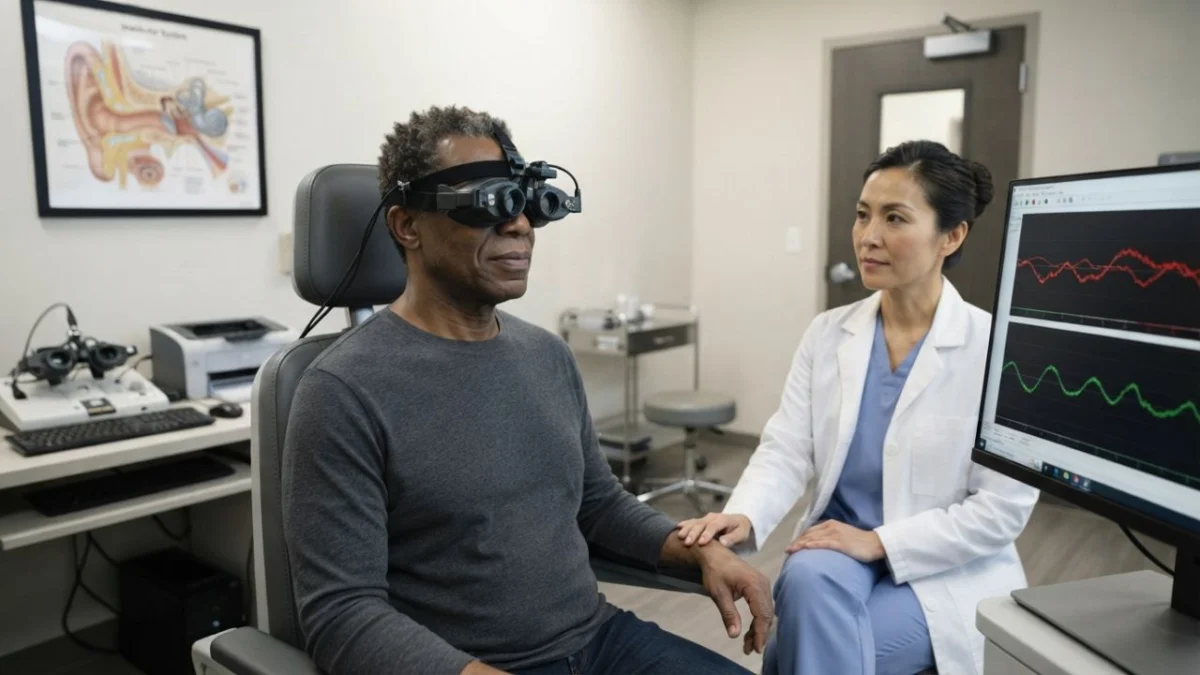
"A rare complication following middle ear surgery, involving a seemingly minor prosthesis, can manifest as vertigo triggered by everyday actions like burping or swallowing, highlighting the intricate connection between pressure changes and the inner ear’s balance system."
A recent case presented at the American Academy of Audiology’s AAA 2026 convention sheds light on an unusual and potentially disorienting complication that can arise after middle ear surgery. For a 54-year-old woman, a routine act of burping or swallowing, events typically unnoticed, would trigger a disconcerting spell of vertigo. This peculiar symptomology began approximately six months after the implantation of a partial ossicular replacement prosthesis (PORP) in her right middle ear. The case, detailed in a poster presentation by clinicians from the Ear Institute at New York Eye and Ear Infirmary of Mount Sinai, underscores the importance of thorough diagnostic evaluation for patients experiencing persistent vestibular symptoms post-surgery.
The woman’s perplexing condition was meticulously investigated, ultimately leading clinicians to identify a leak in her inner ear as the source of her dizziness. This diagnosis prompted a referral for surgical intervention to remove the problematic implant. Following the removal of the prosthesis, her vestibular symptoms, characterized by sudden sensations of spinning or imbalance, completely subsided. This singular case, while not a full peer-reviewed journal article, provides valuable insights into a rare sequela of middle ear procedures, emphasizing that even seemingly minor implants can have profound effects on the delicate structures of the inner ear.
The poster, titled "Positive Fistula Response and Pressure-Evoked Dizziness After Middle-Ear Surgery: Audiologic and Vestibular Findings," was spearheaded by audiologist Katherine Scigliano, AuD, in collaboration with Rebecca Sherman, AuD, Maura Cosetti, MD, and Jenifer Kelly, DPT. The authors noted the rarity of vertigo post-surgery being linked to what is known as a "third-window effect," and importantly, they found no existing case reports that precisely matched the patient’s constellation of symptoms. This suggests the uniqueness of the presentation and the diagnostic challenges it may pose.
A Partial Ossicular Prosthesis and an Unusual Trigger
The device in question was a PORP, a small implant designed to reconstruct a portion of the ossicular chain – the series of tiny bones (malleus, incus, and stapes) responsible for transmitting sound vibrations from the eardrum to the inner ear. As illustrated by resources like Stanford’s otologic surgery atlas, a PORP typically bridges the gap between the eardrum and the stapes, the innermost bone of the chain. Often, a small piece of cartilage is strategically placed between the prosthesis and the eardrum to prevent direct contact and potential damage.
While the specific reason for the woman’s initial surgery was not detailed in the abstract, the onset of her symptoms six months post-operation is a critical piece of information. She began experiencing "pressure induced vertigo," with these episodes being specifically "triggered by burping and swallowing." These triggers are not coincidental; they have a direct physiological basis. Stanford Medicine’s ear institute explains that the Eustachian tube, a channel connecting the middle ear to the back of the throat, plays a crucial role in equalizing pressure within the middle ear. It typically opens with actions like swallowing or yawning. In this patient’s case, the abnormal pressure fluctuations associated with these everyday actions were evidently reaching her inner ear’s delicate balance system, causing the disorienting vertigo.
Eye Movements Pointed to Her Right Ear
Given the suspicion of a "third-window effect" – an abnormal opening in the inner ear that disrupts normal pressure dynamics – the patient underwent comprehensive vestibular testing. A videonystagmography (VNG) study was performed, a diagnostic tool that records involuntary, rapid eye movements known as nystagmus. The inner ear’s vestibular organs, responsible for balance, are intricately linked to the oculomotor system, meaning that abnormal eye movements can signal when these balance structures are being inappropriately stimulated.
The majority of the VNG results were within normal limits, including oculomotor, gaze, and positional testing. However, the fistula test yielded a significant finding. During this test, clinicians artificially alter the air pressure within the ear canal and observe the patient’s eye movements. In the woman’s right ear, the test produced a positive response, characterized by "direction-changing nystagmus with both positive and negative pressure." This response is a classic indicator of "third window physiology," where pressure changes are finding an abnormal pathway to the inner ear. Specifically, positive pressure in the ear canal caused her eyes to move towards the right, while negative pressure induced movement to the left. Her left ear, in contrast, tested normally. Further testing, including VNG while she swallowed, did not produce visible nystagmus, but touching her ear resulted in an inconsistent left-beating nystagmus.
The Inner Ear’s Extra Opening Problem
A healthy inner ear is designed with two primary flexible openings: the oval window and the round window. These windows allow pressure waves to travel through the fluid-filled labyrinth of the inner ear in a controlled and orderly fashion, facilitating both hearing and balance. A "third window" refers to any aberrant opening that disrupts this delicate pressure regulation, allowing pressure to leak into areas where it should not.
Researchers from institutions like Johns Hopkins and Stanford have extensively studied this phenomenon. In a 2017 review published in Frontiers in Neurology, they discussed superior canal dehiscence, a well-documented disorder involving a third window in the semicircular canals. This condition can lead to vertigo and nystagmus in response to loud sounds, straining, or direct pressure on the ear canal, as pressure intended for the cochlea (hearing organ) is diverted to the balance canals.
In the case of the 54-year-old woman, the authors explicitly stated that her "clinical presentation mirrors third-window physiology, suggesting a positive fistula-type response." Based on these findings, she was diagnosed with a perilymph fistula, an abnormal leakage of fluid between the inner ear and the middle ear. She was subsequently referred back to her otologist. The abstract, however, did not provide details about the surgical findings during the removal of the prosthesis, leaving the precise mechanism by which the implant interfered with the inner ear unconfirmed.
Medical literature, such as a StatPearls review updated in August 2025 on NCBI Bookshelf, acknowledges ear surgery as a known cause of perilymphatic fistulas. This review cites a complication rate of approximately 1% following stapes surgery, with factors such as prosthesis malposition or subsequent migration being implicated. The fistula test, wherein pressure applied near the ear canal provokes nystagmus, is described as a classic diagnostic clue. The review further notes that labyrinthine fistulas are rare and their diagnosis can be contentious, lacking a definitive international consensus on diagnostic criteria.
Dizziness Ended, Hearing Loss Remained
The patient underwent a "successful PORP removal," as described by the authors, and crucially, her vestibular symptoms resolved. However, this resolution came at a cost: her hearing. The abstract indicates that she "continues to have a conductive hearing loss," a type of hearing impairment that occurs when sound waves are impeded from efficiently traveling through the outer or middle ear.
The authors’ concluding remark offers a vital message for clinicians: "This case illustrates the need for comprehensive diagnostic management of post operative middle ear surgical patients." In practical terms, this means that patients presenting with dizziness months after middle ear surgery, particularly when linked to pressure changes, require targeted vestibular assessments rather than solely a hearing evaluation.
Several aspects of the case remain undisclosed in the abstract, including imaging results, the original indication for the surgery, the specific material of the prosthesis, and the duration of the patient’s follow-up. Furthermore, as a single-patient report, it cannot establish the incidence or frequency with which a PORP might lead to such complications.
Individuals experiencing any new onset of dizziness, vertigo, or hearing alterations following ear surgery, especially if these symptoms are associated with actions like swallowing, straining, nose-blowing, or exposure to loud noises, are strongly advised to promptly inform their surgeon or audiologist. Early evaluation is key to identifying and managing potential issues.
