
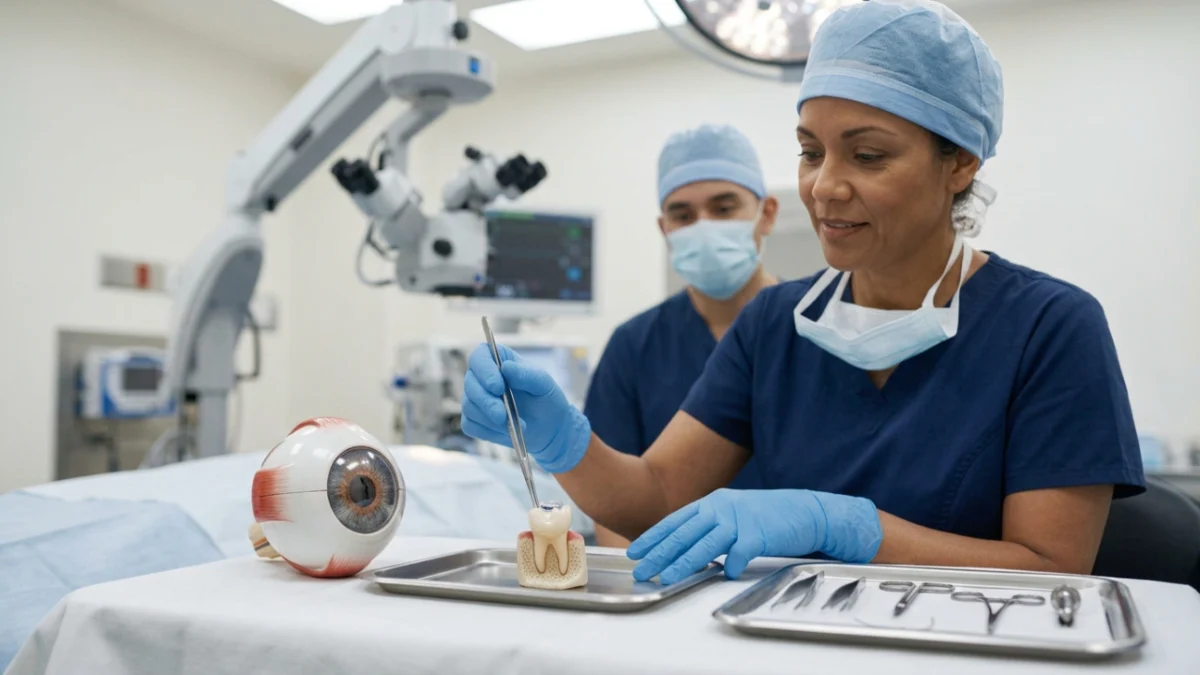
"A tooth, a common part of our anatomy, is being transformed into a sophisticated optical device, offering a second chance at sight for individuals facing otherwise untreatable blindness."
This groundbreaking surgical procedure, known as osteo-odonto-keratoprosthesis (OOKP), represents a remarkable fusion of dentistry and ophthalmology, leveraging the patient’s own biological material to restore vision. While seemingly unconventional, a comprehensive review spanning five decades reveals the extraordinary long-term success of this complex technique, demonstrating its potential to provide functional vision for 20 years or more in many patients. The procedure’s enduring efficacy is underscored by recent developments, including its successful application in Canada, where patients are once again experiencing the world in full color.
A Half-Century of Innovation: The Enduring Legacy of Tooth-Built Corneas
The efficacy and longevity of osteo-odonto-keratoprosthesis have been meticulously documented in a significant five-decade review published in the November 2025 issue of the British Journal of Ophthalmology. This extensive study, the longest-running examination of OOKP to date, analyzed 310 eyes across 269 patients who underwent a modified version of the surgery at two prominent hospitals in Rome, Italy, between 1973 and 2019. The findings paint a compelling picture of a procedure that, despite its complexity, offers remarkable and sustained visual restoration.
The research team reported an average follow-up period of nearly 16 years, with some patients being monitored for as long as 45 years. This remarkable duration of observation allowed for an unprecedented understanding of the long-term performance of tooth-derived corneal implants. The primary indications for the surgery were severe chemical or physical injuries to the eye, accounting for 35.2% of cases. Ocular pemphigoid, a debilitating autoimmune disease that causes severe scarring of the eye’s surface, was another significant factor, responsible for 24.2% of the surgeries. These conditions often lead to irreversible corneal damage, rendering traditional treatments, such as corneal transplantation, ineffective.
The study highlighted a critical aspect of the OOKP procedure: the method of eye coverage. In nearly 90% of cases, the implanted tooth-lens assembly was covered with tissue harvested from the inside of the patient’s cheek. This technique demonstrated exceptional results, with 85.1% of these implants remaining anatomically in place after 20 years and an impressive 82.3% still functional at 45 years. Crucially, functional survival – defined as the eye providing useful vision – was achieved in 70.7% of cases at the 20-year mark and 56.5% at 45 years. In contrast, eyes covered with skin grafts fared significantly worse, underscoring the superiority of the mucosal lining from the cheek. The vision restoration achieved through OOKP was often rapid, with a sharp improvement observed within three months post-surgery, and this functional gain remained stable in approximately two-thirds of patients.
The authors of the study concluded that OOKP exhibits "excellent long-term anatomical and functional survival rates." While acknowledging that estimates at the longest follow-up periods (45 years) are based on smaller cohorts, approximately 10 eyes, and that surgical techniques have evolved over the decades of the study, the findings are undeniably robust. The retrospective nature of the study also presents limitations, but the consistency of the results across a large patient group and over an extended period lends significant weight to its conclusions. These findings are further corroborated by a separate 2022 review of 958 patients from 37 published case series, which reported a similar anatomical success rate of approximately 88%.
The Ingenious Transformation: How a Canine Tooth Becomes a Window to the World
The genesis of osteo-odonto-keratoprosthesis can be traced back to the pioneering work of Italian surgeon Benedetto Strampelli in the 1960s. His groundbreaking concept was further refined and popularized by Giancarlo Falcinelli, a surgeon who performed a significant number of the procedures included in the recent review and who passed away in 2017. The OOKP procedure is a multi-stage surgical marvel that meticulously reconstructs a functional eye.
The initial stage involves the delicate extraction of a patient’s tooth, typically a canine tooth, along with a portion of the surrounding bone. This biological composite is then expertly shaped and drilled to accommodate a precisely crafted plastic optical cylinder. The entire assembly is subsequently implanted beneath the skin of the cheek, a crucial step that allows for the growth of new vascularized tissue around it over approximately three months. During this preparatory phase, a flap of the patient’s cheek lining is carefully prepared and sewn over the damaged eye, creating a protective and receptive environment for the future implant.
The second stage of the operation is where the true restoration of sight takes place. Surgeons meticulously expose the eye, removing damaged structures such as the iris and the natural lens. The prepared tooth-bone-lens prosthesis is then carefully sutured into place. A small opening is deliberately left in the overlying tissue, allowing the patient to see through the newly implanted optical window.
The biological rationale behind using a tooth as the foundation for the artificial lens is rooted in its unique properties. As explained by Vancouver ophthalmologist Dr. Greg Moloney, a proponent of the procedure in North America, "A tooth contains dentin, which is the ideal tissue to house a plastic lens without the body rejecting it." Dentin’s porous structure and biocompatibility allow for integration with the surrounding tissues, minimizing the risk of immune rejection and promoting long-term stability of the implant. This biological anchor is fundamental to the enduring success of OOKP.
Canada Witnesses Sight Restored: A New Dawn for Patients
The application of OOKP is not confined to the historical successes in Europe. In a significant milestone for Canadian ophthalmology, the country’s first three patients to undergo this complex surgery have reported regaining their sight, able to perceive faces, beloved pets, and the intricate details of city skylines once more. Dr. Greg Moloney, who learned the OOKP procedure in his native Australia and was recruited to Vancouver in 2021, spearheaded these groundbreaking cases at Mount Saint Joseph Hospital in 2025. Dr. Moloney, who had previously performed approximately eight such operations in Australia, has brought this life-changing technique to Canadian patients.
One of the first Canadian recipients is Gail Lane, a 75-year-old resident of Victoria. Ms. Lane lost her sight at the age of 64 due to Stevens-Johnson syndrome, a severe and often life-threatening reaction to anti-seizure medication. She underwent her first-stage surgery in February and the second stage in late May. Her visual recovery was gradual, initially perceiving light and large shapes. By mid-July, she experienced the profound joy of seeing her partner’s guide dog, Piper, her tail wagging, a testament to the restored clarity of her vision. With corrective lenses, Ms. Lane’s vision was measured at a remarkable 20/50, a significant improvement that allows for a much richer engagement with the world.
Another inspiring success story is that of Brent Chapman, a 34-year-old from North Vancouver. As a teenager, Mr. Chapman suffered a severe reaction to ibuprofen, resulting in a coma and the subsequent loss of most of his sight. Over two decades, he endured nearly 50 operations, many of which were corneal transplants that ultimately failed to provide lasting vision. His journey with OOKP began in February with the removal of his tooth, followed by the implantation of the tooth-lens structure in June. A final procedure in August fine-tuned the lens placement. Fitted with glasses days later, Mr. Chapman achieved 20/30 vision, a level of sight he had not experienced in 20 years. The emotional impact of this recovery is profound; he shared, "I haven’t really made eye contact in 20 years." A third patient, who preferred to remain anonymous, reported the ability to read documents the day after surgery, highlighting the rapid and impactful nature of the vision restoration.
Dr. Vicente Diaz, an ophthalmologist at Yale School of Medicine who was not involved in these Canadian cases, commented to CNN that OOKP is a procedure reserved for situations where "a standard corneal transplant simply won’t work." This underscores the critical role of OOKP in addressing complex cases of corneal blindness that have exhausted conventional treatment options.
Navigating the Risks: Glaucoma and Infection as Primary Concerns
While OOKP offers a remarkable solution for severe corneal blindness, it is an intricate surgical procedure that carries inherent risks. The Italian review identified several significant complications. Glaucoma, a condition characterized by increased pressure within the eye, occurred in 22.6% of eyes. Endophthalmitis, a serious intraocular infection, presented in 7.7% of cases, and retinal detachment was observed in 6.4%. Endophthalmitis, in particular, poses the greatest threat, often necessitating the removal of the implant to preserve the eye.
Furthermore, the tooth-bone structure itself can undergo gradual resorption over time, a phenomenon documented in at least 14% of eyes in the Rome study. This gradual loss of support can compromise the implant’s stability. Another consideration is the aesthetic outcome; while vision is restored, the eye may not appear entirely natural after the extensive surgical reconstruction.
Candidates for OOKP must possess a healthy retina and optic nerve, as the procedure cannot restore sight if the underlying visual pathways are compromised. The Rome team also implemented exclusion criteria, such as a minimum age of 17, to ensure the best possible outcomes. Critically, the procedure is not suitable for individuals whose blindness originates behind the cornea, such as those with optic nerve damage or retinal diseases.
The availability of OOKP in North America remains extremely limited, reflecting its complexity and the specialized expertise required. Dr. Moloney’s immediate goals in establishing the Vancouver program include successfully completing surgeries without complications and diligently monitoring the long-term viability of the implants. The extensive data from Rome strongly suggests that, for carefully selected patients, these implants can indeed remain viable and functional for decades.
For individuals suffering from severe corneal scarring who have been advised that traditional corneal transplants are not a viable option, consulting with a cornea specialist about potential evaluation for a keratoprosthesis, including OOKP, is a crucial step. This innovative surgical approach represents a beacon of hope for those facing the profound challenges of irreversible vision loss.
Key Questions Answered:
What is tooth-in-eye surgery?
Osteo-odonto-keratoprosthesis (OOKP) is a complex surgical procedure that utilizes a patient’s own tooth and surrounding bone as a living framework to support a precisely fitted plastic lens. This prosthesis replaces a severely scarred or diseased cornea, thereby restoring vision.
Who is a candidate for this procedure?
Candidates typically include adults who have experienced blindness due to severe damage to the eye’s surface, such as from conditions like Stevens-Johnson syndrome, chemical burns, or ocular pemphigoid. A critical requirement is that the patient must still possess a healthy retina and optic nerve, ensuring that the visual signals can be processed and transmitted to the brain.
How long do the tooth-based implants typically last?
The long-term study from Rome indicates impressive durability. In cases where the implant was covered with cheek lining, 85.1% of the implants remained anatomically in place after 20 years. Furthermore, 56.5% of these eyes continued to provide useful vision even after 45 years, showcasing the remarkable longevity of this biological prosthetic.
What are the primary risks associated with OOKP surgery?
While highly effective, the surgery is not without risks. The most significant complications include the development of glaucoma, serious intraocular infections (endophthalmitis), and retinal detachment. There is also a possibility of gradual resorption of the tooth-bone support over time. Due to these risks and the complexity of the procedure, lifelong follow-up with an eye specialist is essential.
Is this surgery readily available in North America?
Availability of OOKP in North America is currently very limited, making it a rare procedure. The program at Mount Saint Joseph Hospital in Vancouver represents one of the few active efforts on the continent, highlighting the specialized nature and demand for this advanced treatment.
