
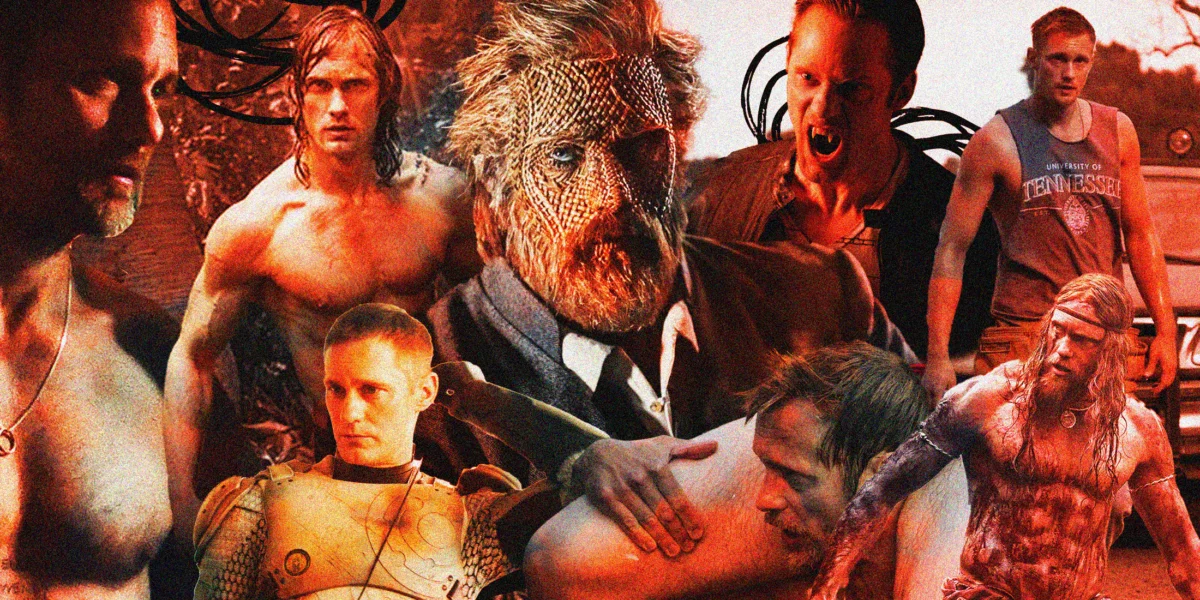
"Alexander Skarsgård has mastered the art of the physical chameleon, weaponizing his imposing stature and chilling screen presence to deconstruct the nuances of power, toxicity, and primal human instinct across two decades of prestige cinema and television."

Throughout his prolific career, Alexander Skarsgård has navigated the treacherous waters of Hollywood by subverting the expectations typically placed upon actors of his physical archetype. While his 6’4" frame and Nordic features initially cast him as a conventional leading man or a romantic interest, Skarsgård has consistently opted for roles that interrogate the darker, more complex facets of masculinity. From his early comedic turns to his harrowing portrayals of domestic abusers and tech-age sociopaths, he has built a filmography that serves as a profound exploration of what it means to occupy space—both physically and psychologically—in the modern world.
The Comedic Genesis: From Meekus to Matsson
The trajectory of Alexander Skarsgård’s career is one of the more fascinating case studies in modern acting, beginning not with a dramatic roar, but with a high-pitched, vapid giggle. In Ben Stiller’s 2001 cult classic Zoolander, Skarsgård appeared as Meekus, one of Derek Zoolander’s "United Nations" of roommates. Baby-faced and draped in early-2000s fashion, Meekus was a parody of the male modeling industry’s perceived vacuity. His character’s narrative arc—ending in a disastrous, gasoline-soaked "orange mocha frappuccino" accident—was a brief but memorable introduction to American audiences.

Returning for a cameo in Zoolander 2 (2016), Skarsgård’s presence served as a reminder of his roots in absurdist comedy. This early willingness to play the "himbo" archetype allowed him to develop a sense of self-awareness that would later inform his more serious roles. It established a baseline of versatility; he was an actor who could look like a god but act like a fool, a quality that prevents his more intense performances from feeling one-dimensional.
The Breakthrough: The Gothic Magnetism of Eric Northman
While Zoolander was a footnote, HBO’s True Blood (2008–2014) was the catalyst for Skarsgård’s global stardom. As Eric Northman, a thousand-year-old Viking vampire prince, Skarsgård tapped into a primal, regal arrogance that defined the series’ peak years. Eric was a "Magneto-esque" figure—a character who viewed humans as little more than cattle, yet possessed a weary, ancient wisdom that made his eventual redemption arc compelling.

True Blood functioned as a gothic soap opera, and Skarsgård was its undisputed center of gravity. His performance was inherently physical; he used his height to dominate scenes, often looming over his costars with a predatory stillness. This role introduced the "Viking" element that would become a recurring motif in his career, blending historical myth with modern sexual magnetism. It was here that Skarsgård began to refine the "menacing yet alluring" persona that would become his trademark.
Interrogating the Alpha: Straw Dogs and Big Little Lies
As his career progressed, Skarsgård began to pivot toward roles that deconstructed the "Alpha" male. In the 2011 remake of Straw Dogs, he played Charlie Venner, a former high school football star and blue-collar worker in a small Southern town. The film, a polarizing update of the Sam Peckinpah original, pitted Skarsgård’s "God, guns, and country" masculinity against James Marsden’s effete, Harvard-educated screenwriter. Skarsgård’s performance was symbolically heavy, representing the physical threat that intellectualism often fails to account for. He wasn’t just an antagonist; he was a manifestation of Marsden’s insecurities.

This exploration of toxic masculinity reached its zenith in David E. Kelley’s Big Little Lies (2017–2019). As Perry Wright, Skarsgård delivered what many critics consider his most harrowing performance. Perry was the "perfect" husband—wealthy, handsome, and devoted—who was simultaneously a serial domestic abuser. Skarsgård’s chemistry with Nicole Kidman was electric and terrifying, portraying a relationship where sex and violence were inextricably linked. By playing a monster who hid behind the mask of an exemplar, Skarsgård forced audiences to confront the reality of domestic terror in "perfect" communities. His portrayal earned him an Emmy, a Golden Globe, and a SAG Award, cementing his status as one of the premier dramatic actors of his generation.
The Messianic and the Demonic: Leadership and Cults
Skarsgård’s inherent magnetism makes him a natural fit for roles involving cult leadership and zealotry. In The East (2013), he played Benji, the charismatic leader of an eco-terrorist cell. With a Jim Morrison-like aesthetic and a self-righteous certainty, he portrayed a man who understood that his followers’ devotion was rooted as much in his physical presence as in his politics.

This "dark leader" energy was amplified in the 2020 adaptation of Stephen King’s The Stand. Playing Randall Flagg, the demonic "Dark Man" and Antichrist figure, Skarsgård leaned into a more theatrical, "made-for-TV" villainy. Flagg is a character who thrives on chaos and vanity, swaggering through a post-apocalyptic landscape with the knowledge that people are drawn to his power even as it destroys them. These roles highlight Skarsgård’s ability to play characters who are hyper-aware of their own influence, using it to manipulate the world around them.
Primal Physicality: The Legend of Tarzan and The Northman
Twice in his career, Skarsgård has been cast in roles that required him to strip away the trappings of civilization and become "physical clay." The first was The Legend of Tarzan (2016), a big-budget attempt to revitalize a problematic IP. While the film struggled to find its footing in a modern context, Skarsgård’s commitment to the physicality of the role was undeniable. One particular scene—an erotic encounter where Tarzan "sniffs" Jane (Margot Robbie)—briefly turned the film into a "romantasy" epic, showcasing Skarsgård’s ability to communicate desire through animalistic instinct rather than dialogue.

However, it was Robert Eggers’ The Northman (2022) that truly utilized Skarsgård’s Viking heritage. As Amleth, a prince seeking vengeance for his father’s murder, Skarsgård delivered a performance of raw, blood-soaked fury. Shredded and lurching through the mud and snow of 10th-century Iceland, he became a folkloric figure of pure vengeance. Unlike the polished Tarzan, The Northman was a gritty, uncompromising look at the brutality of Norse myth. It remains perhaps the most "Skarsgård" role of all: a towering, near-silent force of nature.
The Modern Predator: Succession and the Tech Elite
In the final seasons of HBO’s Succession, Skarsgård introduced a new kind of monster: the tech demigod. As Lukas Matsson, a Swedish billionaire and founder of the streaming giant GoJo, he became the Roy family’s ultimate antagonist. Matsson was a "Swedish Zuckerberg" with a "Musk-ian" edge—misogynistic, socially detached, and intellectually superior.

Skarsgård played Matsson with a casual, hoodie-wearing disdain that made the Roy siblings look like children. His "Odin of Codin" was a man who had transcended the need for traditional corporate decorum, treating the acquisition of a legacy media empire like a game of psychological torture. When he famously told Kendall Roy, "You’re a tribute band," it was the ultimate dismissal of the old guard by the new, digital predator.
New Frontiers: Pillion and Murderbot
As he enters the mid-2020s, Skarsgård continues to subvert his own image. In the A24 film Pillion (2025), he takes on the role of Ray, a "leather daddy" in a BDSM-themed romantic comedy. Playing opposite Harry Melling, Skarsgård explores a sweeter, more vulnerable side of alternative sexuality. As Ray, he communicates through grunts and commands, yet the performance is imbued with a sense of protective masculinity that feels like a departure from his more predatory roles.

Finally, in the Apple TV+ series Murderbot (2025), Skarsgård plays a self-aware security android. The role is a darkly comedic exploration of autonomy and social anxiety, with the "Murderbot" character using its freedom to watch soap operas rather than kill. Serving as a metaphor for neurodivergence and the feeling of being an outsider, the performance is flat and mechanical yet deeply human.
From the vapid runways of Zoolander to the cold, silicon logic of Murderbot, Alexander Skarsgård has proven to be an actor of immense range. He has used his body not just as a tool for attraction, but as a canvas for exploring the complexities of power, the dangers of ego, and the enduring mystery of the human (and post-human) condition. In doing so, he has transcended the limitations of his own "Alpha" exterior to become one of the most essential actors of the 21st century.
