
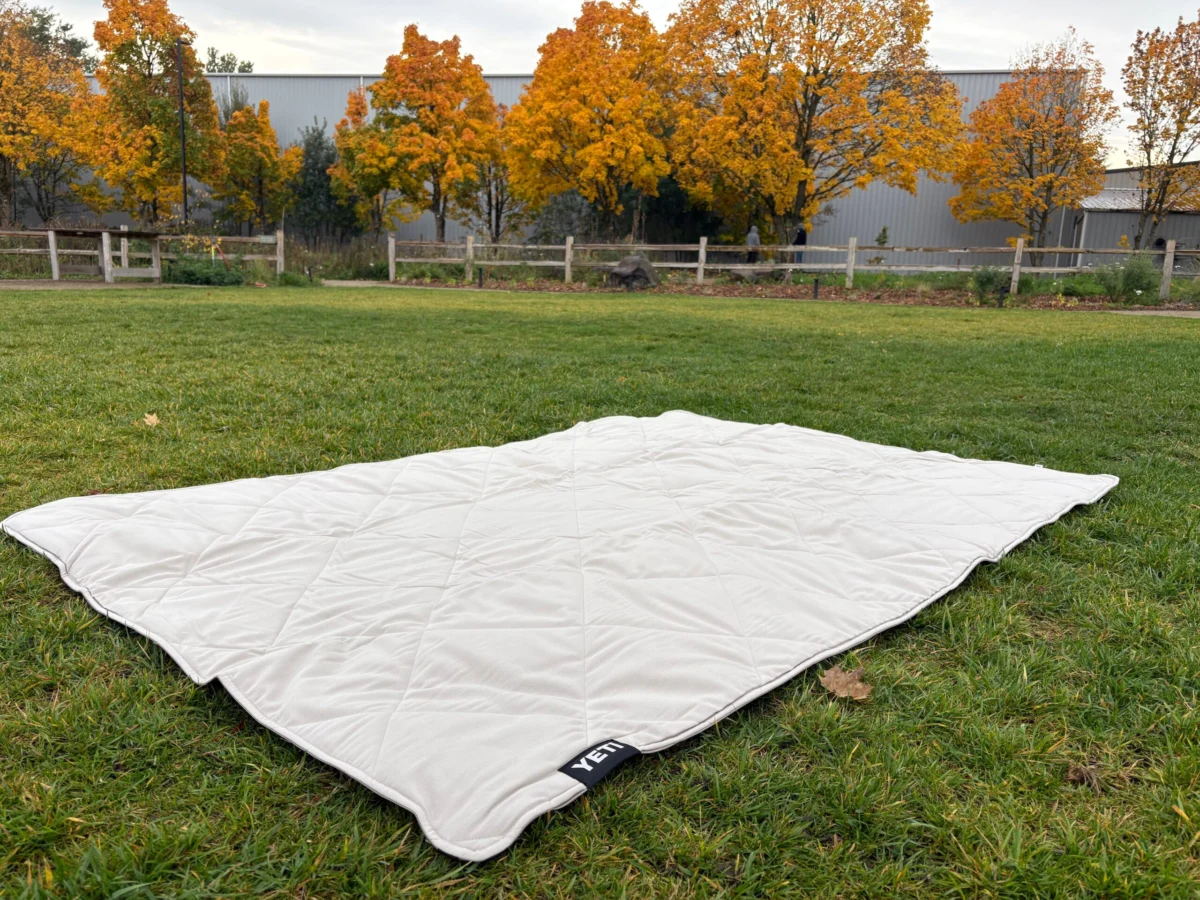
"The YETI Lowlands Blanket bridges the gap between rugged survival gear and high-end textile comfort, offering a waterproof, insulated sanctuary that justifies its premium price through sheer durability and multi-terrain versatility."
In an era where outdoor enthusiasts increasingly demand equipment that performs across diverse environments—from alpine campsites to coastal picnics—the YETI Lowlands Blanket emerges as a significant benchmark for the "luxury-rugged" category. While YETI initially built its reputation on indestructible coolers, the brand has successfully pivoted into the lifestyle and furniture space, applying its "over-engineered" philosophy to products that were once considered simple commodities. This analysis explores how the Lowlands Blanket addresses the technical challenges of outdoor insulation and moisture protection while maintaining a level of tactile comfort typically reserved for indoor furnishings.

The Strategic Expansion of YETI
YETI’s trajectory from a niche cooler manufacturer for professional anglers to a global lifestyle powerhouse is one of the most remarkable stories in modern retail. The Austin-based brand identified a fundamental gap in the market: consumers were tired of "disposable" outdoor gear that failed after a single season. By applying heavy-duty rotational molding to coolers and double-wall vacuum insulation to drinkware, YETI established a trust-based relationship with its audience.
The introduction of the Lowlands Blanket represents the next logical step in this evolution. It is a product designed for the "base camp" lifestyle—activities where weight is less of a concern than performance, durability, and comfort. Whether it is being used as a clean surface for a dog in the back of an SUV or as a thermal barrier against a frozen stadium seat, the Lowlands Blanket is engineered to survive environments that would ruin a standard household throw.
Engineering and Material Composition
At the heart of the Lowlands Blanket is a dual-layer construction that serves two distinct purposes. The "utility side" is a rugged, waterproof polyester shell designed to be laid directly onto wet grass, mud, or sand. This layer acts as a hydrostatic barrier, ensuring that ground moisture does not seep through to the user. The "comfort side," conversely, features a soft, padded material that mimics the feel of a high-quality fleece or a luxury lodge blanket.

The blanket utilizes a diamond-stitched quilting pattern, which is more than an aesthetic choice. This structural stitching ensures that the internal insulation remains evenly distributed, preventing "cold spots" that occur when filling shifts over time. This level of detail is critical for maintaining thermal consistency, particularly when the blanket is used as a supplemental layer during late-autumn camping or winter tailgating.
Performance in the Field: Thickness and Protection
One of the most immediate differentiators of the Lowlands Blanket is its thickness. Measuring nearly half an inch in depth, it provides a level of cushioning that most packable "puffy" blankets cannot match. In field testing, this depth proves invaluable when sitting on uneven terrain. Standard outdoor blankets often leave the user feeling every root, rock, and twig beneath them; the YETI construction effectively "eats up" these contours, providing a stable and comfortable seating surface.
Furthermore, the blanket’s ability to repel debris is a standout feature for pet owners. Traditional fleece blankets act as magnets for dog hair, pine needles, and burrs, often requiring hours of cleaning or specialized tools to restore. The Lowlands material is specifically finished to allow pet hair and dirt to be shaken off with minimal effort. For those who travel with high-shedding breeds, this feature alone often justifies the investment.

Weight, Portability, and the "Base Camp" Philosophy
The primary critique of the Lowlands Blanket is its weight. At approximately six pounds for the regular size (55-in. by 78-in.), it is significantly heavier than the ultralight down blankets favored by backpackers. However, to judge the Lowlands by backpacking standards is to misunderstand its intent.
YETI has designed this for "stationary" outdoor use. It is a tool for the car camper, the beach-goer, the soccer parent, and the outdoor concert enthusiast. To facilitate transport, YETI includes a heavy-duty carry bag with a shoulder strap. While the blanket’s mass makes it cumbersome for long-distance hiking, that same weight provides a benefit in windy conditions. Unlike lighter nylon blankets that can catch a breeze and fly away, the Lowlands remains planted, further aided by integrated corner loops that allow it to be staked down or tied to a vehicle.
Maintenance and Long-Term Durability
High-performance outdoor gear often comes with complex care instructions, but YETI has prioritized user-friendliness. The Lowlands Blanket is fully machine washable and dryer-safe. This is a critical feature for a product designed to be dragged through mud and exposed to campfire smoke.

However, users should be aware of the "breathability-to-waterproof" trade-off. Because the bottom layer is an effective moisture barrier, it can also trap moisture within the fibers if the blanket is packed away while damp. Reports of mildew or odors in the outdoor community are almost always linked to improper storage. To ensure longevity, the blanket should be allowed to air dry completely after a wash or a wet outing before being compressed back into its carry bag.
The Competitive Landscape
The outdoor blanket market is increasingly crowded, with several brands offering specialized alternatives:
- Rumpl: Known for their "Original Puffy" blankets, Rumpl focuses on vibrant aesthetics and a high warmth-to-weight ratio. Their blankets feel more like a sleeping bag and are much lighter than the YETI. However, they lack the rugged, waterproof "ground-side" shell that makes the YETI so effective on wet surfaces.
- Nomadix: This brand offers puffer blankets made from recycled materials. They are highly packable and weigh only two pounds, making them superior for travel. However, they do not provide the same level of physical cushioning or thermal insulation as the Lowlands.
- White Duck Outdoors: Their Trailside Blanket is a budget-friendly alternative under $100. It features magnetic closures that allow it to be worn as a cape. While functional, it does not match the heavy-duty material thickness of the YETI.
- Pendleton: The iconic Oregon brand offers a Roll-Up Blanket with a wool top and a nylon back. It is a classic choice that offers great style, but wool is notoriously difficult to clean compared to YETI’s synthetic build, making it less ideal for high-mess environments.
Sizing and Versatility
YETI offers the Lowlands in two distinct sizes. The "Regular" (55-in. x 78-in.) is essentially a bed topper, large enough for two adults to sit comfortably or for one person to use as a primary sleep layer in a van or tent. The "Small" version (28-in. x 38-in.) is more specialized, functioning perfectly as a dry spot for a dog or a thermal pad for a single stadium seat. The small version does not include a carrying case, as it is designed to be rolled and tossed into a larger bag or the trunk of a car.

The Verdict: Is the Investment Justified?
At a price point of $200 for the regular size, the YETI Lowlands Blanket is an investment. For the casual user who only picnics on dry grass once a year, a standard $20 fleece will suffice. However, for the dedicated outdoor enthusiast, the value proposition lies in the "Buy Once, Cry Once" philosophy.
The Lowlands is built to last a decade or more. It solves the specific problems of ground moisture, uneven terrain, and pet hair management in a way that cheaper alternatives cannot. It is a piece of gear that transitions seamlessly from a summer beach day to a sub-zero football game. For those who find themselves frequently operating at the mercy of the elements, the YETI Lowlands Blanket is not just a luxury; it is a highly functional piece of equipment that redefines what it means to be comfortable in the wild.
