
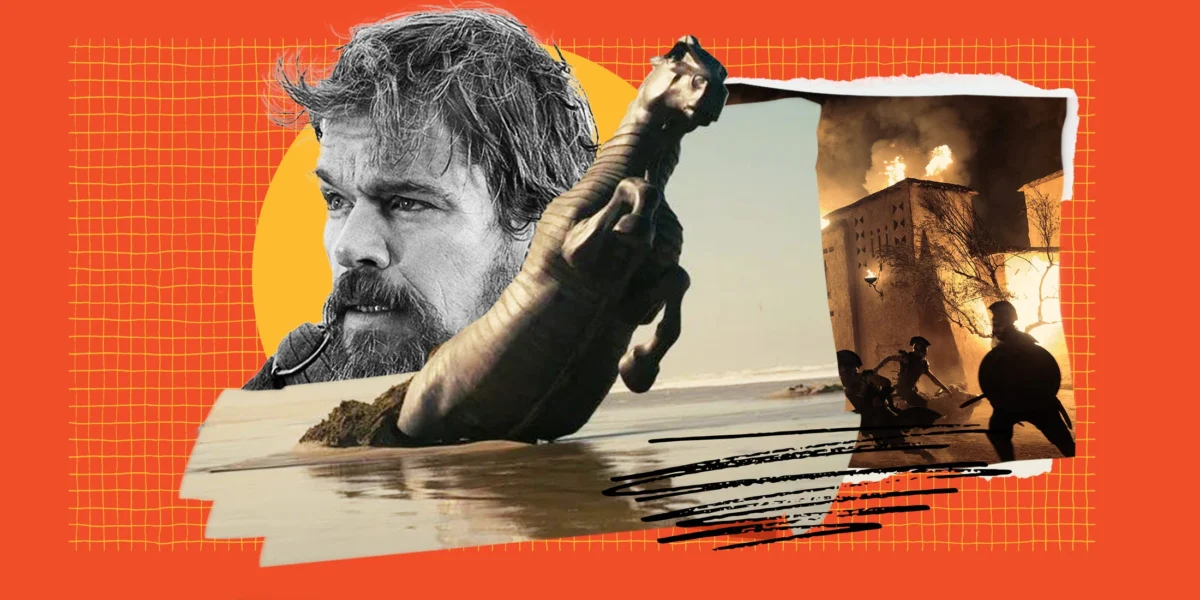
“By transforming Homer’s foundational epic into a ‘Trojan Horse’ of genre experimentation, Christopher Nolan has redefined the limits of the historical blockbuster, proving that ancient myth remains the ultimate canvas for contemporary cinematic innovation.”
Following the monumental success of Oppenheimer, director Christopher Nolan has returned to the roots of Western storytelling with an adaptation of The Odyssey that is as much a technical marvel as it is a narrative reimagining. This analysis explores how Nolan utilizes the episodic structure of the poem to weave together disparate genres—from body horror to revenge thriller—resulting in a film that honors its ancient source while firmly establishing itself as a pinnacle of modern auteur-driven cinema.

The cinematic landscape of the 2020s has been increasingly defined by the tension between franchise reliability and the rare, gravity-defying success of the "event" film. Christopher Nolan, perhaps the only filmmaker working today who can turn a three-hour historical biopic into a billion-dollar cultural phenomenon, has once again shattered expectations with his latest effort, The Odyssey. Released to a staggering quarter-billion-dollar opening weekend, the film represents more than just a successful adaptation; it is a seismic shift in how Hollywood approaches the "Sword-and-Sandal" epic.
While the source material is a staple of middle-school curricula, Nolan’s interpretation strips away the dusty, academic veneer of the ancient poem to reveal a story that is both timeless and urgently contemporary. Much of the early discourse surrounding the film has centered on Nolan’s ability to "Nolan-ize" Homer. The protagonist, Odysseus, is framed through the director’s favorite lens: the hubristic genius. Like the protagonists of Inception, The Prestige, or Oppenheimer, Odysseus is a man called away from the domestic sphere to perform a monumental, perhaps impossible, duty. In doing so, he achieves greatness but unwittingly contributes to the erosion of the very society he seeks to protect.
However, beneath this familiar thematic structure lies a film that is a radical departure for the director. Known for his "puzzle-box" timelines and clinical precision, Nolan has embraced the picaresque nature of Homer’s work to create a film that functions as a "Trojan Horse." Disguised as a conventional historical epic, the movie is actually a vessel for a series of high-concept genre experiments. By breaking the narrative into distinct vignettes, Nolan explores styles he has previously only touched upon, turning the three-hour runtime into a breathless tour of cinematic history.

The Sword-and-Sandal Creature Feature
One of the most surprising elements of The Odyssey is its status as Nolan’s most overtly fantastical film. For a director who famously insisted on practical effects to simulate a nuclear explosion in Oppenheimer, the transition to a world of sea monsters and witches is handled with a grounded, visceral intensity. The encounter with Scylla, the multi-headed sea monster, is a standout sequence. As giant tentacles descend from the cavernous heights to pluck sailors from the deck, Nolan eschews the glossy, weightless look of modern CGI in favor of practical animatronics and clever camera work.
This approach pays homage to the matinee classics of the mid-20th century, specifically the work of Ray Harryhausen and director Don Chaffey in Jason and the Argonauts. By utilizing practical effects for creatures like the Laestrygonians—invincible giants who tear ships apart with their bare hands—Nolan creates a sense of "physical reality" that makes the supernatural elements feel genuinely threatening. The inclusion of the Cyclops, Polyphemus, and the witch Circe further pushes the film into the realm of the "Creature Feature," proving that Nolan can navigate high fantasy without losing his signature realism.
The Procedural Prison Break
Midway through the film, the narrative tempo shifts from grand adventure to the methodical tension of a prison break. The sequence in which Odysseus and his crew are trapped in the cave of Polyphemus is filmed with the clinical focus of a heist movie or a procedural. The audience is invited to watch the "mechanics" of survival: the spitballing of ideas, the false starts, and the brutal necessity of violence.

Nolan has always been fascinated by the "how" of a situation—how to plant an idea in a dream, how to stage a temporal pincer movement, or how to build an atomic bomb. In The Odyssey, he applies this fascination to the ancient world. The escape from the cave is not just a feat of strength; it is a feat of engineering and psychological manipulation. For a brief window, the film offers a glimpse into what a Christopher Nolan-directed Escape from Alcatraz might look like, focusing on the minute details of a plan executed under extreme duress.
The Naturalist Disaster Film
While Nolan’s previous work has explored the vacuum of space and the labyrinth of the human mind, The Odyssey marks his first significant engagement with the raw power of the natural world. Utilizing IMAX photography to its fullest potential, the film features stunning, on-location wide shots of the open sea and jagged island cliffs. This visual scale is essential for the film’s "Disaster Movie" segment, which occurs after the crew’s ill-fated decision to slaughter the cattle of Helios.
As Poseidon unleashes his wrath, the film transforms into a survival drama reminiscent of Wolfgang Petersen’s The Perfect Storm. The sheer scale of the water effects and the immersion provided by the IMAX format create an overwhelming sensory experience. This segment also serves a narrative purpose, stripping Odysseus of his last vestiges of command and leaving him isolated. It is here that the film introduces Calypso, played with a haunting, ethereal quality by Charlize Theron, marking the transition into the film’s most intimate chapter.

The Psychosexual Drama
The relationship between Odysseus and Calypso allows Nolan to delve into the territory of the psychosexual thriller. The director utilizes Ludwig Göransson’s eerie, creeping score to heighten the tension of Odysseus’s captivity on Ogygia. The film raises a provocative question: Does Odysseus actually want to go home?
Nolan frames the hero’s amnesia and his "side relationship" with Calypso as a battle for his soul. There are echoes of Alfred Hitchcock’s Vertigo and Adrian Lyne’s Fatal Attraction in these sequences, as Odysseus is torn between the memory of his wife, Penelope, and the immediate, seductive temptation of Calypso. The "fishnet" costume design for Theron and the hazy, opiate-infused atmosphere of the island create a sense of moral and psychological disorientation that is rare for a summer blockbuster.
Practical Body Horror
Perhaps the most talked-about sequence in the film is the encounter with Circe, played by Samantha Morton. In a scene that evokes the transformative horror of Spirited Away and the visceral grit of the Saw franchise, Circe turns Odysseus’s men into swine. What makes the sequence remarkable is the revelation, confirmed by actor Himesh Patel, that the transformation was achieved entirely without CGI.

Using Rick Baker-style latex and makeup, Nolan depicts the dehumanization of the soldiers in a way that feels disturbingly real. Morton’s performance provides a voice for the "faceless masses" of history—those who were pillaged and marauded by the "heroes" of ancient epics. By turning the soldiers into pigs, the film literalizes their base instincts and offers a stinging critique of the "heroic" warrior archetype. It is a masterclass in body horror that serves a profound thematic purpose.
The Revenge Thriller Conclusion
The final act of the film shifts gears one last time, evolving into a high-stakes revenge thriller. As Odysseus returns to Ithaca disguised as a beggar, the tension builds toward a cathartic explosion of violence. The suitors, led by a "deliciously slimy" Robert Pattinson as Antinous, are depicted as the ultimate villains: greedy, cruel, and profoundly disrespectful of the social order.
When Odysseus finally strings his bow, the film enters a mode of "righteous anger" that rivals the best of the John Wick series. The ensuing battle in the Great Hall is a masterpiece of choreography and sound design, as the "war drums thunder" and the hero systematically eliminates his rivals. It is a satisfying, blood-soaked conclusion to a three-hour journey of moral ambiguity.

In the end, The Odyssey confirms Christopher Nolan’s status as the preeminent architect of the modern cinema experience. By refusing to stick to a single genre, he has created a film that is as multifaceted and enduring as the poem that inspired it. It is a reminder that in the hands of a master, even the oldest stories can be made to feel dangerously new.
