
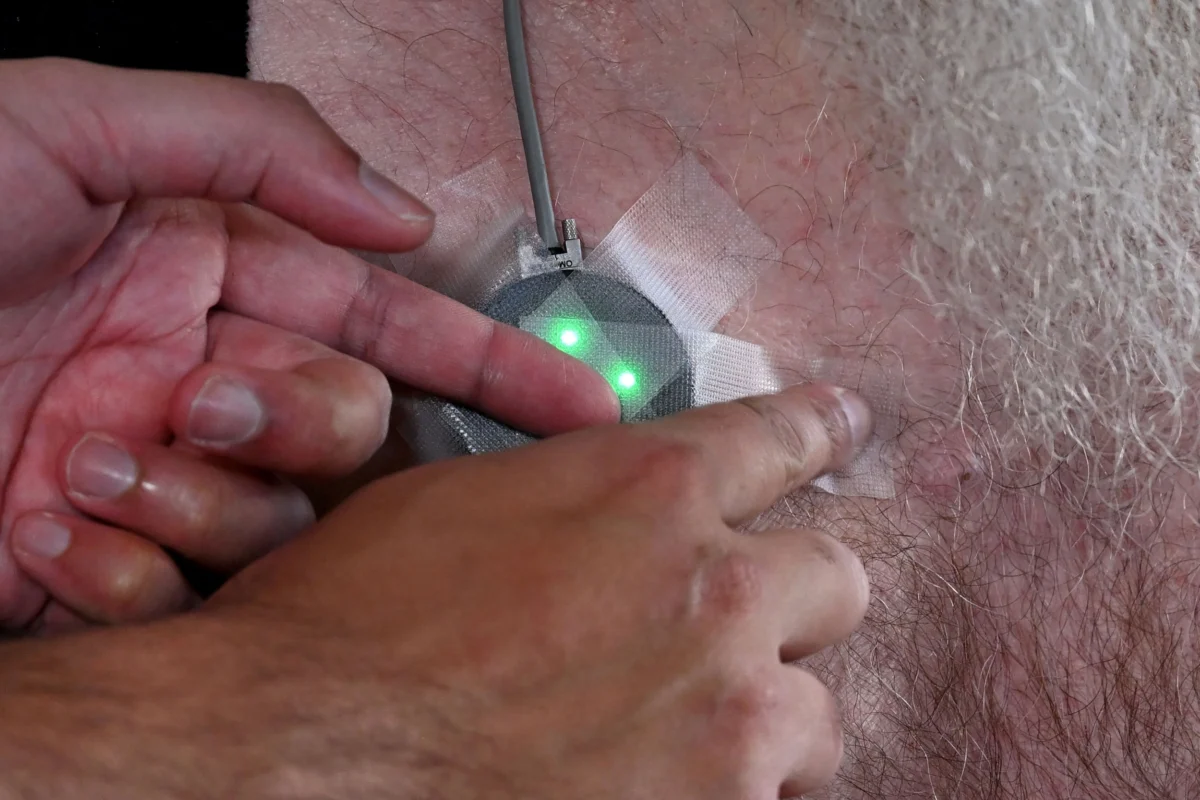
"A novel wearable ultrasound patch, developed by researchers at the University of Texas at Austin, has demonstrated the ability to significantly reduce the time it takes to reach REM sleep and increase its duration in a small study, offering a potential new avenue for understanding and treating sleep disorders."
Researchers at the University of Texas at Austin have unveiled a sophisticated, skin-adherent patch that integrates focused ultrasound technology with brain activity sensors. This innovative device, named NEUSLeeP, has shown in a preliminary study of 28 participants that it can help individuals reach the crucial Rapid Eye Movement (REM) stage of sleep approximately 43 minutes faster and remain in it for about 16 minutes longer. The findings, published in the esteemed journal Nature Communications in June, represent a significant step forward in non-invasive neuromodulation for sleep enhancement, though researchers emphasize the technology is still in its early stages and not yet available for public use.
The NEUSLeeP device is a flexible, bioadhesive patch designed for comfortable overnight wear. It weighs approximately 103 grams and incorporates a tunable concentric-ring ultrasound array alongside hydrogel electrodes. This dual functionality allows the patch to deliver transcranial focused ultrasound stimulation to the subthalamic nucleus, a deep brain structure integral to sleep regulation, while simultaneously monitoring the brain’s electrical activity in real-time. This integrated approach is what the research team highlights as a novel contribution, enabling the non-invasive targeting of deep brain regions involved in REM sleep and real-time brain activity monitoring—a feat not previously achievable.
Kai Wing "Kevin" Tang, the doctoral student in biomedical engineering who spearheaded the research, noted the unprecedented nature of simultaneously targeting deep brain regions for REM sleep modulation while observing brain activity. Huiliang Wang, the assistant professor who supervised the project, expressed optimism about the patch’s potential to revolutionize the study of sleep and the treatment of sleep disorders within home environments.
The study design involved participants sleeping for two nights: one with a sham (inactive) stimulation and another with active stimulation. Of the 28 individuals who participated, sleep recordings from 26 were deemed usable for analysis. The results indicated a notable increase in REM sleep, rising from an average of 16.3% to 20.9% of total sleep time, an increase of 4.6 percentage points, which translates to approximately 16 minutes. Crucially, the time taken to reach the first REM episode, known as REM latency, decreased from an average of 177 minutes to 135 minutes. Other sleep parameters, such as the number of awakenings and overall sleep efficiency, did not show significant changes.
The cohort was comprised of 16 individuals who reported sleeping well and 12 with mild sleep difficulties, as assessed by a standard sleep quality questionnaire. Both groups experienced a significant increase in REM sleep duration. However, the reduction in REM latency was statistically significant only in the group of good sleepers, while it did not reach significance in the group with mild sleep difficulty. This suggests that the device’s effects might be more pronounced or consistent in individuals without pre-existing sleep disturbances, or that further refinement might be needed for those with more pronounced sleep issues.
Beyond sleep architecture, the study also observed other physiological responses. In healthy participants, the ultrasound stimulation was associated with an increase in heart rate variability, a recognized indicator of the body’s adaptive capacity to stress. This effect was not observed in the group experiencing mild sleep difficulties. Separately, an imaging study involving 16 healthy adults revealed changes in basal ganglia and midbrain activity during an emotional face-matching task when subjected to the stimulation. Importantly, vital signs remained stable during stimulation, and skin irritation was negligible even after eight hours of wear, underscoring the patch’s safety profile for short-term use.
Understanding the significance of REM sleep and its latency is crucial to appreciating the potential impact of this research. REM sleep is widely recognized as the stage of sleep associated with vivid dreaming and plays a vital role in emotional processing and memory consolidation. REM latency, the time elapsed from falling asleep to the onset of the first REM period, is a standard metric in sleep medicine and carries clinical implications. Shortened REM latency, for instance, has been observed in conditions such as major depressive disorder, while REM sleep abnormalities are characteristic of narcolepsy and post-traumatic stress disorder (PTSD). This clinical relevance makes a device capable of modulating REM sleep particularly compelling for therapeutic applications. The research team has indicated plans to explore the NEUSLeeP device’s potential in treating PTSD, depression, and chronic insomnia.
However, it is critical to note that the benefits of increased REM sleep or faster REM onset are not universally applicable. In certain clinical contexts, treatments are specifically designed to suppress REM sleep. Therefore, any device that reliably alters REM sleep architecture would necessitate rigorous investigation within defined patient populations before its clinical utility could be established. The direction and magnitude of benefit can vary significantly depending on the individual’s underlying condition.
The limitations of the NEUSLeeP study are substantial and warrant careful consideration, particularly given the small sample size. With only 28 participants (26 with usable data), the observed effect sizes are preliminary and could potentially diminish or disappear in larger, more diverse populations. Such findings are common in early-stage research and underscore the need for replication.
A more significant methodological caveat, acknowledged by the authors themselves, relates to the study’s design. Participants underwent sham stimulation on their first night and active stimulation on the second, a fixed order rather than a randomized one. Furthermore, the study was single-blinded, meaning participants knew whether they were receiving active or sham treatment, and lacked a parallel control group. These design choices mean that placebo effects and order effects—where the sequence of interventions influences the outcome—cannot be definitively ruled out. The researchers themselves call for double-blind, sham-controlled trials with pre-registered outcomes, a level of candor that highlights the study’s current standing as a feasibility demonstration rather than definitive proof of clinical benefit.
Several questions remain unanswered by this research that are of paramount importance to individuals experiencing sleep difficulties. The study did not assess whether participants subjectively felt more rested, whether their daytime functioning improved, or if their mood or memory experienced meaningful changes. Moreover, the durability of any observed effects with repeated use over weeks or months was not evaluated. While changes in heart rate variability and brain imaging provide mechanistic insights, they do not directly translate to patient-reported outcomes or functional improvements.
The NEUSLeeP device is currently a laboratory-grade system and not a consumer product. The research team is collaborating with the university’s commercialization unit and has filed a patent application, indicating a path toward potential commercialization. However, this process typically involves extensive further development, rigorous regulatory review by bodies like the Food and Drug Administration (FDA), and large-scale clinical trials, a journey that can span several years and in which many promising technologies do not ultimately succeed.
For individuals currently struggling with sleep, the realistic takeaway is that no new consumer-ready solutions have emerged from this research this week. Established and well-supported treatments remain the most effective options. Cognitive Behavioral Therapy for Insomnia (CBT-I) is consistently recommended as the first-line treatment by major medical organizations. CBT-I is accessible through trained clinicians and validated digital programs, and its efficacy is supported by a vast body of evidence that far surpasses that of any prototype device.
Furthermore, untreated obstructive sleep apnea (OSA) is a prevalent and often undiagnosed condition that significantly impacts sleep quality and overall health. The expansion of home sleep testing has greatly improved access to OSA diagnosis, offering a crucial pathway for those who experience loud snoring, witnessed pauses in breathing during sleep, or excessive daytime sleepiness. These symptoms warrant a professional medical evaluation.
Consumers should exercise skepticism toward over-the-counter products marketed with claims of REM enhancement through methods like sound, light, or vibration. These devices are distinct from the technology described in the NEUSLeeP study and generally lack comparable scientific evidence.
Persistent difficulties in falling or staying asleep, loud snoring accompanied by observed breathing interruptions, or daytime sleepiness that impairs daily activities such as driving or work, should prompt an evaluation by a healthcare professional. Insurance coverage for sleep studies can vary, and home sleep apnea tests are often a more cost-effective option for appropriate candidates compared to in-laboratory polysomnography.
The future developments to monitor will include larger, rigorously designed controlled trials involving specific patient groups, any forthcoming regulatory submissions, and independent replication of these findings by research institutions unaffiliated with the NEUSLeeP developers. Until then, the confirmed scientific contribution is a small-scale feasibility study demonstrating short-term, measurable alterations in REM sleep timing. The patient population that could ultimately benefit most from this technology are individuals with REM-related sleep and mood disorders, rather than the general public. For individuals experiencing poor sleep, pursuing established treatments like CBT-I or seeking evaluation for conditions like sleep apnea remains the most prudent course of action. The central question that future research must answer is whether these promising effects can be reliably reproduced and validated under stringent trial conditions.
