
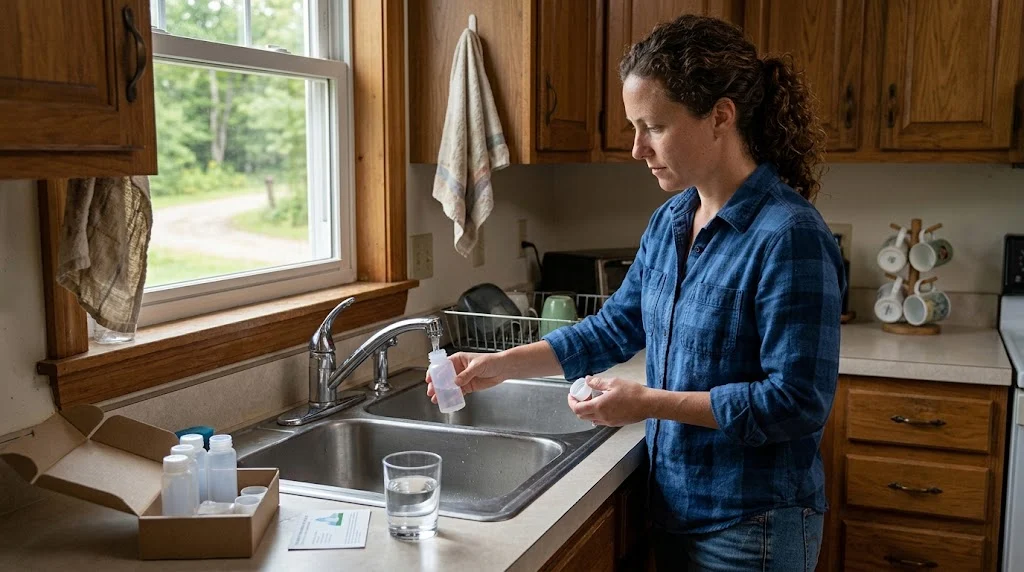
"Despite nearly a decade of state-led initiatives and extensive outreach, the percentage of Maine homeowners testing their private wells for arsenic has barely budged, highlighting persistent challenges in public health messaging, funding, and the inherent difficulties of addressing a silent, naturally occurring threat."
Maine’s efforts to encourage homeowners to test their private wells for arsenic have encountered a persistent roadblock, with testing rates showing negligible improvement over the past ten years. As of 2023, only 53% of Mainers relying on private wells had submitted their water for arsenic testing, a marginal increase from approximately 48% in 2014. This falls significantly short of the state’s benchmark of 65% by 2020. Compounding these concerns, a program designed to assist lower-income households in treating arsenic-contaminated wells has reached far fewer homes than initially projected, as reported by The Maine Monitor. This stagnation underscores a complex interplay of public awareness, financial barriers, and the invisible nature of arsenic contamination, a naturally occurring element found in the state’s bedrock.
The issue is particularly pertinent in Maine, where over half of all households depend on private wells for their drinking, cooking, and bathing water. The Maine Center for Disease Control and Prevention (CDC) estimates that a concerning one in ten of these wells exceeds safe arsenic levels. This widespread potential for exposure is exacerbated by the fact that households earning less than $25,000 annually are the least likely to have their well water tested, creating a vulnerable demographic with limited access to crucial information and potential solutions.
The persistent low testing rates are not attributed to a lack of awareness regarding the necessity of testing. Survey data collected by the Maine Tracking Network, which relies on residents self-reporting their testing habits, reveals that the numbers have remained remarkably stable despite multiple outreach campaigns. This suggests that the problem lies less in informing the public about the existence of arsenic and more in overcoming the practical and financial hurdles that prevent widespread testing and subsequent remediation.
In response to these challenges, Maine established its first dedicated arsenic treatment program for low-income homeowners in 2017. Initially funded with a one-time allocation of $500,000 from MaineHousing, the program managed to install 124 filters between 2017 and 2022. Recognizing the need for increased support, the Legislature allocated an additional $400,000 in 2022, broadening the program’s scope to include other contaminants. The Maine CDC had projected that this new funding would enable more than 500 homes to install filtration systems. However, three years into this initiative, only $385,000 of the $400,000 has been disbursed, assisting just 57 homeowners.
Scott Thistle, a spokesperson for MaineHousing, has clarified that the initial projection of assisting 500 homes was "not a realistic expectation." He explained that at an approximate cost of $3,000 per home for treatment, excluding administrative and testing expenses, the available funding could realistically cover the installation of at most around 134 systems. A representative from the state’s health department further elaborated that the higher figure was derived from an analysis of average treatment costs and was never intended as a formal target for the program. This discrepancy highlights a potential disconnect between initial program planning and the on-the-ground realities of implementation and cost.
The escalating cost of water treatment systems is outpacing the available grant funding, creating a significant barrier for homeowners. Kim Ferenc, who directs the abatement program, noted that the average treatment cost, which was around $3,500 per home in 2022, has since risen to between $4,000 and $5,000. For a comprehensive whole-house system, the cost can reach up to $15,000, which is also the maximum grant amount offered by the program. Consequently, most grants have been directed towards smaller, point-of-use systems, such as under-sink filters, rather than systems that treat all water entering a residence.
Installers cite increased import costs as a major contributor to the rising prices. Jack Martin, co-owner of Haskell’s Water Treatment in Rockland, explained that his company sources essential components like ultraviolet lights from Canada and water pumps from Italy and Germany. He reported an approximately 8% price increase across all materials following recent tariff measures. Two other companies that participate in state-funded work have corroborated similar cost escalations over the past four years, indicating a broader trend impacting the affordability of water treatment solutions.
Furthermore, the current program structure does not encompass the crucial aspect of maintenance, which represents a recurring expense for homeowners. Water filters require regular replacement to remain effective, and an unmaintained treatment system can cease to function properly without any visible changes in the water quality, leaving residents unknowingly exposed to contaminants.
State Representative Daniel Ankeles, a Democrat from Brunswick, has characterized the existing funding as "a drop in the bucket" and criticized its non-ongoing nature. He recently introduced a bill to establish a $1 million contamination response fund specifically for private wells, which unfortunately did not pass the Legislature this spring. Representative Ankeles has indicated his intention to reintroduce the bill in the next legislative session, underscoring the ongoing need for sustained financial support.
The presence of arsenic in Maine’s wells is not a consequence of industrial spills or localized pollution events. Instead, it is a naturally occurring phenomenon stemming from the fractured bedrock that serves as the source for most drilled wells, typically found at an average depth of around 250 feet. Dr. Jean MacRae, an associate professor of civil and environmental engineering at the University of Maine, has elucidated that soluble fractions of arsenic-bearing minerals leach into the groundwater stored within this bedrock. The complex geological makeup means that even neighboring homes can yield vastly different test results, as their water sources may draw from distinct fractured systems. This geological variability renders a neighbor’s clean test result an unreliable indicator of one’s own water quality.
Compounding the challenge is arsenic’s insidious nature: it is undetectable by human senses. It possesses no taste, odor, or color, and does not cause cloudiness or staining in water, providing no immediate visual or sensory cues for homeowners to suspect contamination and initiate testing.
The health concerns driving the state’s outreach efforts are significantly informed by a groundbreaking study of Maine schoolchildren conducted by Columbia University researchers, with co-authorship from the University of New Hampshire, and published in the journal Environmental Health. This study examined 272 children in the third through fifth grades. It found that children whose household water contained arsenic at or above 5 micrograms per liter scored approximately 5 to 6 points lower on full-scale IQ tests and several other cognitive measures compared to children with lower exposure levels. These findings remained consistent even after adjusting for factors such as maternal IQ and education, home environment, school district, and the number of siblings.
It is important to note that the 5 micrograms per liter threshold identified in the study is half of the federal limit of 10 micrograms per liter for arsenic in drinking water. The study’s design, however, was cross-sectional, meaning it captured a snapshot of children’s exposure and cognitive function at a single point in time. Therefore, while it demonstrates a compelling association, it does not definitively prove causation. The study authors cautiously framed their conclusions as suggesting that arsenic levels at or above 5 micrograms per liter may pose a threat to child development. They also acknowledged the limitation of not being able to reconstruct each child’s full lifetime exposure. Independent research has, however, linked longer-term arsenic exposure to an increased risk of certain cancers.
The challenge of ensuring safe private well water extends far beyond Maine’s borders. Approximately 43 million Americans rely on private wells, and crucially, these water sources are not regulated under the federal Safe Drinking Water Act. This means that the responsibility for testing, treatment, and ongoing maintenance falls entirely upon the well owner, as outlined by the U.S. Environmental Protection Agency’s guidance on private wells. Arsenic-bearing bedrock is a common geological feature not only across New England but also in significant portions of the Upper Midwest, the Southwest, and the Rocky Mountain states, creating a widespread public health concern.
The CDC recommends annual testing for common contaminants such as coliform bacteria, E. coli, nitrates, and nitrites. For arsenic, along with radon, uranium, lead, manganese, and other less common contaminants, testing every three to five years is advised. In Maine, free arsenic test kits are available to some well owners through state programs. For residents in other states, contacting their state or county health department is the recommended course of action. These departments often maintain lists of accredited laboratories and may offer subsidized testing services.
Receiving a test result that exceeds the safe limit does not necessitate an immediate decision regarding expensive treatment systems. Bottled water for drinking and cooking can serve as a reasonable interim solution while homeowners explore their treatment options, a step many families already take. For parents concerned about a child’s potential exposure to arsenic, the recommendation is to discuss these concerns with a pediatrician rather than proceeding with independent testing. MedicalDaily has previously reported on how soil and water contamination can affect children long before any overt symptoms become apparent, underscoring the importance of proactive and informed health management.
