
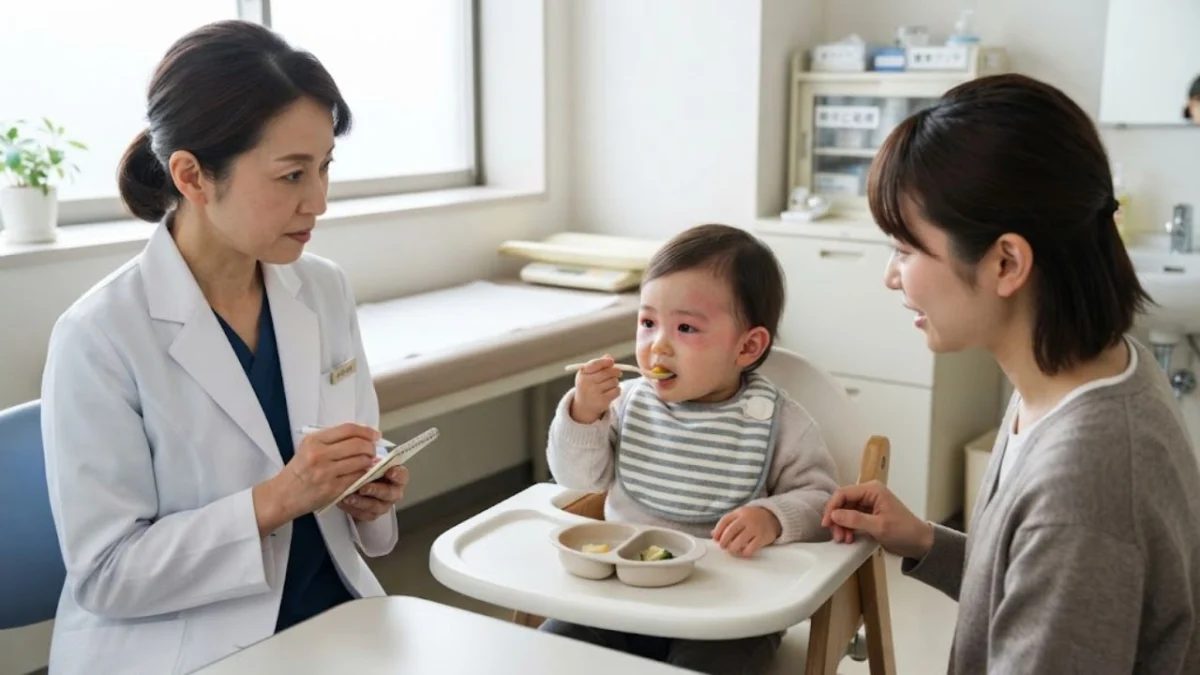
"A perplexing case of infant Frey syndrome in Japan highlights how a rare nerve condition can masquerade as a food allergy, leading to unnecessary dietary restrictions and diagnostic delays for families."
A baby boy in Japan experienced a puzzling phenomenon: within minutes of consuming certain foods, he developed distinct red patches on his temples and under his eyes. While initially suspected to be a food allergy, a closer examination by specialists at Kanagawa Children’s Medical Center in Yokohama revealed a much rarer diagnosis: bilateral infantile Frey syndrome. This nerve-related condition causes facial flushing in response to eating, and the boy’s presentation defied typical diagnostic patterns, underscoring the importance of recognizing this mimic of food allergy to prevent misdiagnosis and unnecessary interventions. The findings were detailed in a report published in Pediatric Investigation on April 24, 2026.
The infant’s symptoms began around six months of age, coinciding with the introduction of solid foods. By ten months, the episodes had become remarkably consistent. Upon ingestion of specific foods such as apples, bananas, yogurt, bread, peanut butter, and tuna, he would develop pronounced redness over both temples and beneath his eyes. These episodes would typically commence within three to five minutes of eating and persist for a duration of 30 to 45 minutes. Importantly, consumption of beef, pork, bacon, carrots, pumpkin, and green beans did not elicit any reaction.
Several key observations strongly suggested that this was not a typical allergic reaction. The flushing occurred irrespective of whether the food made direct contact with the child’s skin, and crucially, it spared the area around his mouth. This is significant because contact rashes from food allergies commonly manifest around the oral region. Furthermore, the infant exhibited no signs of itching, hives, swelling, respiratory distress, or gastrointestinal upset during these flushing episodes, all of which are hallmarks of allergic reactions. An oral antihistamine prescribed by another clinic also proved ineffective in reducing the frequency, spread, or duration of the flushing, further distancing the condition from a standard allergic response. Despite these clinical indicators, the parents’ initial concern about a food allergy understandably led to considerations of significant dietary restrictions.
To definitively rule out an allergic etiology, allergy specialists conducted comprehensive investigations. Prick-to-prick skin testing, a method where a suspected food allergen is pricked with a needle and then the skin is similarly pricked, yielded negative results for all tested foods. A histamine control, used to ensure the test’s accuracy, produced the expected positive response, confirming the integrity of the testing procedure. The absence of a reaction to the food allergens, coupled with the consistent and localized nature of the flushing, formed the basis of the diagnostic conclusion. While the Minor starch-iodine test, which visualizes sweat production, was not performed, the reproducible clinical presentation was deemed sufficient for diagnosis.
Frey syndrome, also known as auriculotemporal syndrome, is characterized by gustatory sweating, a phenomenon where eating triggers sweating, typically on one side of the face. This occurs due to aberrant regeneration of nerve fibers near the parotid salivary gland. Following damage, these nerve fibers can misdirect, forming abnormal connections with sweat glands in the skin instead of rejoining the salivary gland. In adults, the most common precipitating factor is surgery to remove the parotid gland.
In pediatric cases, the etiology is often linked to birth trauma. A 2022 systematic review published in the European Journal of Pediatrics, which analyzed 121 published cases of Frey syndrome not associated with surgery or diabetes, found that a significant portion, 52%, were linked to forceps-assisted delivery. Only 17% of all reported pediatric cases involved both sides of the face. The Japanese infant, however, presented a unique profile. He was born at term via cesarean section due to umbilical cord entanglement, with no history of instrumental delivery, facial injury, or surgery. The authors noted that bilateral cases of pediatric Frey syndrome, while less common, account for an estimated 17% to 27% of such diagnoses. Interestingly, in bilateral Frey syndrome, a history of damage to the auriculotemporal nerve (ATN) is rare, leading to many such cases being classified as idiopathic, meaning of unknown cause. Familial predispositions have also been documented. Given these factors, the researchers concluded that the infant’s presentation was more indicative of an idiopathic or potentially congenital mechanism.
The medical team’s approach shifted from dietary restriction to reassurance and continued feeding of the identified trigger foods. This strategy proved successful, as the episodes gradually diminished in frequency and intensity over time. By 14 months of age, flushing occurred approximately once a week. By 19 months, the affected area had reduced, primarily to the lower eyelids, and fewer foods were implicated. At the final follow-up, when the child was 24 months old, only tomatoes and tomato sauce consistently elicited the redness, and these episodes were brief, lasting about five minutes. This marked improvement was described by the authors as indicative of "ongoing spontaneous regression," suggesting that the condition often resolves on its own in children.
Frey syndrome, though uncommon in children, poses a significant diagnostic challenge due to its propensity to mimic more prevalent conditions like food allergies. The 2022 review highlighted that pediatric Frey syndrome is frequently underrecognized and misdiagnosed as food allergy, with a substantial 45% of patients enduring a diagnostic delay of 12 months or longer. The Japanese case report echoes these concerns, citing earlier data indicating that only 20% of children receive a definitive diagnosis upon their initial visit, while a concerning 21% are subjected to inappropriate dietary restrictions. The authors emphasized that their case "highlights the importance of recognizing pediatric Frey syndrome to avoid unnecessary dietary restrictions, undue concerns about anaphylaxis, and excessive allergy investigations."
This case report follows a similar finding from Canada, published in Allergy, Asthma & Clinical Immunology in February 2026. In that instance, an eight-month-old boy was initially diagnosed with allergies to milk, soy, peanut, wheat, and egg. However, further investigation revealed unilateral flushing and sweating of his right cheek, consistent with Frey syndrome. Supervised food challenges were employed to help confirm the diagnosis in that case.
The limitations of allergy testing alone are underscored by these cases. Food allergy guidelines, as summarized by the American Academy of Family Physicians, state that skin prick tests, when used in isolation, are not definitively diagnostic. In the Japanese infant’s case, the negative skin prick test results, when considered alongside the specific clinical presentation—localized facial redness without systemic symptoms like hives—provided crucial diagnostic clues.
It is vital to emphasize that this report details a single case, and the diagnosis relied on clinical judgment rather than a formal supervised food challenge or sweat test. This does not imply that all instances of facial redness after eating are benign. Children who exhibit hives, swelling, vomiting, wheezing, or difficulty breathing following food consumption require immediate medical attention, as these are potential indicators of a severe allergic reaction. Parents concerned about potential food allergies in their infants should always consult with a pediatrician or allergist before implementing any dietary restrictions.
Key Questions Answered:
What happened to the baby in this case?
A baby boy in Japan experienced redness on both temples and lower eyelids within minutes of eating certain foods, starting at six months of age. Despite negative skin prick tests for allergies, doctors diagnosed him with bilateral infantile Frey syndrome, a rare nerve condition.
Why is this Frey syndrome case unusual?
Most reported pediatric cases of Frey syndrome affect one side of the face and are linked to instrumental delivery, often with forceps. This infant exhibited flushing on both sides of his face and was born via cesarean section without any birth injury.
How can Frey syndrome be told apart from a food allergy?
Frey syndrome typically causes predictable flushing, sometimes accompanied by sweating, in the same localized areas of the face with each occurrence. It is not associated with hives, itching, swelling, breathing difficulties, or stomach issues. Allergy tests are usually negative, and the diagnosis is made by a clinician based on the specific pattern of symptoms.
Does pediatric Frey syndrome go away?
In this specific case, the flushing episodes gradually decreased in frequency, size, and duration over 14 months, eventually being triggered only by tomatoes. The authors noted that most reported children with pediatric Frey syndrome show improvement or spontaneous recovery, although comprehensive data on the long-term course of the condition remain limited.
Should parents remove foods that cause facial redness?
Parents should not unilaterally remove foods based solely on facial redness without professional medical guidance. Data indicate that approximately 21% of children with Frey syndrome have been placed on unnecessary and inappropriate diets. Consulting a pediatrician or allergist is crucial before making any changes to an infant’s diet.
When is facial redness after eating an emergency?
Facial redness accompanied by hives, swelling of the lips or face, vomiting, wheezing, or difficulty breathing can be signs of a serious allergic reaction and necessitate immediate medical evaluation and treatment.
