
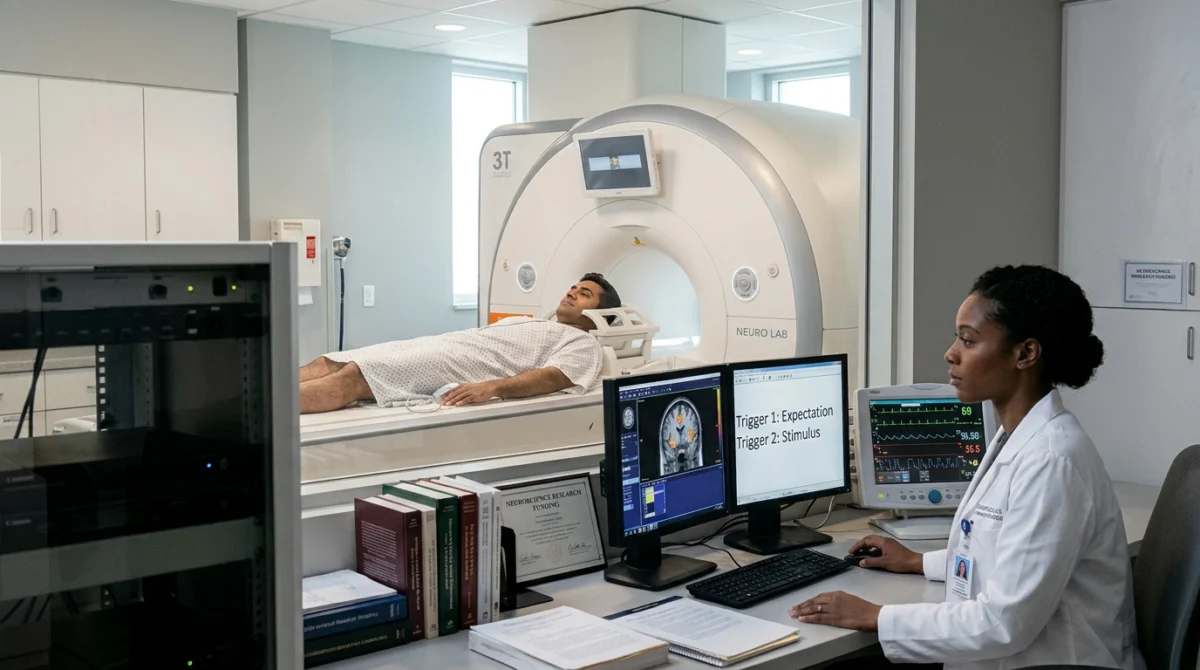
"A mild burning sensation in the nose, initially perceived as a sign of a potent painkiller, lost its pain-relieving power the moment volunteers understood it was not linked to a feared opioid. This study reveals how perceived side effects, rather than pharmacological action, can significantly influence pain perception and potentially distort the results of drug trials."
A recent study conducted by neuroscientists at the University Medical Center Hamburg-Eppendorf has unearthed a critical vulnerability in the design and interpretation of clinical drug trials. The research, published in the prestigious journal Brain in May 2024, demonstrates how the presence of noticeable side effects can lead participants to believe they are receiving a more potent treatment, thereby enhancing the perceived effectiveness of a drug, even when it is inactive. This phenomenon, particularly potent when participants suspect they might be receiving a powerful opioid like fentanyl, highlights a significant challenge in placebo-controlled trials, where the expectation of side effects can inadvertently amplify treatment outcomes.
The randomized trial involved 77 volunteers who were administered nasal sprays, with the initial understanding that there was a 50% chance of receiving fentanyl. In reality, none of the sprays contained fentanyl. Instead, one spray contained a small dose of capsaicin, the active compound in chili peppers, known to induce a burning sensation, while the other spray was inert. In the initial phase of the study, the burning sensation, regardless of whether it was from capsaicin or simply the belief in receiving a strong medication, appeared to contribute to pain relief. This initial phase was designed to establish a baseline where the expectation of fentanyl was high.
The pivotal moment arrived in the second session, conducted within an MRI scanner. The volunteers were divided into two groups. One group of 42 participants was informed that the procedure would simply be repeated, maintaining their initial belief about the potential presence of fentanyl. The remaining 35 participants, however, were debriefed. They were explicitly told that no fentanyl was administered and that any perceived differences in pain relief were solely attributable to variations in the physical stimuli applied to their skin, such as controlled heat.
Crucially, the physical sensation of the burning spray remained consistent across both groups. Participants reported similar levels of discomfort from the burning spray, with side effect ratings averaging 2.71 after the capsaicin spray and a negligible 0.05 after the plain spray, with no significant difference noted between the debriefed and non-debriefed groups. This indicates that the physical intensity of the side effect itself was not the differentiating factor.
What did change dramatically was the interpretation and perceived value of that sensation. Among the volunteers who continued to believe they might be receiving fentanyl, the burning spray led to a notable reduction in pain ratings. On a scale of 0 to 100, their reported pain levels averaged 38.7 after the burning spray, compared to 43.0 after the plain spray, suggesting a tangible pain-relieving effect. In stark contrast, for the volunteers who had been informed about the absence of fentanyl, the burning spray offered no significant pain relief. Their pain ratings were 45.0 after the burning spray and 43.5 after the plain spray, a difference that was statistically insignificant and indicated no benefit. This divergence underscores that the sensation alone did not alleviate pain; it was the belief system attached to that sensation that mediated the pain relief.
Brain imaging data provided further support for this psychological interpretation. In the group that maintained their belief in the potential for fentanyl, the burning spray coincided with enhanced communication between specific brain regions: the rostral anterior cingulate cortex (rACC) and the periaqueductal gray (PAG). These areas are well-established components of the body’s endogenous pain control system. The researchers interpreted this heightened neural connectivity as evidence that expectation was actively engaging the brain’s built-in pain relief mechanisms. While brain imaging cannot definitively prove causation, the correlation strongly suggests that psychological anticipation plays a direct role in modulating physiological pain responses.
This finding exposes a potential "weak spot" in the methodology of many placebo-controlled trials. The gold standard in clinical research involves comparing an active drug against an identical-looking inactive placebo. The underlying assumption is that any non-specific effects, such as participant expectations, hope, and the experience of side effects, will be distributed equally between the drug and placebo groups. Consequently, any superior outcome observed in the drug group is attributed to the pharmacological action of the medication itself.
However, the Hamburg study demonstrates that noticeable side effects can undermine this fundamental assumption. If a drug produces a distinct side effect – such as dry mouth, drowsiness, or a tingling sensation – and the placebo does not, participants may be able to deduce which treatment they are receiving. This phenomenon is termed "functional unblinding." The research team argues that this unblinding can lead to an overestimation of a drug’s efficacy. When side effects boost expectations specifically within the active drug group, a portion of the observed therapeutic benefit may stem from psychological factors rather than the drug’s inherent pharmacology.
To address this issue, the authors propose the use of "active placebos." These are inactive treatments designed to mimic the side effects of the actual drug, thereby maintaining the blind for participants. Lead author Lieven Schenk emphasized this point in an interview with Swissinfo, stating that when a drug causes side effects, researchers must "make sure that the placebo also causes them." This approach aims to equalize the psychological experience of both groups, ensuring that any differential outcome is more likely to be due to the drug’s pharmacological properties.
The concern regarding functional unblinding is not merely theoretical; it has direct implications for regulatory decisions. In June 2024, an FDA advisory committee expressed significant concerns about the efficacy and risk-benefit profile of MDMA-assisted therapy for PTSD, developed by Lykos Therapeutics. A key issue raised was the high rate at which participants could identify whether they had received the active drug or a placebo, a situation exacerbated by the drug’s noticeable side effects. While the FDA’s ultimate rejection of the application on August 9, 2024, was based on multiple factors, including selection bias and safety data, the unblinding issue was a prominent concern. BioSpace reported that experts consider functional unblinding to be a pervasive challenge in virtually all psychiatric drug trials.
Despite the compelling logic behind active placebos, their implementation is not a straightforward solution. A comprehensive Cochrane review of 21 trials comparing active and standard placebos, encompassing 1,462 participants, found no clear, consistent difference in the estimated effects of drugs. The authors noted that the results were imprecise. However, in a subset of five trials with a low risk of bias, a larger difference was observed, although the reviewers cautioned that this association might be coincidental. Nevertheless, the reviewers still recommended that researchers carefully consider the type of placebo employed, particularly when a drug has discernible side effects and patient-reported outcomes are the primary measures of efficacy, a scenario common in many pain studies.
The findings from the Hamburg study, while significant, are subject to certain limitations. The participants were healthy young adults, the pain stimulus was artificially induced in a laboratory setting, and the side effect was a mild, transient burning sensation. Furthermore, in a follow-up session held approximately a week later, the burning spray did reduce pain in both groups, and the statistically significant difference between the debriefed and non-debriefed groups disappeared. The researchers hypothesize that the debriefed volunteers may have, over time, re-established their expectations, although this was not directly measured. The study also excluded about a quarter of the 104 individuals initially enrolled, and the research team has made its data publicly available for further scrutiny.
For patients, this study does not provide a definitive method for determining whether a medication is working based solely on the presence or absence of side effects. The complex interplay of psychological factors and pharmacological action means that side effects can be misleading. Individuals experiencing concerns about their medication’s effects or side effects are strongly advised to consult with their prescribing clinician before making any adjustments to their treatment regimen. Open communication with healthcare providers remains the most reliable pathway to understanding and managing medication-related issues.
Key Questions Answered:
What changed when volunteers learned the truth?
When volunteers were debriefed and understood that the burning spray did not contain fentanyl, its pain-relieving effect vanished. Those who maintained their belief in the possibility of receiving fentanyl reported lower pain levels after the burning spray, while those who were informed of the truth did not experience the same reduction.
Did the burning sensation itself change?
No, the physical sensation of the burning spray remained consistent across all participants. Both groups rated the side effect similarly, indicating that it was the belief attached to the sensation, rather than the sensation itself, that influenced pain relief.
What is functional unblinding?
Functional unblinding occurs in clinical trials when participants can discern whether they have received the active drug or a placebo, often due to the presence of noticeable side effects associated with the active drug. This can lead to biased results.
What is an active placebo?
An active placebo is an inactive substance designed to mimic the side effects of a particular drug. Its purpose is to maintain the blind in a clinical trial by making it difficult for participants to distinguish between the active treatment and the placebo.
Should patients read side effects as a sign a drug is working?
No, this study does not suggest that side effects are a reliable indicator of a drug’s efficacy. The experience of side effects is complex and can be influenced by psychological factors. Patients with concerns about their medication should always consult with their physician.
