
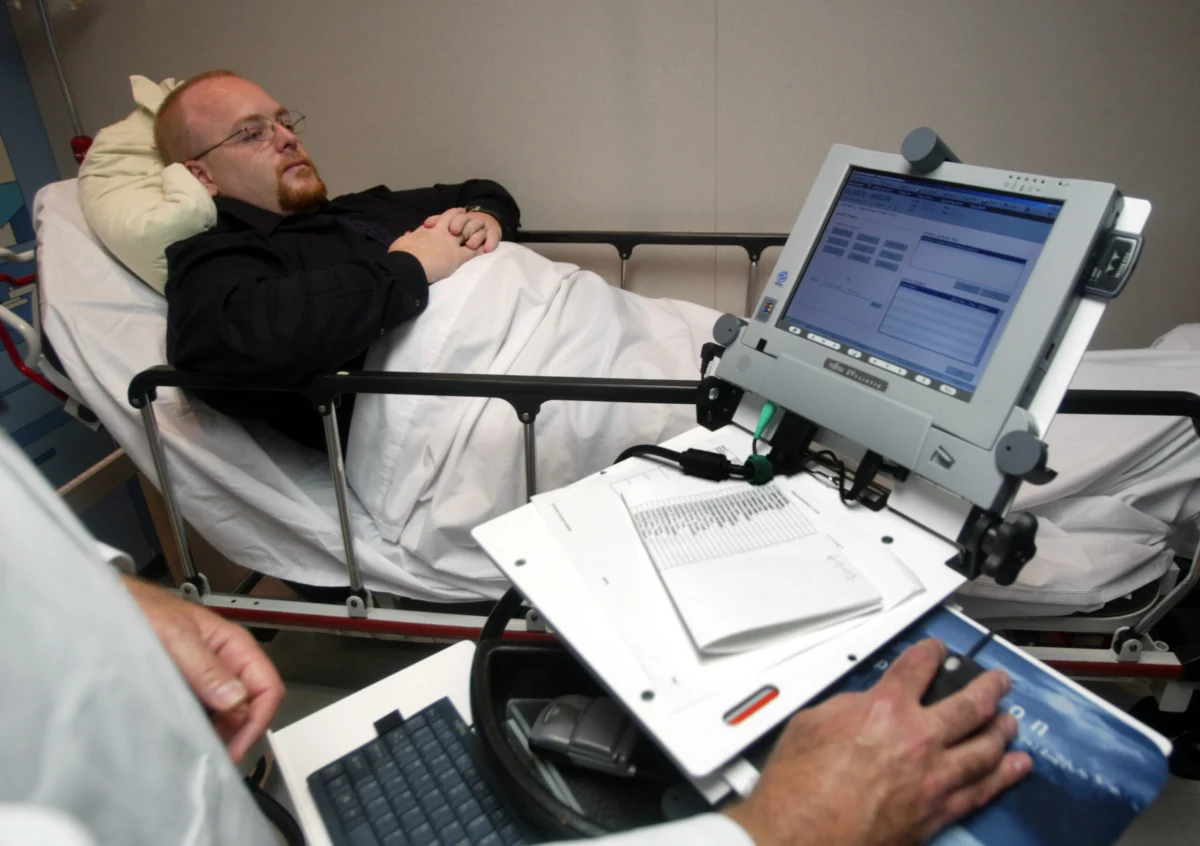
"While ambient AI documentation tools are rapidly being adopted by US hospitals, outpacing traditional health IT adoption cycles, their increasing capabilities are raising critical questions about accountability and the potential for widening healthcare disparities."
The integration of artificial intelligence into healthcare is accelerating at an unprecedented pace, particularly with the widespread adoption of ambient AI documentation tools in U.S. hospitals. These sophisticated systems, designed to listen to patient-clinician conversations and automatically generate draft medical notes, are revolutionizing physician workflows. A recent study published in the American Journal of Managed Care reveals that by mid-2025, nearly two-thirds of U.S. hospitals utilizing Epic’s electronic health records (EHR) platform had implemented such AI tools. This rapid diffusion, largely driven by word-of-mouth among physicians, marks a significant departure from the typically slow and cautious adoption patterns of health IT. However, this technological leap forward is outstripping the development of governance frameworks, leaving a crucial gap in determining accountability for the accuracy and implications of AI-generated medical information.
The Pervasive Reach of Ambient AI: A Closer Look at Adoption
The headline figures surrounding ambient AI adoption, while impressive, require careful examination. The Emory University researchers’ study, which formed the basis of the American Journal of Managed Care publication, focused on a national sample of 6,561 U.S. hospitals. Within this sample, 2,784 hospitals, or 42.4%, were identified as using Epic as their primary inpatient EHR system. Of these Epic-utilizing hospitals, a substantial 1,744, representing 62.6%, had deployed ambient AI tools. This translates to approximately two-thirds of Epic hospitals adopting these technologies, rather than two-thirds of all U.S. hospitals. The market for these tools is notably concentrated, with three primary products—DAX Copilot, Abridge, and ThinkAndor—accounting for over 80% of usage among adopting facilities.
Further analysis of the adoption landscape reveals significant disparities. Deployment has been notably higher in large hospitals, nonprofit facilities, metropolitan areas, and institutions exhibiting stronger operating margins and higher staffing-adjusted workloads. The study highlights a stark difference in adoption rates between hospital types: nonprofit hospitals demonstrated an adjusted probability of 70.2% for adoption, contrasting sharply with only 28.8% for for-profit institutions. Geographically, uptake was also uneven, with lower adoption rates observed in the Midwest compared to the South. The authors of the study emphasize that this uneven diffusion pattern could exacerbate existing healthcare disparities, particularly for resource-constrained hospitals, if targeted support is not provided. This concern about equity adds a critical dimension to the ongoing discussions surrounding clinical AI, which have often been dominated by safety considerations.
Complementing the hospital-level data, a separate 2026 Doximity survey of over 3,100 physicians provides insight into individual physician adoption of voice-based documentation. This survey indicated a significant increase in physician use, rising from 20% to 29% within a single year. This surge in physician engagement underscores the perceived benefits of these tools in streamlining administrative burdens.
Navigating the Nuances: Distinguishing Clinical AI Categories and Their Risks
The broad term "clinical AI" encompasses a diverse range of technologies, each with distinct functionalities, associated risks, and regulatory implications. Understanding these distinctions is paramount for effective oversight and governance.
Ambient documentation tools primarily function as advanced transcription services. They capture the nuances of clinical encounters and generate draft notes for physician review. As of early 2026, these AI scribes are classified as administrative tools rather than medical devices, thereby exempting them from direct oversight by the Food and Drug Administration (FDA).
In contrast, clinical decision support (CDS) systems are designed to actively assist clinicians in making diagnostic and therapeutic choices. These tools may suggest diagnoses, flag critical findings, or recommend specific treatment pathways. The FDA’s revised guidance in January 2026 drew a crucial line: CDS software is only considered outside of medical device regulation if the clinician can independently verify the underlying logic or algorithm. If a clinician cannot scrutinize the reasoning behind a recommendation, the software falls under medical device regulations.
Risk prediction models represent another significant category, employing AI to estimate the likelihood of patient deterioration, hospital readmission, or the onset of sepsis. These models often trigger automated clinical workflows, necessitating careful integration and validation.
Patient monitoring systems continuously analyze data streams from bedside equipment, generating alerts when patterns suggest a patient’s condition is worsening. The proactive nature of these alerts is vital for timely intervention.
The varying degrees to which these categories directly influence clinical decision-making dictate the nature and extent of regulatory oversight. A tool that merely drafts a note operates under a different legal framework than one that recommends a medication, even when offered by the same vendor and integrated into the same clinical workflow. The evolving capabilities of newer ambient systems are blurring these lines. Many are now venturing beyond simple transcription to identify care gaps, pre-populate physician orders for review and signature, and even draft prior authorization requests. While documentation remains a clerical task, the generation of orders and administrative requests edges closer to direct medical practice. Some analyses suggest that health systems are increasingly viewing these expanded functionalities as mere "feature upgrades" rather than a fundamental shift in the tool’s classification, potentially circumventing more stringent regulatory scrutiny.
The Unsettled Question of Accountability
For ambient documentation tools, the current consensus on accountability is clear, albeit potentially insufficient in practice: the clinician who ultimately signs the generated note bears full responsibility for its accuracy and completeness. No vendor of ambient AI documentation software currently accepts clinical liability. Physician review and sign-off before finalizing a note remain both a legal and professional obligation.
However, the sheer efficiency of these tools can lead to a subtle erosion of diligence. When an AI system consistently produces accurate notes with high reliability, the physician’s review process may become perfunctory. This is precisely the scenario in which errors, however infrequent, can slip through unnoticed and propagate through the patient’s record.
The landscape of accountability for clinical decision support tools is far less settled. Existing malpractice frameworks were designed around human judgment, and the allocation of responsibility among a clinician who follows an AI recommendation, a hospital that deployed the system, and the vendor that developed it remains an unresolved legal challenge.
Evidence of this uncertainty is emerging in physician employment negotiations. Issues of indemnification for AI-related errors are increasingly appearing alongside compensation and call schedules as key contractual points. This development signals a tacit acknowledgment by healthcare stakeholders that regulatory bodies are unlikely to provide definitive answers on these complex liability questions in the immediate future.
Existing Safeguards and Their Limitations
A multi-layered system of safeguards is in place to govern the use of clinical AI, though their application and effectiveness vary across different categories of tools.
The FDA provides regulatory oversight for software that meets the definition of a medical device. This framework encompasses the entire product lifecycle, from premarket review to post-market surveillance. Ambient documentation tools, however, currently operate outside this direct regulatory purview.
Professional standards of care remain a critical layer of oversight. Regardless of the technology employed, clinicians are ultimately responsible for the care they deliver. Signing a medical note signifies an attestation to its accuracy and adherence to professional standards.
The Health Insurance Portability and Accountability Act (HIPAA) governs the privacy and security of protected health information. Before any tool handling patient data can be implemented, a business associate agreement (BAA) is typically required. However, a recurring practical challenge involves the unauthorized use of consumer-grade AI tools by healthcare staff. When patient details are entered into such platforms, which may not have a BAA in place, the data could be stored or processed outside the secure parameters established by hospital contracts, creating a significant vulnerability.
Hospital governance structures are the primary locus of oversight for many AI tools. Internal committees, rigorous vendor assessments, bias evaluations, and local validation processes play a crucial role. This decentralized approach means that the quality and robustness of oversight can vary significantly from one institution to another. A tool that undergoes thorough validation at one hospital might be deployed elsewhere without comparable scrutiny.
State legislation is beginning to address clinical AI, but this is resulting in a fragmented regulatory landscape rather than a uniform standard. Consequently, the legal framework governing a particular AI tool can depend on the state in which a hospital is located. This patchwork approach mirrors developments in adjacent areas, such as enforcement actions in virtual behavioral health, where regulatory oversight has often followed the trajectory of technological adoption.
Patient Empowerment: Navigating the AI-Infused Healthcare Experience
Patients are increasingly encountering AI tools during their healthcare interactions, most commonly in the form of ambient documentation during routine visits, sometimes without explicit notification. This evolving landscape necessitates informed engagement from patients.
Several questions are reasonable for patients to ask. Inquiring whether AI is being used to document the encounter is important, as consent requirements can vary by state and the nature of the visit. Patients should also confirm that their clinician reviews the AI-generated note before signing it, a practice they are professionally obligated to uphold. Furthermore, understanding the process for requesting corrections if a visit summary contains an error is crucial, as patients have a HIPAA-mandated right to request amendments to their medical records.
Regardless of whether AI was involved in documentation, patients should routinely review after-visit summaries and patient portal notes. Errors in medication lists, allergies, or diagnoses can have far-reaching consequences, propagating through subsequent care. A mistake identified and corrected by a patient at home is significantly easier to rectify than one discovered months later by another clinician relying on inaccurate information.
The introduction of these tools should not deter patients from seeking care. The primary intent of ambient documentation assistance is to free up clinician time, allowing for greater focus on the patient. Evaluations have indicated reductions in self-reported physician burnout and modest decreases in time spent interacting with the EHR. However, clear financial returns on investment have been more challenging to demonstrate. MedicalDaily has previously reported on quality gaps observed in AI note-taking tools specifically within mental health care, highlighting the need for continued vigilance and improvement across all specialties. The promise of increased clinician availability and improved efficiency is undeniable, but the accompanying challenges of equitable access, robust accountability, and transparent patient engagement must be proactively addressed to ensure that AI truly serves to enhance, rather than complicate, the delivery of quality healthcare.
