
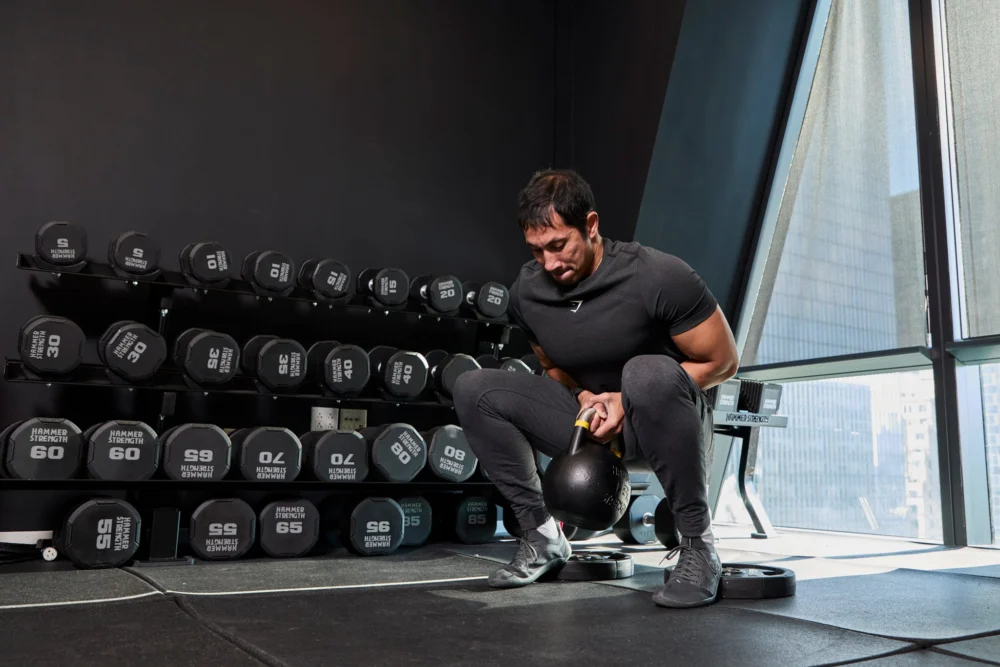
“The somersault squat offers a unique mechanical advantage for extreme quadriceps isolation, allowing athletes to bypass the glutes and hamstrings to achieve a massive muscle pump without the need for specialized leg extension machines.”
While modern fitness culture often prioritizes high-tech machinery and complex algorithms, the recent viral resurgence of the somersault squat proves that some of the most effective muscle-building tools are hidden in the archives of old-school bodybuilding. Pioneered by trainer Joe Daniels over fifteen years ago, this unconventional movement has transitioned from a niche bodybuilding secret to a social media phenomenon, championed by IFBB pros and biomechanics experts alike. By intentionally manipulating the body’s center of gravity and leverage points, the somersault squat provides a high-intensity stimulus to the quadriceps while minimizing systemic load on the spine, making it a versatile tool for both aesthetic development and functional strength-endurance.
The Resurrection of a Bodybuilding Classic
In the fast-paced world of digital fitness, what is old eventually becomes new again. A few months ago, Joe Daniels, a veteran trainer and former competitive bodybuilder, noticed a sudden surge in his social media notifications. High-profile figures in the fitness industry, including IFBB Pro Petar Klancir, Julian Zaletti, and "Glute Guy" Bret Contreras, were suddenly dissecting a movement Daniels had first introduced to the public via a fledgling YouTube more than a decade ago: the somersault squat.

Daniels, who won the 2009 Cincinnati NPC Championship, originally developed the move out of necessity and accidental discovery. While performing a weighted stretch on a Smith machine, he found himself in a compromised position with the bar pinned against his hips. To escape the weight, he tilted his torso forward and extended his knees, a maneuver that resulted in an immediate, intense contraction of the quadriceps unlike anything he had experienced with traditional squats. After refining the form and realizing its potential for isolating the "front of the thighs," Daniels coined the term "somersault squat" due to the forward-leaning, tucked-under posture that mimics the starting position of a gymnastic tumble.
The exercise has seen waves of popularity, most notably during the COVID-19 lockdowns when gym-goers were forced to find creative ways to train their legs with limited equipment. Today, it has evolved into a staple for those looking to build massive quads without the luxury—or the joint stress—of a leg extension machine.
The Biomechanics of Quad Dominance
To understand why the somersault squat is so effective, one must look at the biomechanics of the traditional squat. In a standard back or front squat, the movement is a "compound" lift, meaning it involves multiple joints (hips, knees, ankles) and several large muscle groups (quadriceps, glutes, hamstrings, and erectors). While excellent for overall strength, the glutes and hamstrings often take over a significant portion of the load, especially as a lifter nears failure.
The somersault squat changes the equation by placing the lifter in a bent-over, front-loaded position. By keeping the torso pitched forward and the weight (typically a kettlebell or dumbbell) held close to the hips or tucked under the belly, the lifter creates a mechanical disadvantage for the posterior chain. This "stripper squat" posture—a term sometimes used derisively by critics—is actually a deliberate tactical choice. It forces the knees to move significantly forward over the toes, a position that maximizes the stretch and subsequent contraction of the four muscles that make up the quadriceps.

Ebenezer Samuel, C.S.C.S., fitness director for Men’s Health, notes that this exercise fills a critical gap in modern minimalist gyms. Many functional fitness spaces have moved away from machines in favor of racks and turf. While this is great for general athleticism, it makes isolating the quads difficult. The somersault squat serves as a "manual leg extension," allowing for the same targeted fatigue of the vastus medialis (the "teardrop" muscle) and the vastus lateralis (the outer sweep) without needing a 500-pound machine.
Training for Hypertrophy and Longevity
Beyond the aesthetic benefits of "teardrop" quads, the somersault squat offers significant advantages for those dealing with physical limitations. Traditional heavy squatting places a massive "systemic load" on the body. This means the central nervous system and the spine must work incredibly hard to stabilize a heavy barbell across the shoulders. For athletes with lower back pain, herniated discs, or general spinal sensitivity, heavy squatting is often impossible.
Because the somersault squat is performed with much lighter weights—often half or even a third of what one would use for a back squat—the spinal compression is negligible. The load is carried in a way that emphasizes the leverage of the legs rather than the strength of the back. This makes it a "high-reward, low-risk" accessory move.
Furthermore, Joe Daniels found the move invaluable as he transitioned from bodybuilding to kettlebell sport. In competitions that require ten minutes of continuous overhead jerks, quad endurance is the deciding factor between a podium finish and a premature exit. The somersault squat builds the specific strength-endurance required to repeatedly drive weight upward from a deep knee-bend position, proving its worth beyond the mirror.

Safety and Prerequisites: The "Goblet Rule"
Despite its benefits, the somersault squat is an advanced variation that requires a baseline of mobility and strength. Because the move involves significant "knee-over-toe" travel, it puts a high degree of stress on the patellar tendon. For individuals with a history of reconstructive knee surgery or chronic patellar tendinitis, the extreme angles of the somersault squat may be contraindicated.
Ebenezer Samuel suggests a simple litmus test before attempting the move: the Goblet Squat Rule. A lifter should be able to perform 8 to 10 clean repetitions of a standard goblet squat using a weight equal to at least half of their body weight. This ensures that the lifter has the necessary ankle mobility and "vertical shin" stability before they begin experimenting with the aggressive knee angles required for the somersault squat.
Technical Execution: Fine-Tuning the Form
To perform the somersault squat correctly, most lifters will benefit from elevating their heels. Using a slant board or a pair of stacked weight plates allows for greater range of motion at the ankle, which in turn allows the knees to track further forward.
- The Setup: Stand with your heels elevated and your feet roughly shoulder-width apart. Hold a kettlebell by the horns or a dumbbell in a "tucked" position near the lower abdomen.
- The Descent: Unlike a traditional squat where you "sit back," you will "sit down and forward." Allow your torso to tilt forward naturally as your knees drive toward the floor.
- The Bottom Position: At the bottom, your hamstrings should be in contact with your calves. Hold this position for a split second to eliminate momentum and ensure the quads are doing the work to initiate the ascent.
- The Ascent: Push through the balls of your feet to straighten your legs. Crucially, stop just short of a full lockout. Keeping a slight bend in the knees at the top maintains constant tension on the muscle and prevents the load from shifting to the skeletal system.
Advanced Variations: The Spanish Somersault
For those who have mastered the basic movement, the "Spanish Somersault Squat" offers an even higher level of intensity. By wrapping a heavy resistance band around a stable post and placing it behind the knees, the lifter creates a "pulling" force that the quads must constantly fight against.

This variation provides a "one-two punch" of muscle tension. The somersault positioning provides tension in the "shortened" position of the muscle, while the resistance band provides peak tension in the "stretched" position. While effective, this setup is notoriously difficult to manage and should be reserved for experienced trainees looking to break through a growth plateau.
Integration into a Training Program
The somersault squat is not intended to replace the heavy squat or deadlift. Instead, it should be treated as an isolation or "finishing" move. Because it is difficult to load with extreme weight, it is most effective when performed for higher repetitions—typically in the 12 to 20 range.
Expert programming suggests placing the somersault squat toward the end of a leg workout. After the heavy, neurologically demanding lifts are finished, the quads are already pre-fatigued. At this point, the somersault squat can be used to drive the muscle to near-failure with relatively light weights, maximizing hypertrophy while minimizing the risk of injury.
In an era where the "latest" fitness trends are often just repackaged marketing, the somersault squat stands out as a genuine contribution to the iron game. It is a reminder that by understanding human anatomy and mechanical leverage, we can unlock new levels of physical development using nothing more than a single kettlebell and a willingness to look a little "silly" in the pursuit of results.
