
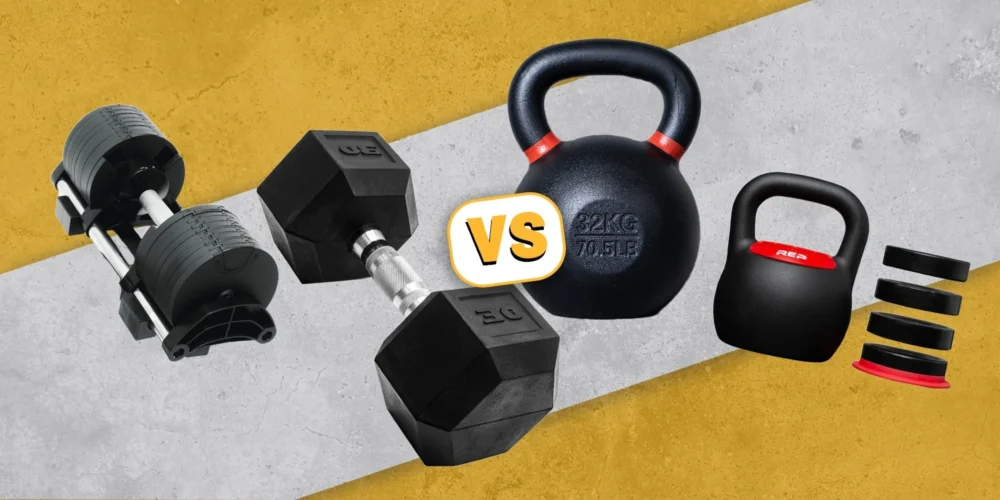
"While dumbbells offer the symmetrical stability required for precision muscle hypertrophy and foundational strength, kettlebells provide the offset load and dynamic versatility essential for athletic power and metabolic conditioning."

The decision to equip a home gym often begins with a fundamental question of utility: should one invest in the traditional dumbbell or the versatile kettlebell? While both implements are categorized as free weights—allowing for a natural range of motion unconstrained by the fixed paths of gym machines—their physical designs dictate vastly different physiological impacts. Choosing between them requires an understanding of how the distribution of mass affects joint mechanics, muscle recruitment, and the long-term trajectory of one’s fitness goals. This guide explores the nuanced differences between these two iconic tools to help lifters build a home environment that aligns with their specific training philosophy.
The Physics of the Load: Symmetry vs. Offset Weight
The primary distinction between a dumbbell and a kettlebell lies in the center of gravity. A dumbbell features a central handle with weight distributed evenly on both ends. This creates a balanced, stable tool that is easy to control during single-plane movements. Because the weight is centered in the palm of the hand, the torque on the wrist is minimized, making dumbbells the gold standard for "slow" lifts where the goal is maximum mechanical tension on a specific muscle group.

In contrast, a kettlebell is essentially a cast-iron or steel ball with a U-shaped handle attached to the top. This design places the center of mass outside the grip, often resting against the back of the forearm or hanging below the hand. This offset load creates an inherent instability that the body must compensate for during every repetition. When pressing a kettlebell, the weight wants to pull the wrist into extension; when rowing it, the mass hangs further from the body’s midline. This requires greater engagement of the stabilizer muscles and the core, transforming a simple lift into a full-body coordination challenge.
Training Objectives: Hypertrophy and Strength
For those whose primary objective is bodybuilding (hypertrophy) or raw strength, the dumbbell is often the superior choice. Building muscle effectively requires a concept known as progressive overload—the gradual increase of stress placed upon the body during exercise. Dumbbells excel here because they typically come in small, predictable weight increments, such as 2.5-pound or 5-pound jumps. This allows a lifter to precisely increase the load as they get stronger without sacrificing form.

Furthermore, the stability of the dumbbell allows for greater "mind-muscle connection." Exercises like the chest press, overhead press, and lateral raise are more easily performed with dumbbells because the weight does not shift or rotate around the hand. This stability allows the lifter to focus entirely on the contraction of the target muscle, which is the cornerstone of traditional aesthetic training. Ebenezer Samuel, C.S.C.S., Fitness Director at Men’s Health, notes that dumbbells are the "best option for strength and learning fundamental movements," particularly for those just beginning their journey.
The Power of the Kettlebell: Athleticism and Conditioning
Kettlebells are the preferred tool for those who prioritize functional athleticism, explosive power, and metabolic conditioning. The unique handle design allows the bell to rotate freely around the hand, making it the ideal implement for ballistic movements such as cleans, snatches, and the signature kettlebell swing. While these movements can be performed with dumbbells, they often feel clunky or awkward because the dumbbell’s heads can interfere with the lifter’s legs or the rotation of the wrist.

The kettlebell is also the king of "flows"—training sequences where multiple exercises are linked together without setting the weight down. For example, a lifter might perform a clean, followed by a front squat, followed by an overhead press. The offset weight of the kettlebell makes these transitions fluid and natural. This style of training keeps the heart rate elevated, providing a potent cardiovascular stimulus alongside strength work. However, this versatility comes with a "steeper learning curve," as Samuel points out. Mastering the timing of the kettlebell’s rotation is essential to avoid bruising the forearms or straining the wrists.
Progressive Overload and Weight Increments
A subtle but significant difference between the two tools is how they are measured and progressed. Dumbbells are almost universally measured in pounds (at least in the U.S.) and follow a linear progression. Kettlebells, however, follow a traditional Russian heritage and are often measured in kilograms. Standard jumps—from 12kg (26 lbs) to 16kg (35 lbs) to 20kg (44 lbs)—represent significant leaps in total mass.

While a nine-pound jump might be insurmountable for a specialized exercise like a dumbbell curl, kettlebell athletes often find these jumps manageable because they primarily use the tool for compound, explosive movements. A swing or a clean utilizes the power of the hips and legs, which can handle larger weight increases more easily than the smaller muscles of the upper body. For the home gym owner, this means you may need fewer kettlebells to achieve a high level of fitness, whereas a serious dumbbell trainee will eventually require a vast array of pairs to continue making progress.
Space, Storage, and Economics
In the context of a home gym, space is often the most valuable commodity. This has led to the rise of high-quality adjustable dumbbells, such as the BowFlex SelectTech 552 or the SMRTFT Nuobell. These systems allow a user to replace an entire rack of weights with a single pair of handles, taking up no more room than a shoebox. This is a massive advantage for apartment dwellers or those using a corner of a garage.

Kettlebells also offer a space-saving advantage, though for a different reason. Many kettlebell programs are designed around a single bell (unilateral training) rather than a pair. Training with one weight at a time not only saves money and space but also introduces a significant anti-rotational core challenge, as the body must work to stay upright against the lopsided load. While adjustable kettlebells do exist—such as the Rep Fitness models—they are often criticized for being bulkier and less balanced than their fixed-weight counterparts, which can interfere with the "feel" of dynamic movements.
Choosing Your Starting Point
For the beginner, the choice should be dictated by the immediate goal. If the goal is to learn the basics of lifting and build a foundation of muscle, starting with a pair of 20- to 30-pound dumbbells or a set of adjustables is the most logical path. This provides the stability needed to master form without the distraction of an unstable load.

If the goal is to improve "work capacity"—the ability to perform high-intensity work over a long period—a single 16kg (35 lb) kettlebell is a transformative investment. It allows for high-rep swings for fat loss, goblet squats for leg strength, and get-ups for shoulder stability. As lifters progress, the most effective home gyms often become hybrid environments. They utilize dumbbells for heavy, controlled presses and rows, and kettlebells for the explosive, high-octane finishers that build the "look" and "feel" of an athlete.
Ultimately, the choice between kettlebells and dumbbells is not a matter of which is "better," but which is more appropriate for the current phase of one’s training. By understanding the physics of the load and the demands of the movement, any lifter can make an informed decision that ensures their home gym remains a place of consistent, injury-free progress. Whether choosing the balanced precision of the dumbbell or the rugged versatility of the kettlebell, the key to success lies in mastering the specific mechanics of the tool and applying the principles of consistency and progressive challenge.
