
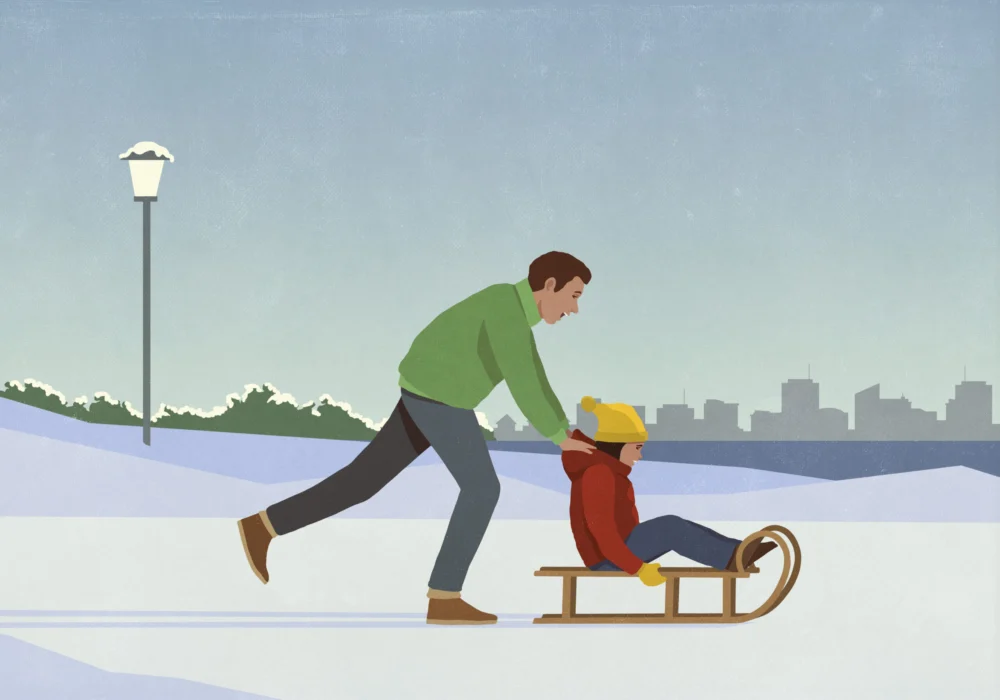
"While technology ensures academic continuity, the shift toward remote learning during winter storms risks erasing the critical social cognition and developmental growth that traditional, unstructured snow days provide."
As educational technology advances and remote learning becomes a permanent fixture of the academic landscape, the traditional "snow day"—a spontaneous reprieve from the rigors of the classroom—is increasingly viewed by administrators as an obsolete relic of a pre-digital era. However, emerging research in human development and social cognition suggests that the move to replace these wintry breaks with virtual instruction may have unintended consequences for the psychological and social well-being of a generation already grappling with unprecedented levels of stress.
For decades, the American snow day was governed by a set of cultural rituals that served as a rite of passage for school-aged children. From wearing pajamas inside out to placing spoons under pillows or gargling saltwater, these superstitions were more than mere whimsy; they represented a collective hope for a shared experience of wonder. The anticipation of the local news scroll, where names of school districts drifted across the screen like the flakes themselves, created a unique sense of community. When the announcement finally came, it triggered a transition from the structured, hierarchical environment of the classroom to a world of free-form exploration.
The shift away from this tradition gained significant momentum following the COVID-19 pandemic, which proved that school districts possessed the infrastructure to maintain instruction regardless of physical location. By February 2024, this capability was put to a high-profile test in New York City. Mayor Eric Adams and the Department of Education mandated that nearly one million students transition to remote learning during a predicted winter storm. The Mayor’s rationale was clear: to "minimize how many days our children are just sitting at home making snowmen." This stance, however, ignited a fierce debate among parents, educators, and developmental experts who argue that "sitting at home making snowmen" is, in fact, a vital educational activity.
The pushback in New York City was not merely philosophical but also practical. On the morning of the mandated virtual classes, a massive network outage crippled the login systems, leaving hundreds of thousands of students and teachers in a state of digital limbo. Reports surfaced of teachers quietly advising parents to ignore the official edict and allow their children to go outside. This incident highlighted a growing tension between the administrative desire for uninterrupted instructional hours and the human need for flexibility and respite.
Dr. Melanie Killen, a professor of human development and quantitative methodology at the University of Maryland, argues that the elimination of snow days reflects a fundamental misunderstanding of how children learn. According to Dr. Killen, a snow day is not a "brain break" in the sense of cognitive dormancy; rather, it is a shift in the type of learning being performed. When children are released into a snowy landscape, they engage in what Killen calls "a different kind of learning"—one that is autonomous and driven by peer interaction rather than teacher-led dissemination.
The physics of a snow day are found in the tactile world. Constructing a snowman requires an intuitive understanding of structural integrity and material science; children must determine which snow is "packing snow" and which is too dry to hold its form. Sledding involves implicit calculations of velocity, friction, and trajectory. Throwing snowballs is a lesson in projectile motion and hand-eye coordination. These activities provide a sensory-rich environment that virtual screens cannot replicate.
Perhaps more importantly, snow days are a primary incubator for social cognition. The American Psychological Association defines social cognition as the way individuals perceive, interpret, and judge their own social behaviors and those of others. In the unstructured environment of a snow-covered neighborhood, children must navigate complex social dynamics without the mediation of adults. They must negotiate the rules of a snowball fight, collaborate on building a fort, and learn to infer the intentions and expectations of their peers. These "free-form" interactions are essential for the development of fairness, morality, and justice. By forcing children onto a Zoom call during a storm, districts may be "undermining the power of peer interactions," which Dr. Killen notes are fundamental for developmental change.
The debate over snow days also exposes deep-seated socioeconomic inequities, often referred to as the "digital divide." While affluent districts may provide every student with a high-end laptop and reliable high-speed internet, millions of American children remain on the wrong side of the connectivity gap. Estimates suggest that as many as 12 million students lack sufficient home internet access to participate in synchronous remote learning.
In response, some districts have gone to extreme lengths to bridge the gap, experimenting with Wi-Fi hotspots and even drone-delivered connectivity. However, these solutions are often stop-gap measures that fail to address the underlying reality: for many families, a snow day is not just a logistical hurdle but a moment of crisis. When schools close, families who rely on school-provided meals or specialized childcare are left vulnerable. Yet, forcing virtual learning on these families often compounds the stress, as parents—many of whom may be essential workers or lack the ability to work from home—must suddenly act as IT support and teaching assistants in a home environment that may not be equipped for it.
The logistical challenge of snow days is particularly acute in regions with limited winter infrastructure. In places like Chapel Hill, North Carolina, the decision to close schools is a high-stakes calculation performed by superintendents and operations teams. Andy Jenks, the chief communications officer for Chapel Hill/Carrboro City Schools, notes that the primary driver is always safety. In the South, where fleets of salt trucks and plows are smaller than in the North, a single inch of ice can render roads impassable for days.
The "all or nothing" approach to school closures in these regions is also a matter of equity. "No one is going to get left behind on account of the weather," Jenks says. If a portion of the student body lives on unplowed rural roads, the entire district must close to ensure that no child is penalized for their geographic location. This philosophy of collective safety and shared experience is a hallmark of the traditional snow day, standing in stark contrast to the individualized, isolated experience of virtual learning.
As of early 2026, the data suggests that weather patterns are becoming more erratic and extreme. While some regions are seeing longer "snow droughts"—Chapel Hill recently went over 760 days without a significant snowfall—others are being hit by more frequent and intense winter storms. This environmental volatility makes the debate over virtual learning even more pressing. If snow days become more frequent due to climate change, the pressure to "go virtual" will increase.
However, the psychological toll on students cannot be ignored. Today’s children are often described as the most overscheduled and stressed generation in history. The "regular grind" of school-based learning, combined with the constant connectivity of social media and digital extracurriculars, leaves little room for the spontaneous joy that once defined childhood. The snow day serves as a rare "reset button," a moment where the clock stops and the only requirement is to exist in the physical world.
Ultimately, the preservation of the snow day is a question of values. Is the goal of education solely the accumulation of instructional minutes and the completion of a curriculum, or is it the holistic development of a human being? While virtual learning is a powerful tool for maintaining education during long-term emergencies, its use as a replacement for every weather-related break may be a case of technological overreach.
As Andy Jenks observes, even those tasked with making the difficult decision to close schools remember the magic of those mornings. "All of us used to be kids and we do appreciate the enjoyment of a good old-fashioned snow day on a fresh winter morning," he says. "We still believe that kids should have that experience." Protecting that experience requires recognizing that some of the most important lessons in life aren’t found in a textbook or on a screen, but in the collaborative, creative, and cold work of building a snowman.
