
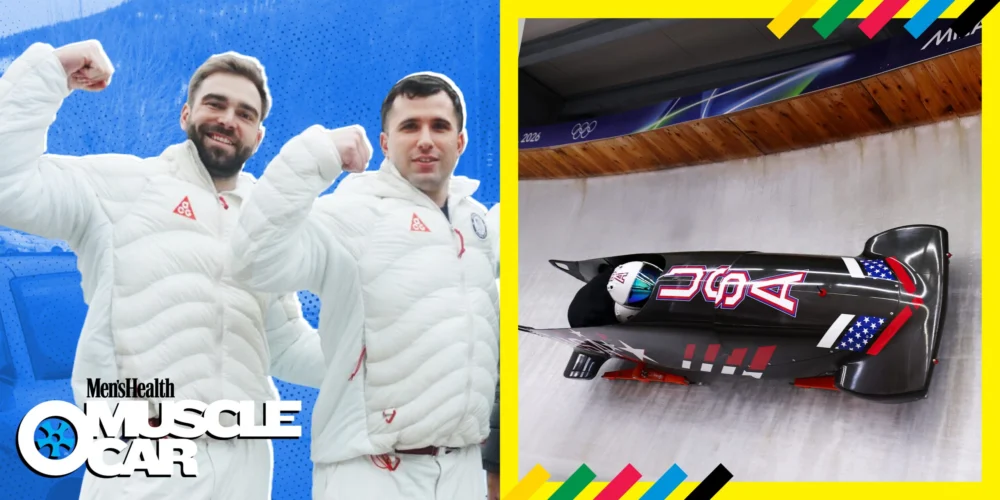
"Success in elite bobsledding is a delicate equilibrium between explosive sprinting power, systemic weightlifting strength, and the mechanical precision required to navigate icy corners under extreme gravitational pressure."
As the world’s attention turns to the Milano-Cortina 2026 Winter Games, the intersection of high-performance automotive engineering and human athleticism has never been more apparent. In a sport often described as "Formula One on ice," Team USA bobsledders Frank Del Duca and Josh Williamson represent a new era of multi-disciplinary athletes who must balance the raw power of a track sprinter with the technical acumen of a race car driver. Through their preparation for the two-man bobsleigh event, these athletes reveal a world where success is measured in hundredths of a second and physical survival depends on core stability and systemic strength.
The Pedigree of Performance
The journey to the Olympic track in Italy for Frank Del Duca and Josh Williamson is a study in diverse high-performance backgrounds. Del Duca, an Army Sergeant, is a prominent member of the Army World Class Athlete Program (WCAP). This elite unit allows soldier-athletes to perform at the highest levels of international competition while maintaining their military standing. His role as one of the two flag bearers for Team USA at the Milano-Cortina Opening Ceremony underscores his status as a leader within the American delegation. Del Duca’s military background translates seamlessly into the discipline required for bobsledding, a sport that demands rigorous attention to detail and a "mission-first" mentality.
In contrast, Josh Williamson’s path to the ice began in the sunshine of Florida. Williamson rose to prominence through the Scouting Camp: Next Olympic Hopeful competition series, a program designed to identify elite athletes from other sports—such as football or track and field—who possess the explosive power necessary for winter sliding sports. Together, the pair forms a symbiotic unit: the meticulous, technical driver and the explosive, powerhouse brakeman.
The Mechanical Edge: Bobsledding as Auto Racing
The parallels between bobsledding and auto racing are not merely metaphorical. During a recent transit in a Maserati GranTurismo, Del Duca—a self-proclaimed "car guy"—noted that the technical variables in bobsledding are as complex as those in professional motorsports. "It’s hard to quantify because there are so many variables," Del Duca explained. "Even if you control for weight and wind, the equipment remains paramount."
In the world of international sliding, technical secrecy is a form of currency. When asked which nation maintains the most guarded technical secrets, the consensus is clear: Germany. The German federation has long been the gold standard in bobsled engineering, utilizing advanced aerodynamics and metallurgy to create sleds that seem to find speed where others find friction. This "arms race" on ice means that Team USA must not only be stronger and faster but also more diligent in their "garage work," fine-tuning runners and sled cowlings to shave off vital milliseconds.
The Physics of the Slide: Battling the G-Force
Once a bobsled enters the "line"—the ideal path through a curve—the athletes are subjected to immense G-forces that can reach up to 5G. For the uninitiated, this feels like five times one’s body weight pressing down on the spine and neck. To combat this, the training regimen is grueling and specific.
Del Duca, who sits in the pilot’s seat, emphasizes the necessity of the Pallof press. This anti-rotation core exercise is vital for maintaining a stable torso while the sled attempts to whip the body laterally. For Williamson, the focus is on systemic strength. "The back squat checks about every box," Williamson noted. "If you can be a strong human, you can handle Gs better."

The training is a hybrid of two worlds: they must train like Olympic weightlifters to move the 400-plus pound sled from a standstill, and like world-class sprinters to accelerate that mass over the first 50 meters of the track. Williamson, who recently recorded a 160kg (352 lbs) double in the clean, exemplifies this explosive power.
The Weight Paradox and Nutrition
Bobsledding is one of the few sports where being heavy is an advantage, provided that weight is composed of functional muscle. There are strict minimum and maximum weight limits for both the sled and the combined weight of the crew and equipment. If a team exceeds the maximum limit, they are disqualified; if the sled is too light, the same fate awaits.
This creates a unique nutritional challenge. Athletes must maintain a high caloric intake to preserve mass while ensuring they don’t lose the "fast-twitch" fibers necessary for the start. Interestingly, the athletes have identified a surprising superfood in the Olympic Village: Parmesan cheese. "It has a higher protein content per 100 grams than meat, chicken, or beef," Williamson explained, citing its 36 grams of protein per 100-gram serving. This dense protein source, paired with staples like grilled chicken, fuels the recovery needed to handle the "micro-vibrations" of the sled—a constant rattling that leaves athletes physically exhausted and often motion-sick after a day of sliding.
Team Dynamics: The Pilot and the Power
The relationship between a driver and a brakeman is one of total trust and contrasting personalities. Del Duca admits to a level of "thoroughness" that borders on the obsessive—he collects the stickers from the sled as mementos and cannot relax until the next day’s preparations are complete. Williamson, on the other hand, prefers a more relaxed approach, often finding his zen in a three-hour session at a coffee shop.
However, when the visor goes down, these differences vanish. The driver’s job is arguably more mentally taxing, involving "track walks" where they pace the entire length of the course to study every frost pattern and transition. The brakeman’s job is a singular burst of violent, focused energy. Both agree that while the driver carries the responsibility of the "line," the physical toll of the sport is shared equally.
Debunking the Cinematic Myth
The 1993 film Cool Runnings remains the primary cultural touchstone for bobsledding, but Del Duca and Williamson are quick to point out the creative liberties taken by Hollywood. The most significant myth is the "leaning" of the crew in the sled. In the movie, the crew leans into the turns like motorcyclists. In reality, the crew remains as still and aerodynamic as possible. Any unnecessary movement by the brakeman can disrupt the driver’s steering and create drag.
One thing the film got right, however, was the sport’s reliance on track and field athletes. The Jamaican Bobsled Team was indeed founded on the principle that elite sprinters could be taught to slide. Today, Team USA continues that tradition, recruiting from the highest echelons of collegiate and professional athletics to find the "engines" for their icy rockets.
The Road to the Podium
As Del Duca and Williamson prepare for their runs in Milano-Cortina, the strategy remains deceptively simple yet incredibly difficult to execute: start fast, load well, and drive the perfect line. Beyond the physical strength and the technical data, there is a mental component—a "time warp" that occurs when an athlete is fully immersed in their craft. For Del Duca, it’s the military-honed focus on the task at hand. For Williamson, it’s the transition from a Florida "hopeful" to a seasoned Olympian.
In a sport where the difference between a gold medal and fourth place is often less than the blink of an eye, every squat, every gram of protein, and every minute spent studying the ice counts. As they navigate the high-speed corners of the Italian Alps, Del Duca and Williamson aren’t just racing against the clock; they are demonstrating the peak of human potential in one of the world’s most demanding environments.
