
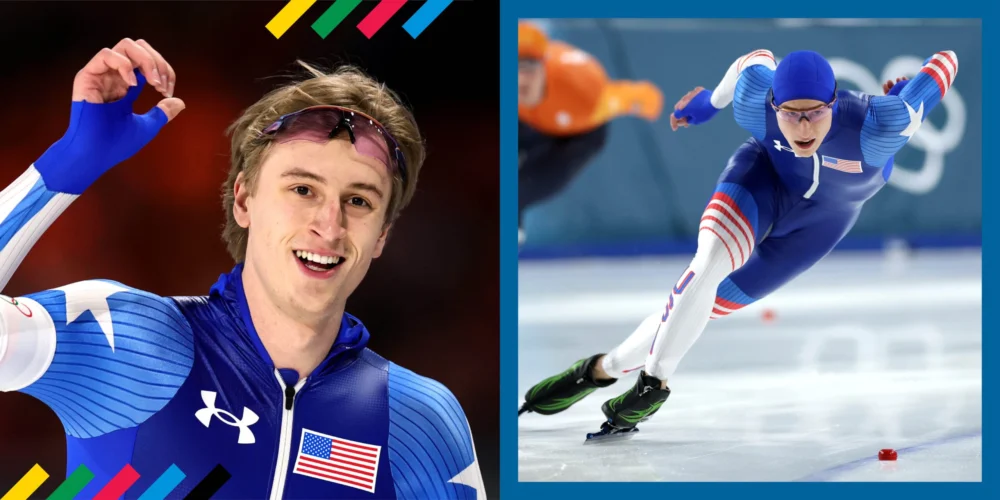
"Jordan Stolz is fundamentally altering the physiological expectations of speed skating, merging the explosive power of a world-class sprinter with the sustained aerobic capacity of a distance specialist."
The ascent of American speed skater Jordan Stolz represents a generational shift in winter sports, as the young athlete continues to shatter Olympic records and defy long-standing biological conventions. By dominating both the short-track sprints and middle-distance events, Stolz has positioned himself not just as a gold medalist, but as a biological outlier whose unique combination of power and endurance has left even his greatest rivals acknowledging a gap in sheer physical capability.
The atmosphere at the men’s 500-meter speed skating final during the Milano-Cortina Olympics was one of fleeting triumph and inevitable transition. When Canada’s Laurent Dubreuil crossed the finish line, the scoreboard illuminated a new Olympic record. For most athletes, such a feat marks the pinnacle of a career. For the 33-year-old Dubreuil, however, the celebration was tempered by a sober reality: Jordan Stolz was up next.
Dubreuil’s premonition proved accurate. Stolz, the 21-year-old phenom from Wisconsin, delivered a performance that transcended mere victory. Clocking in at 33.77 seconds, Stolz didn’t just win gold; he obliterated the record Dubreuil had held for only a few minutes, finishing 0.55 seconds faster than the previous mark. In a sport where races are often decided by thousandths of a second, a half-second margin is an eternity. This victory secured Stolz’s second gold medal and second Olympic record of the Games, further cementing his status as the most formidable force on the ice today.
To understand the magnitude of Stolz’s dominance, one must look toward the Netherlands, the global epicenter of speed skating. In a nation where the sport rivals the popularity of basketball or American football in the United States, Stolz has achieved a level of celebrity reserved for icons like Michael Jordan or LeBron James. The Dutch public, known for their deep technical knowledge of the sport, have christened him "Straaljager"—the Fighter Jet. This moniker reflects his ability to maintain extreme velocity without the typical "fade" seen in traditional sprinters. His popularity in Europe has translated into significant commercial success, including major endorsements from Dutch brands that rarely look outside their own borders for athletic ambassadors.
The primary factor setting Stolz apart is a rare physiological profile. In the specialized world of speed skating, athletes typically fall into two categories: the explosive sprinters who thrive in the 500-meter "drag race," and the endurance-focused skaters who manage their energy over the 1,500-meter and 5,000-meter distances. The 500-meter race requires an immediate, violent burst of power from the starting gun, a demand that usually depletes an athlete’s glycogen stores and induces heavy lactic acid buildup by the final turn.
Dubreuil, a specialist in the 500-meter, noted that while most sprinters "lose steam" around the 300-meter mark, Stolz possesses a unique engine that allows him to keep accelerating through the finish. "He’s good at everything," Dubreuil remarked, highlighting the frustration of competing against an athlete who defies the standard trade-offs of human biology. "His ability to put power into the ice when all the other top sprinters are dead is unbelievable. It’s not something I think we can copy. He’s just physically superior."
This physical superiority is the result of a highly specific approach to biomechanics and strength conditioning. Unlike many elite athletes who prioritize total-body hypertrophy, Stolz and his coaching team have focused almost exclusively on the core and lower body. Speed skating is a sport of centers of gravity and aerodynamic efficiency; excess upper-body mass is often viewed as a liability. Added weight in the chest and shoulders raises a skater’s center of gravity, making it more difficult to maintain the deep, seated "tuck" required to navigate turns at high speeds.

Stolz famously avoids traditional upper-body lifts, noting that he has not performed a bench press in years. This focus on "skating-specific" strength allows him to maximize the transfer of force from his quadriceps and glutes into the ice without the aerodynamic drag or metabolic cost of carrying unnecessary muscle mass. This "bottom-heavy" build is essential for the 1,500-meter race—a distance many consider the most difficult in the sport because it requires both a sprinter’s start and a distance skater’s aerobic threshold.
Beyond the physical, Stolz’s mental architecture is equally distinct. The pressure of the Olympic stage often causes athletes to over-analyze their technique, leading to "paralysis by analysis." Stolz, however, operates on a philosophy of "feeling" rather than "thinking." Even during the high-tension moments of the 500-meter final, which saw five false starts in preceding heats, Stolz remained unruffled. He used the delays not to fret over strategy, but to deepen his focus on the tactile sensation of the blades on the ice.
"I’m super focused on my feeling on the ice," Stolz explained. "It’s not more so thinking in like, ‘Oh, I have to do this and that.’ It’s more so just the feeling under my feet." This mindfulness-based approach allows him to maintain a state of "flow," where technical adjustments happen instinctively rather than through conscious effort. It is a level of psychological maturity that belies his age and allows him to treat the most high-stakes races as a "toss-up," reducing the cortisol spikes that can lead to muscle tension and poor performance.
The historical implications of Stolz’s performance are profound. Prior to these Games, the 500-meter and 1,000-meter "sweep" was a feat so rare it had not been accomplished by a male skater since the legendary Eric Heiden at the 1980 Lake Placid Games. Heiden eventually won five gold medals in a single Olympics, a feat widely considered the greatest individual performance in Winter Olympic history. While Stolz is modest about such comparisons, the trajectory of his career suggests he is the first athlete in four decades with the legitimate potential to match Heiden’s versatility.
However, Stolz remains his own harshest critic. Despite having two gold medals and two Olympic records already in his possession, he views his Olympic campaign as only a partial success until he competes in the 1,500-meter race. "It’s more so of a partial success if I don’t win the 1,500," he admitted. "Just because I’ve been so good in that distance for so long." His dominance in the 1,500-meter is well-documented; he holds the world record in the 1,000-meter (1:05.37) and has consistently beaten the world’s best middle-distance skaters in World Cup events.
The upcoming 1,500-meter race represents the ultimate test of his "hybrid" physiology. His rivals, including the Netherlands’ Jenning De Boo—who took silver in the 500-meter with a record-breaking time of his own—are preparing for what may be the most anticipated race of the Games. De Boo, who described Stolz as "crazy strong," represents a new generation of skaters trying to close the gap, yet even he acknowledges that Stolz is currently "the man to beat."
As the Games progress toward the middle-distance events, Stolz’s routine remains remarkably mundane. He prioritizes recovery, spending his downtime scrolling on his phone and attempting to disconnect from the pressures of the rink. This ability to switch off the competitive drive until the moment he steps onto the ice is perhaps his greatest asset.
For the rest of the world, watching Jordan Stolz is a lesson in the evolution of human performance. He has proven that the traditional boundaries between sprinting and endurance are not as rigid as once thought. As he prepares for his final individual events, the question is no longer whether Stolz is the best in the world, but rather how far he can push the limits of what is possible on two thin blades of steel. The "Fighter Jet" is fueled and ready, and the record books may need to be rewritten once more before the torch in Milano-Cortina is extinguished.
