
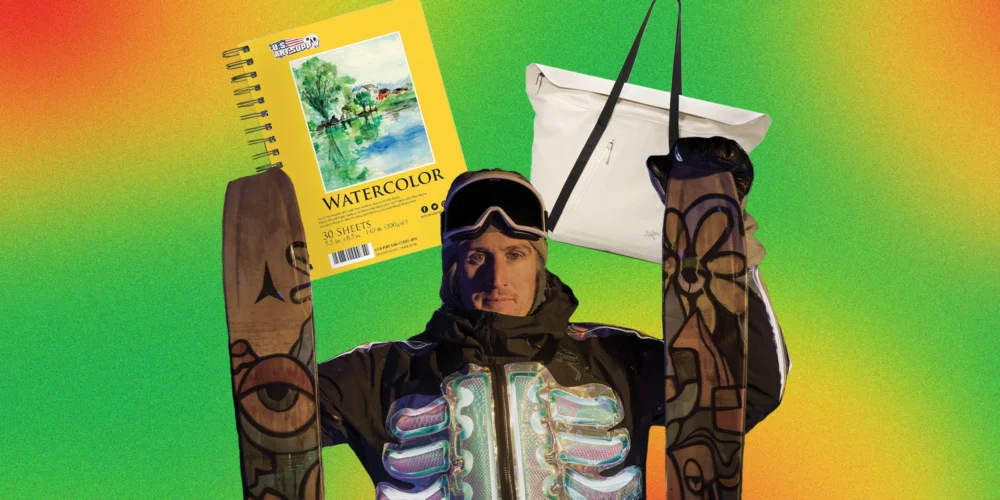
“For a professional athlete, the equipment is not just a tool for performance, but a bridge between physical execution and creative expression in the world’s most demanding environments.”

Maintaining a career at the intersection of professional freeskiing and fine art requires a meticulous approach to gear that balances high-octane technical requirements with the necessity of mental and physical recovery. Chris Benchetler, a visionary in the ski industry known for both his gravity-defying lines and his distinctive psychedelic-nature artwork, has curated a kit that serves his dual life as an athlete and a filmmaker. Whether navigating the jagged rock outcroppings of Mammoth Mountain or seeking a moment of creative clarity in a cramped airplane seat, Benchetler’s choices reflect a philosophy where utility meets mindfulness, ensuring that every item packed serves a specific purpose in his pursuit of excellence.
The Technical Foundation: Atomic Bent 110 GFD Skis
In the world of professional skiing, the relationship between an athlete and their skis is foundational. For Benchetler, whose name is synonymous with the Atomic "Bent Chetler" franchise, the selection of a specific model depends entirely on the terrain’s demands. While wide powder skis are often the face of backcountry filming, the Atomic Bent 110 GFD has emerged as his primary tool for technical, variable conditions.

The 110mm waist width represents the "sweet spot" of the modern freeride market—wide enough to provide floatation in fresh snow, yet narrow enough to remain responsive on firm pack and through technical "no-fall" zones. Benchetler notes that during his recent filming projects at Mammoth Mountain, the 110s were essential for navigating rocky lines where precision is paramount. The "GFD" designation refers to a construction optimized for stability; unlike lighter touring-specific models, these skis are designed to damp vibrations and maintain an edge when the snow turns from powder to ice.
Beyond the physics of the ski, Benchetler emphasizes its "playfulness" and "trick ability." In professional cinematography, the ability to pivot, butter, and launch off natural features is what separates a standard descent from a world-class film segment. The maneuverability of the 110 allows for a creative approach to the mountain, treating the terrain as a canvas rather than just a slope to be descended.

The Architecture of Recovery: LitBear Sleep Masks and Hest Earplugs
High-level athletic performance is often won or lost in the hours spent off the mountain. For professional filmmakers and athletes, the production schedule is rarely dictated by the sun; it is dictated by the light, the weather, and the "blue hour." This often results in a fractured sleep schedule, requiring the ability to rest during the day or in loud, chaotic environments like base camps or transit hubs.
Benchetler identifies himself as a poor "day sleeper," a common challenge for athletes whose circadian rhythms are tuned to high-output daylight activities. To combat this, he relies on the LitBear Sleep Mask. Unlike standard airline masks, this model features a contoured thickness that provides a total light seal without putting pressure on the eyelids—a crucial detail for REM sleep.

Supplementing the visual blackout are Hest Sleep Earplugs. In the context of a filming project, silence is a luxury. Whether it is the sound of wind battering a high-altitude tent or the hum of a plane engine, noise is a significant barrier to the deep recovery needed to mitigate the physical toll of skiing. Benchetler’s collaboration with Hest on a signature camp pillow underscores his commitment to "portable comfort," proving that elite athletes view sleep as a disciplined part of their training regimen.
The Creative Outlet: Watercolor Art and Premium Paper
While Benchetler is a titan in the ski industry, his identity is equally rooted in his work as an artist. The transition from the adrenaline-fueled environment of a technical ski line to the quietude of a hotel room can be jarring. To manage this mental shift, Benchetler avoids the common pitfall of "doom-scrolling" on a smartphone, opting instead for a watercolor kit and high-quality paper.

Traveling with a U.S. Art Supply Premium Heavyweight Watercolor Paper Pad allows Benchetler to process the visual stimuli of his travels. The choice of heavyweight paper is a technical one; it prevents warping when saturated with water, ensuring that the integrity of the artwork remains intact despite the rigors of travel. By carrying a micro-watercolor sketching kit and professional brushes, he maintains a portable studio.
This practice is more than a hobby; it is a cognitive tool. Art serves as a medium for Benchetler to express the ideas that "live in his head," providing a beneficial use of downtime that contributes to his overall mental well-being. For a professional who designs his own gear graphics, this constant creative practice ensures that his artistic evolution keeps pace with his physical progression on the snow.

Logistics and Durability: The Arc’teryx Granville 30 Carryall
The logistical reality of professional skiing involves a constant cycle of packing, unpacking, and moving gear through harsh environments. The Arc’teryx Granville 30 Carryall Bag serves as the "connective tissue" of Benchetler’s kit. Arc’teryx is renowned for its AC² (Advanced Composite Construction) technology, which makes their bags highly weather-resistant and nearly indestructible.
The Granville 30 is a departure from the traditional technical backpack. Its open carryall design allows for the quick stowing of "overflow" items—pillows, snacks, extra layers, or camera accessories—that don’t fit into a primary pack. Its ability to fold down into a compact size makes it an ideal secondary bag for travel. For Benchetler, the bag represents a refined "system" developed over years of trial and error. In the backcountry, a bag that fails or leaks isn’t just an inconvenience; it can jeopardize the day’s production. The Granville’s blend of minimalist aesthetics and rugged performance aligns with the "fast and light" ethos of modern mountain travel.

Systemic Health: The Philips Sonicare ProtectiveClean 5300
One of the most surprising elements of Benchetler’s kit is his insistence on a high-end electric toothbrush, even during remote snow-camping expeditions. While many backcountry travelers look for ways to cut weight—often opting for "sawed-off" manual toothbrushes—Benchetler prioritizes the efficiency of the Philips Sonicare 5300.
The rationale is simple: systemic health. Professional athletes are increasingly aware of the link between oral hygiene and overall physical performance. The Sonicare’s pressure sensor and high-frequency vibrations provide a level of cleaning that manual brushing cannot replicate, especially in conditions where water is limited and hygiene can easily slip. For a person who has never had a cavity, this isn’t just a habit; it’s a maintenance protocol. By bringing an electric brush into the wilderness, Benchetler maintains a sense of routine and personal care that is often lost in the grit of outdoor life.

Conclusion: The Philosophy of the Kit
Chris Benchetler’s gear selection reveals a deep understanding of what it takes to sustain a high-level career in the outdoors. It is a kit that acknowledges the physical necessity of stability and precision (the Atomic skis), the biological necessity of rest (the sleep mask and earplugs), the psychological necessity of creation (the watercolor pad), and the logistical necessity of durability (the Arc’teryx bag).
By investing in tools that serve both his body and his mind, Benchetler ensures that he is prepared for the volatility of the mountains and the demands of the creative process. His kit serves as a roadmap for anyone looking to balance performance with longevity, proving that the right gear doesn’t just help you do your job—it helps you stay inspired while doing it.
