
"A sincere apology in a high-pressure medical environment does more than repair a relationship; it restores the psychological safety essential for a functional emergency department."
As The Pitt enters the final stretch of its second season, the series has shifted its focus from the mechanical urgency of the ER to the fragile psychological infrastructure of the clinicians themselves. By juxtaposing a mass casualty event with the internal collapse of one of its lead physicians, the show provides a sophisticated look at how "cognitive overload" and personal stressors can compromise even the most seasoned medical veterans, ultimately highlighting the necessity of peer accountability in high-stakes environments.
The second season of The Pitt has masterfully built a sense of claustrophobic tension, portraying the Pittsburgh emergency room as a literal and figurative pressure cooker. In Episode 10, "4:00 P.M.," this tension reaches a boiling point. The ER staff is already stretched thin, navigating the standard influx of urban trauma, when they are hit with a "yellow alert" mass casualty incident: the collapse of a waterslide at a local waterpark. This event serves as the external catalyst for the episode’s internal drama, forcing the staff to balance the influx of critically injured patients with their own mounting personal crises.

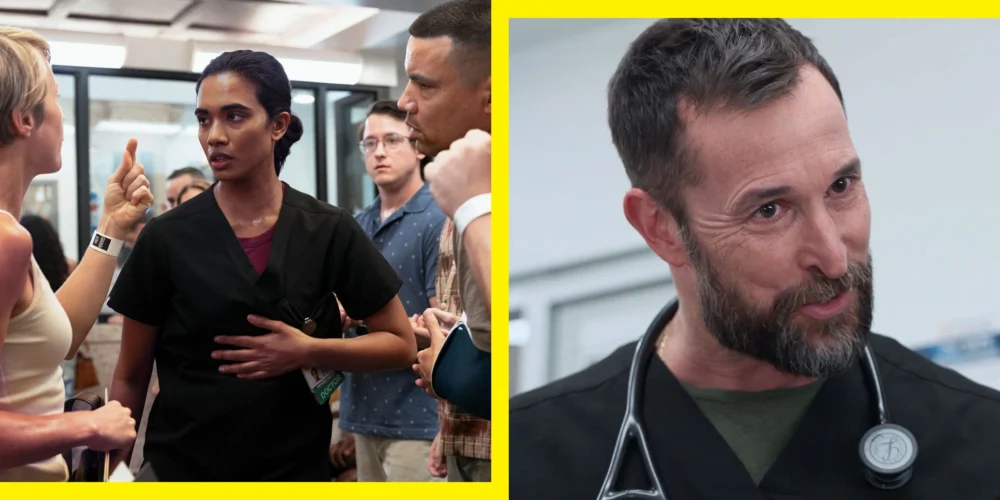
The central conflict of the episode revolves around Dr. Mohan (Supriya Ganesh), who, while treating a patient, begins to exhibit the classic signs of a myocardial infarction—shortness of breath, diaphoresis (excessive sweating), and acute chest tightness. The scene is a harrowing depiction of the "physician-as-patient" trope, handled with a level of realism that eschews melodrama for clinical accuracy. Student Dr. Joy (Irene Choi) acts as the first line of defense, demonstrating the "ABC" protocol—Airway, Breathing, and Circulation—by immediately stabilizing Dr. Mohan in a wheelchair and seeking senior intervention.
When Dr. Langdon (Patrick Ball) and eventually Dr. Robby (Noah Wyle) arrive, the atmosphere shifts from clinical concern to interpersonal friction. Dr. Robby, long established as the "cool-headed" anchor of the department, finds himself at a breaking point. Upon learning that Dr. Mohan’s physical tests are clear and that her symptoms were likely the result of a panic attack brought on by an overbearing mother and career anxieties, Robby snaps. He delivers a harsh ultimatum, telling her to "get her head in the game or go home."
To understand the weight of this interaction, one must look toward the expertise of medical professionals who navigate these halls in reality. Dr. Robert Glatter, an Assistant Professor of Emergency Medicine at Lenox Hill Hospital and a member of the Men’s Health Advisory Board, notes that seeing a peer struggle often triggers a defensive mechanism in other doctors. "Watching a peer collapse or struggle reminds everyone—consciously or not—of their own vulnerability," Dr. Glatter explains. "That recognition can provoke fear, guilt, or even frustration, especially in a high-stakes, high-stress environment such as the emergency department, where resilience is part of one’s identity."
In this context, Dr. Robby’s outburst is not merely an act of cruelty, but a manifestation of "detachment as a defense." By dismissing Dr. Mohan’s panic attack as a lack of focus, Robby is attempting to reassert control over an environment that feels increasingly chaotic. This is particularly poignant given Robby’s own deteriorating mental state throughout the season. He is a man struggling with his own "cognitive overload," and seeing a trusted colleague succumb to the same pressures he is fighting to suppress acts as a mirror he is not yet ready to look into.

However, The Pitt distinguishes itself from other medical procedurals by how it handles the aftermath of this toxicity. Rather than letting the resentment fester or treating it as a standard "tough love" trope, the show introduces a model of peer accountability through Dr. Al-Hashimi (Sepideh Moafi). Recognizing that Robby’s behavior was a breach of professional conduct and detrimental to the team’s morale, Al-Hashimi pulls him aside for a private, constructive confrontation.
This move is vital for the preservation of "psychological safety"—a term used in organizational psychology to describe an environment where team members feel safe to take risks and be vulnerable without fear of punishment. Dr. Glatter emphasizes the importance of this intervention: "Dr. Al-Hashimi’s decision to challenge Dr. Robby—privately and constructively—demonstrates a model of peer accountability that protects psychological safety for the whole team."
The subsequent reconciliation between Robby and Mohan serves as the episode’s emotional anchor. Robby’s apology is not a perfunctory gesture; it is a moment of self-awareness that acknowledges the humanity of his staff. In a field where "provider burnout" is reaching epidemic levels, the depiction of a senior leader admitting fault is a radical act of workplace health. "A sincere apology in this context matters not only between two individuals, but for the culture of the department," says Dr. Glatter. "His acknowledgment that his reaction was inappropriate helps rehumanize him in her eyes, and signals to others that emotional missteps can be owned and amended."
Beyond the character drama, the episode provides an educational look at the intersection of mental and physical health in a clinical setting. A panic attack can mirror a heart attack with terrifying accuracy, involving the same sympathetic nervous system response: tachycardia, chest pain, and a feeling of impending doom. For a physician, who is trained to recognize these as signs of mortality, the experience is doubly traumatic. The show highlights that Dr. Mohan was "taking care of herself" in the traditional sense, but the "everything around her"—the systemic pressure of the medical field combined with personal baggage—was simply too much for the nervous system to process.

The "Waterslide Collapse" serves as a fitting metaphor for this internal breakdown. Just as a structure can fail when the weight exceeds its design capacity, the human psyche has a "load-bearing" limit. In the ER, where doctors are expected to be infallible, the collapse of a doctor like Mohan is a reminder that the healers are also human. The "mature, functional order" that The Pitt portrays is not one where no one ever breaks, but one where, when someone does, the rest of the team knows how to provide the "ABCs" of emotional support.
As the season progresses, the fallout from this episode is likely to ripple through the department. Dr. Robby’s apology may have mended his relationship with Dr. Mohan, but it also signaled a crack in his own armor. The show is moving toward a conclusion that asks a difficult question: Who cares for the caregiver when the system itself is the source of the trauma?
By integrating expert medical perspectives and focusing on the nuances of workplace culture, The Pitt has evolved into more than just a drama about saving lives; it is a study on the cost of doing so. The episode "4:00 P.M." stands as a testament to the idea that in medicine, technical proficiency is only half the battle. The other half is the maintenance of the "collegial trust" and "shared humanity" that allows a team to function when the world—or a waterslide—comes crashing down.
In the final analysis, Dr. Mohan’s return to her patient within the hour is not just a display of grit, but a testament to the power of a supportive environment. Because her colleagues responded with "safety and dignity" (even after a rocky start), she was able to reestablish control. As the ER prepares for the next wave of patients, the audience is left with a clear message: a doctor’s greatest tool isn’t just the stethoscope or the scalpel, but the peer standing next to them, ready to hold them up when they can no longer stand on their own.
